
While officials acknowledge the ongoing challenge posed by Hezbollah, the administration views this as a significant diplomatic breakthrough.
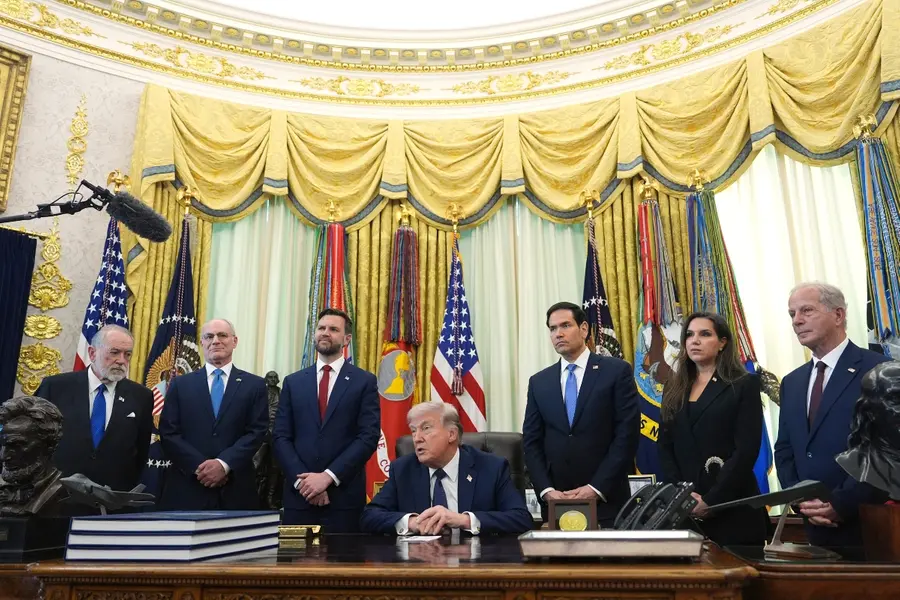
Washington: US President Donald Trump announced on Friday that Israel and Lebanon have agreed to a three-week extension of their current ceasefire following high-level negotiations at the White House.
Addressing reporters, Trump indicated that the agreement marks a continued cessation of hostilities, though he acknowledged the complexities involving non-state actors. "We had a great meeting with the very high officials of Lebanon and the very high officials of Israel, and I think that the president of Lebanon and the prime minister of Israel, over the next couple of weeks, will be coming here," Trump said.
"They've agreed to an additional three weeks of, I guess, no firing — ceasefire — no more firing," he continued. "Let's see. We hope that happens. It's not going to happen between them, but we still have Hezbollah to think about."
Oval Office Negotiations
The announcement was preceded by a statement on Truth Social, where the president detailed the diplomatic session held in the Oval Office. The meeting included Vice President JD Vance, Secretary of State Marco Rubio, Ambassador to Israel Mike Huckabee, and Ambassador to Lebanon Michel Issa, alongside senior representatives from the two Middle Eastern nations.
Trump noted that the United States intends to assist Lebanon in bolstering its domestic security against Hezbollah. "The Meeting went very well!" the president wrote. "I look forward in the near future to hosting the Prime Minister of Israel, Bibi Netanyahu, and the President of Lebanon, Joseph Aoun. It was a Great Honor to be a participant at this very Historic Meeting!"
Diplomatic Momentum
Members of the administration characterised the extension as a pivotal breakthrough achieved through the president’s personal intervention. Vice President JD Vance described the three-week reprieve as a "major, historic moment," asserting that the agreement was a direct result of Trump’s involvement.
"We're going to extend the ceasefire for three weeks; that's already in place between Israel and Lebanon. Of course, it would not have happened without the President's direct engagement," Vance said.
Secretary of State Marco Rubio echoed these sentiments during a briefing in the Oval Office, suggesting that the additional time would facilitate efforts toward a more enduring resolution.
"The president wanted to be personally involved and glad he was, because it made it possible to get this extension, and it gives everybody time to continue to work on what's going to be permanent peace between two countries that want to be in peace," Rubio said. He added that he remains "very optimistic" that the parties will move closer to a definitive peace agreement in the coming weeks.
With inputs from ANI
Published: 24 Apr 2026, 06:33 am IST
Related Topics
Disclaimer: Kindly avoid objectionable, derogatory, unlawful and lewd comments, while responding to reports. Such comments are punishable under cyber laws. Please keep away from personal attacks. The opinions expressed here are the personal opinions of readers and not that of Mathrubhumi.
