

Donald Trump's AI-generated air filter barrier at the Canada border has sparked debate. Experts explain why stopping wildfire smoke with a giant outdoor filter is not currently possible.
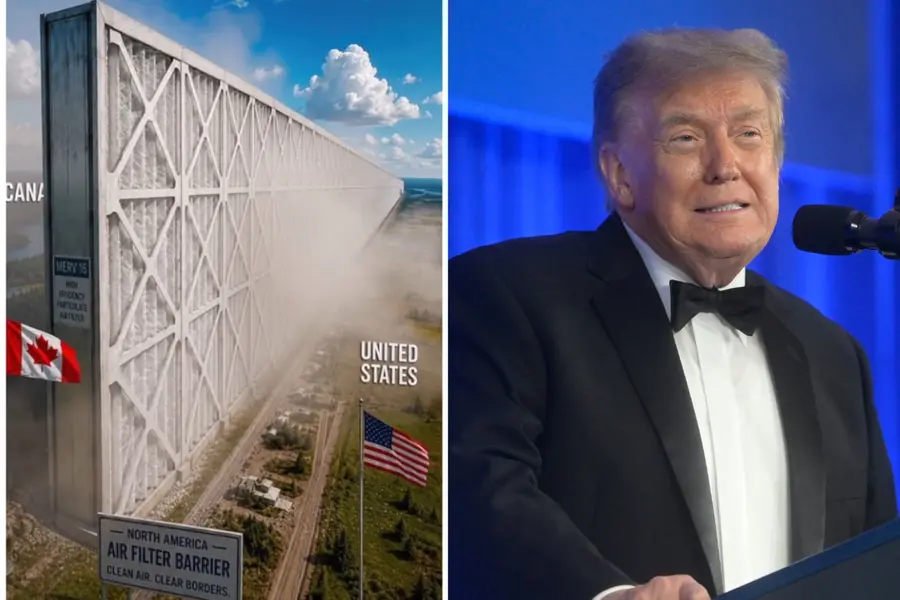
Washington DC: US President Donald Trump shared an artificial intelligence-generated image on his Truth Social platform showing a massive filtration structure placed along the US-Canada border.
The image features a giant barrier labelled "North America. Air Filter Barrier. Clean Air. Clean Borders," suggesting a fictional solution to block smoke from Canadian wildfires from entering the United States.
Also Read
The post came amid Trump's criticism of Canada over wildfire smoke drifting into parts of the US and affecting air quality in several states.
Could a giant air filter actually stop wildfire smoke?
A giant outdoor air filter stretching across a national border is not a realistic technology with current capabilities.
Air filtration systems are effective in controlled environments such as homes, hospitals, offices and industrial facilities where air can be contained and processed. However, filtering the open atmosphere across thousands of kilometres would require an unprecedented amount of infrastructure, energy and maintenance.
Wildfire smoke does not move like a solid object that can be blocked by a wall. It consists of tiny particles and gases carried by wind patterns, allowing it to travel across large distances and affect regions far away from the original fires.
Why wildfire smoke is difficult to control
Wildfire smoke spreads through natural atmospheric movement and changes depending on weather conditions, wind direction and fire intensity. Even a massive filtration structure would not be able to prevent smoke from moving through the atmosphere.
Scientists and governments generally focus on controlling the source of smoke by improving wildfire prevention, firefighting response and forest management rather than attempting to block pollution after it has already spread.
Trump's AI image appears symbolic, not a real proposal
The AI-generated image appears to function mainly as a political message rather than an actual engineering proposal.
The image combines two issues frequently highlighted in Trump's political messaging: border security and concerns about impacts coming from outside the United States. By presenting wildfire smoke as something crossing a national boundary, the post frames an environmental problem as part of a broader political dispute with Canada.
Canada wildfire smoke becomes a political issue
Canada is facing another severe wildfire season, with hundreds of active fires producing smoke that has crossed into parts of the United States.
Speaking to reporters aboard Air Force One, Trump said he had discussed the issue with Canadian Prime Minister Mark Carney and urged Canada to do more to control the fires.
Trump also suggested that the US could seek compensation from Canada for the impact of wildfire smoke and raised the possibility of tariffs, while also saying America was willing to help fight the fires.
What are the real solutions?
The practical response to wildfire smoke focuses on reducing fire risks, improving early warning systems and protecting public health during smoke events.
Governments rely on wildfire prevention strategies, firefighting resources, air-quality monitoring and public advisories to manage the impact of smoke. Indoor air filtration systems can help people protect themselves, but cleaning outdoor air on a continental scale remains beyond current technology.
The wildfire smoke dispute is likely to remain part of wider US-Canada discussions as both countries deal with increasingly severe wildfire seasons.
While Trump's AI air filter barrier may not represent a realistic solution, it highlights a growing challenge facing governments worldwide: finding effective ways to manage the impact of climate-related disasters that increasingly cross national borders.
Published: 25 Jul 2026, 11:03 pm IST
ABOUT THE AUTHOR
Related Topics
Disclaimer: Kindly avoid objectionable, derogatory, unlawful and lewd comments, while responding to reports. Such comments are punishable under cyber laws. Please keep away from personal attacks. The opinions expressed here are the personal opinions of readers and not that of Mathrubhumi.