
Taiwan's transport network has been severely disrupted, with 931 flights reportedly cancelled as airlines suspended services ahead of the storm.
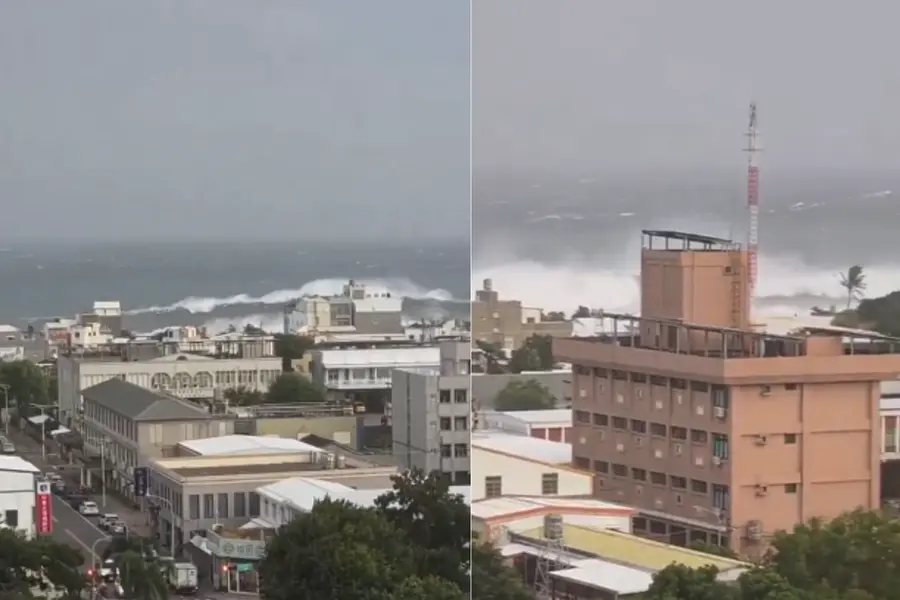
Taipei: Taiwan came to a near standstill on Friday as Typhoon Champi approached the island, forcing the closure of schools, offices, and financial markets, disrupting hundreds of flights, and prompting mass evacuations amid warnings of destructive winds and torrential rainfall.
At least one person has died after being swept away by powerful waves generated by the storm, while 94 others have been injured, according to reports. Nearly 1,300 residents, particularly those living in vulnerable mountainous areas, have been evacuated as authorities prepare for potentially dangerous weather conditions.
Although Champi has weakened after briefly reaching super-typhoon intensity, meteorologists warned that its enormous size could expose much of Taiwan to severe weather even without a direct landfall.
According to Taiwan's Central Weather Administration (CWA), the typhoon was producing gusts of around 191 kilometres per hour near its centre. With a storm radius extending approximately 320 kilometres, Champi was large enough to affect most of the island.
The storm was located about 330 kilometres east of Taiwan's southern tip and was forecast to pass close to the northeastern coast before turning north towards waters off China and eventually southern Japan.
Authorities warned that the storm's effects could persist for nearly two days, with heavy rainfall and strong winds expected through Saturday.
Taiwan's transport network has been severely disrupted, with 931 flights reportedly cancelled as airlines suspended services ahead of the storm.
The transport ministry had earlier confirmed the cancellation of all 262 scheduled domestic flights and more than 350 international services on Friday.
Financial markets remained closed, while schools and government offices suspended operations across nearly the entire island. The Taiwan-controlled Kinmen islands, situated close to the Chinese mainland, were among the few areas where normal activities were permitted.
Public transport in Taipei continued operating, although some services were reduced as heavy showers and strong winds swept through the capital.
Streets across northern and northeastern Taiwan were largely deserted as residents remained indoors, with businesses shuttered and emergency personnel preparing for rescue operations.
The government has placed thousands of military personnel on standby to assist with evacuations, emergency relief and rescue efforts if conditions deteriorate.
Weather authorities have warned of particularly intense rainfall in mountainous areas of northern Taiwan, including regions surrounding Taipei and Yilan County, where cumulative precipitation could approach one metre.
Such rainfall could trigger flash floods and landslides, especially in steep terrain already vulnerable to extreme weather.
Coastal communities have also been warned about dangerous sea conditions, with waves exceeding six metres expected in some areas.
Taipei's fire department urged residents to secure their homes, prepare emergency supplies and avoid unnecessary travel during the storm.
Authorities have particularly advised people to stay away from beaches, rivers and mountainous regions as the typhoon moves closer.
The storm has also disrupted travel in neighbouring Japan, where more than 100 domestic flights were cancelled ahead of its expected approach.
Japan's westernmost inhabited island, Yonaguni, in Okinawa Prefecture, is among the areas expected to experience severe weather as Champi moves through the region.
The typhoon has also affected preparations for Keen Sword, a major military exercise involving Japan, the United States and other participating nations, with training activities being adjusted because of adverse weather conditions.
Champi is among the strongest tropical cyclones recorded in the Pacific this year, having previously intensified into a super typhoon before weakening as it approached Taiwan.
Its arrival comes during an unusually active Pacific storm season associated with the El Niño climate phenomenon, which has driven exceptional warming across the equatorial Pacific.
The United Nations warned on Wednesday that the developing El Niño event was reaching extraordinary levels, urging countries to prepare for potentially severe weather-related consequences.
The phenomenon, characterised by unusually warm ocean temperatures in the central and eastern tropical Pacific, can alter global rainfall patterns, intensify drought conditions in some regions and increase the likelihood of flooding elsewhere.
The current El Niño episode is expected to peak in December, although its effects on communities, agriculture and infrastructure could extend well into 2027.
While Taiwan has extensive disaster preparedness systems developed through decades of exposure to powerful tropical cyclones, authorities remain concerned about the potential impact of prolonged rainfall and strong winds.
Weather officials expect Champi to begin moving away from Taiwan on Saturday afternoon. However, heavy rainfall could continue in northern and central areas even after the storm's centre moves farther north.
Published: 23 Oct 2026, 07:57 am IST
ABOUT THE AUTHOR

Disclaimer: Kindly avoid objectionable, derogatory, unlawful and lewd comments, while responding to reports. Such comments are punishable under cyber laws. Please keep away from personal attacks. The opinions expressed here are the personal opinions of readers and not that of Mathrubhumi.