
Officials confirmed most victims were foreign nationals who ignored "shelter-in-place" orders.
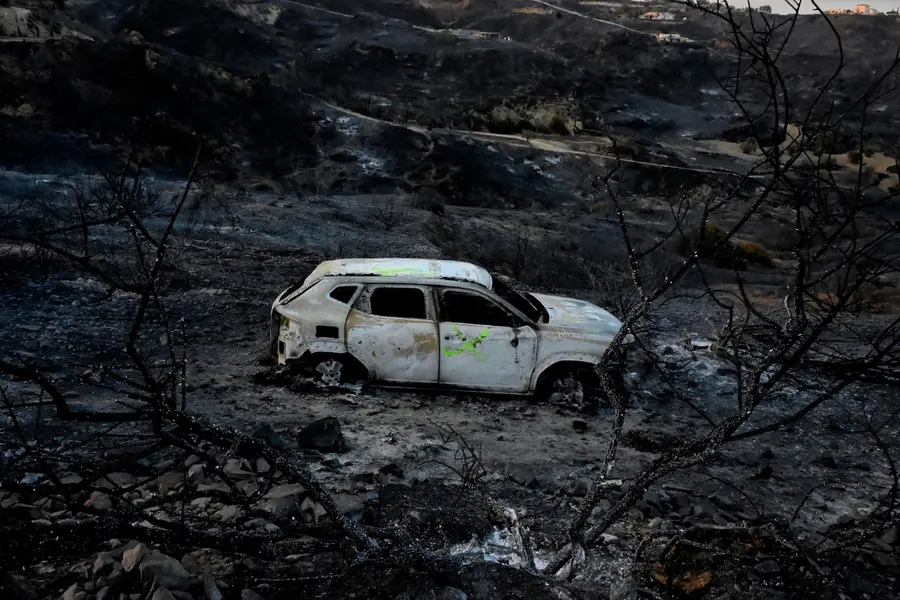
Madrid: A fast-moving wildfire swept through a remote expatriate community in southern Spain overnight, killing at least 12 people as residents attempted to escape the flames in vehicles and on foot, officials said Friday.
Another eight people sustained injuries, and 23 individuals remain unaccounted for, according to Andalusia's regional president, Juan Manuel Moreno.
The disaster, which ranks among Spain's deadliest forest fires, erupted late Thursday in a semi-arid district near the Sierra de Los Filabres mountains in Almeria province, amid a period of blistering temperatures across the country.
Most of the victims perished after failing to follow instructions to shelter in place, said Antonio Sanz, the director of Andalusia's emergency services. Several people attempted to flee through a dry riverbed that ultimately "turned into a death trap," he said.
Regional authorities stated that four of the dead are suspected to be British citizens, noting that the steering wheel of their incinerated car was positioned on the right side, typical of British vehicles. Other nationalities, which were not specified, are also believed to be among the casualties, and officials warned that the death toll is likely to rise.
Seven of the victims died whilst on foot after abandoning their vehicles, Sanz noted, adding that the majority of the deceased are thought to be foreign nationals.
Dean Taylor, a resident who splits his time between Spain and the UK, recounted that he managed to narrowly escape the settlement by navigating rural back roads.
"It was quite terrifying," Taylor told The Associated Press. "It's a very sad day, isn't it? It's devastating, really."
The fire continued to burn out of control into Friday afternoon. Around 150 firefighters and 220 personnel from Spain's military emergency unit were deployed to combat the blaze, which has devoured more than 3,200 hectares (7,900 acres) of woodland and agricultural land.
Moreno, the Andalusian regional leader, explained that the steep and arid landscape was severely hampering efforts to contain the perimeter.
"It consists mainly of scrubland and esparto grass," Moreno said. "Everything is extremely dry due to the heat waves, making it the perfect fuel; combined with the wind, it's a ticking time bomb."
Spanish Prime Minister Pedro Sánchez offered his condolences to those affected. "Immense sadness and desolation in the face of the terrible consequences of the fire affecting the province of Almeria," he wrote in a post on X.
Spain has grappled with frequent and intense heatwaves in recent years, with thermometers regularly climbing past 40C (104F). High winds, extreme temperatures, and a prolonged lack of rainfall frequently cause minor outbreaks to expand into unmanageable infernos.
In June, a prolonged spell of record-breaking heat across Spain resulted in more than 1,000 excess deaths linked to the high temperatures.
Europe remains the world's fastest-warming continent, with its temperatures rising at double the global average rate since the 1980s, according to data from the European Union's Copernicus Climate Change Service. Areas of Western Europe are currently enduring their third heatwave within a six-week window. Globally, 2025 was recorded as the third-hottest year on record, bringing several severe heatwaves to the European continent.
Neighbouring France is also experiencing the peak of its third summer heatwave, with temperatures hitting 40C (104F) across western and central regions and reaching around 37C (98F) in Paris.
French officials have issued warnings of an exceptionally high risk of wildfires. Major blazes in the south have already scorched thousands of hectares this week, disrupting the Tour de France cycling race and placing heavy strain on emergency resources.
The largest of the French fires, located in the eastern Pyrenees near the border with Spain, had lessened in intensity by Friday, authorities said. However, the blaze has consumed roughly 5,000 hectares (12,000 acres) and prompted the temporary evacuation of over 10,000 people from nearby villages.
Last month marked the hottest June on record for France, with mortality rates rising by nearly a third during the peak week of heat.
Climate scientists warn that global warming, driven in part by the combustion of fossil fuels such as petrol, oil, and coal, is increasing the frequency and severity of extreme heat and drought, leaving vulnerable areas highly susceptible to wildfires.
Spain is accustomed to seasonal blazes; last year's fire season destroyed more than 393,000 hectares (nearly 1,520 square miles)—an area twice the size of London—and resulted in four fatalities, according to the European Forest Fire Information System.
The country's worst recorded wildfire occurred in 1979, when 21 people lost their lives in Lloret de Mar, a coastal town situated about an hour north of Barcelona.
In 2017, a catastrophic wildfire in nearby Portugal claimed 66 lives in Pedrogao Grande, located 200 kilometres (120 miles) northeast of Lisbon. In that incident, 47 of the victims died on a single stretch of road whilst attempting to escape the flames in their cars.
AP
Published: 11 Jul 2026, 06:53 am IST
Disclaimer: Kindly avoid objectionable, derogatory, unlawful and lewd comments, while responding to reports. Such comments are punishable under cyber laws. Please keep away from personal attacks. The opinions expressed here are the personal opinions of readers and not that of Mathrubhumi.
