
Los Angeles: Rainfall that began Saturday across Southern California is providing much-needed relief to firefighters tackling multiple wildfires. However, the heavy downpours on recently charred hillsides also pose a serious risk of toxic ash runoff, potentially leading to further environmental hazards.
Rainfall in Southern California is a welcome sight for firefighting crews who have been battling intense wildfires in the region. The Los Angeles County fire crews have been working tirelessly to remove vegetation, reinforce roads, and stabilize slopes in areas devastated by the Palisades and Eaton fires, which began on January 7 during powerful winds. These fires have destroyed entire neighborhoods, leaving behind rubble and ash.
Also Read

While the rain, which is expected to bring around an inch (2.5 cm) of precipitation over the coming days, will assist with firefighting efforts, it also increases the risk of mudslides and debris flows, especially in burn areas. Localized cloudbursts could trigger dangerous runoff, including toxic ash.
Toxic ash runoff poses serious environmental threat
The National Weather Service has warned of the risk of mudslides and debris flows in fire-affected areas, especially if heavy showers focus on burned zones. “The problem would be if one of those showers happens to park itself over a burn area,” said meteorologist Carol Smith. “That could be enough to create debris flows.”
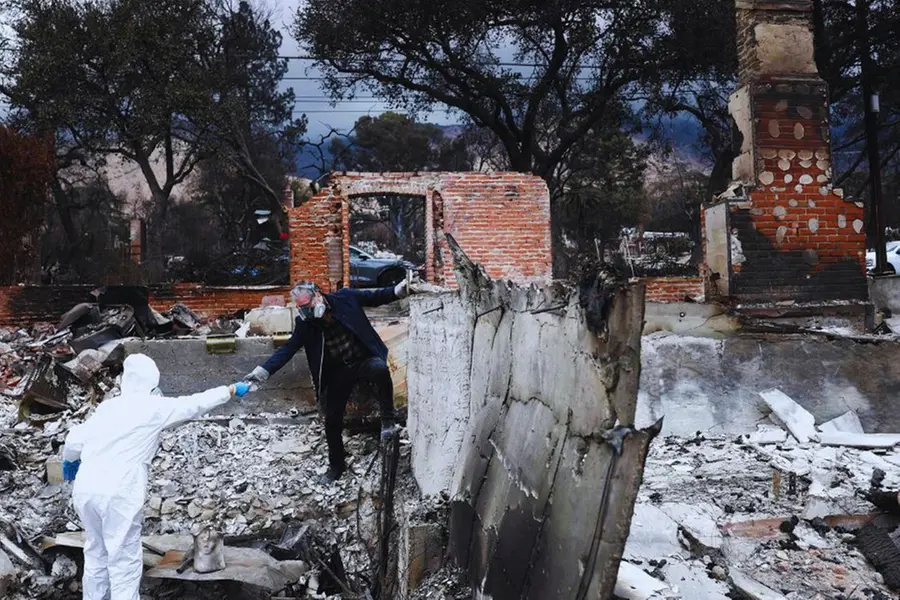
The ash from recent fires is highly toxic, containing incinerated materials such as cars, electronics, batteries, paints, and plastics, as well as harmful substances like pesticides, asbestos, and lead. Residents and cleanup crews have been urged to wear protective gear to avoid exposure to these hazardous materials.
Preparations underway to mitigate risks
In response to the looming risk, Los Angeles Mayor Karen Bass has issued an executive order to speed up cleanup efforts, while county supervisors approved measures to install flood-control infrastructure and expedite sediment removal in fire-impacted areas. Fire crews have been filling sandbags, while county workers have been clearing drainage systems and setting up barriers to prevent flooding and debris flows.
Despite the rain, several wildfires continue to burn across Southern California. As of Saturday, the Palisades Fire was 81 percent contained, and the Eaton Fire was 95 prcent contained. These fires have claimed at least 28 lives and destroyed over 14,000 structures. Firefighters have also made progress against the Hughes Fire, which forced evacuations in northern Los Angeles County, and the Border 2 Fire, which is still burning in San Diego County’s Otay Mountain Wilderness.
This rain is especially significant as Southern California has been enduring a near-record dry streak, with much of the region receiving less than 5 percent of its average rainfall since the start of the water year on October 1. The U.S. Drought Monitor reports that most of Southern California is now classified as being in "extreme" or "severe drought" conditions.
As the region faces both the aftermath of the wildfires and the risks posed by heavy rain, residents and officials continue to monitor the situation closely.
Published: 26 Jan 2025, 10:36 am IST
Related Topics
Disclaimer: Kindly avoid objectionable, derogatory, unlawful and lewd comments, while responding to reports. Such comments are punishable under cyber laws. Please keep away from personal attacks. The opinions expressed here are the personal opinions of readers and not that of Mathrubhumi.