
Pakistan PM Shehbaz Sharif says water must never be weaponised as he raises the Indus Waters Treaty issue during his address at the SCO Summit.
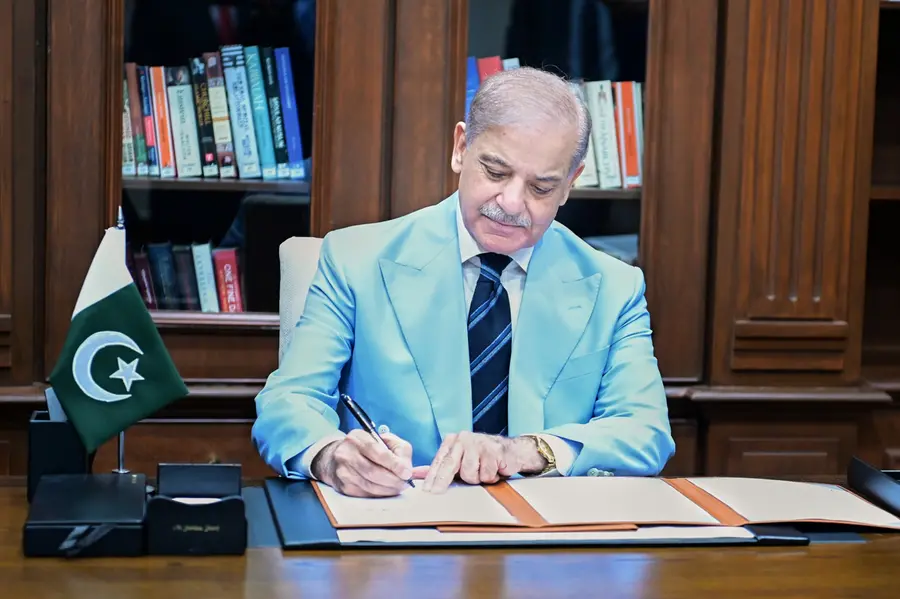
Pakistan Prime Minister Shehbaz Sharif on Tuesday raised the Indus Waters Treaty issue at the Shanghai Cooperation Organisation (SCO) Summit, saying shared water resources must never be "weaponised" or used as a tool for political pressure.
Addressing leaders at the summit in the Kyrgyz capital, Sharif described water as the "lifeblood" of the region and stressed that agreements governing shared rivers were binding commitments that could not be set aside for political convenience.
"Water is the lifeblood of our region. It sustains millions of lives, nourishes our land and secures the very future of our coming generations," Sharif said.
Without directly naming India in his remarks, the Pakistan Prime Minister said water should never become an instrument of coercion or political leverage.
"The treaties governing our shared waters are solemn, binding international commitments. They are not matters of political convenience to be cast aside at your will. They must be honoured unconditionally, in both letter and spirit," he said.
Remarks come amid India-Pakistan dispute over treaty
Sharif's comments come against the backdrop of the continuing dispute between India and Pakistan over the Indus Waters Treaty (IWT).
ALSO READ: ‘Every drop is a red line’: Pakistan PM Shehbaz Sharif warns India ahead of Independence Day | WATCH
India had put the treaty in abeyance as part of a series of punitive diplomatic and economic measures announced following the Pahalgam terror attack in April last year, in which 26 civilians were killed.
His remarks also came a day after India rejected an order by the Permanent Court of Arbitration that set aside New Delhi's decision to suspend the treaty. India maintained that the body was "illegally-constituted" and had no jurisdiction to comment on the country's sovereign decisions.
Pakistan had approached the Permanent Court of Arbitration in The Hague in March this year seeking a determination on the status of the treaty following India's action.
India has consistently maintained that it does not recognise the legal existence of the so-called Court of Arbitration and has argued that the very establishment of the body violated the provisions of the Indus Waters Treaty.
‘Peace essential for region's potential’
At the SCO Summit, Sharif also said the region could not realise its full potential without lasting peace.
ALSO READ: After Pakistan PMO crops Modi, Iran President from SCO photo, Sharif shares full image
Terrorism remained one of the gravest threats facing the region, he said, adding that Pakistan had actively worked to strengthen regional counter-terrorism cooperation as chair of the SCO Regional Anti-Terrorist Structure.
Sharif said Pakistan had sacrificed more than 90,000 lives and suffered economic losses exceeding USD 150 billion in its fight against terrorism over the past two and a half decades.
On Afghanistan, he said Pakistan wanted a peaceful and stable neighbour but warned that lasting peace would remain difficult as long as terrorists continued to use Afghan territory to carry out attacks against Pakistanis and citizens of other countries.
Sharif speaks on Iran mediation efforts
The Pakistan Prime Minister also referred to Islamabad's mediation efforts during the US-Iran conflict and the disruption caused by the closure of critical energy supply routes, referring to the Strait of Hormuz.
Sharif said Pakistan had consistently acted as a mediator and facilitator, adding that its diplomatic efforts culminated in the signing of the Islamabad Memorandum of Understanding between the US and Iran in June.
ALSO READ: LeT water training at Mangla Dam? New video surfaces amid Indus Waters Treaty tensions | WATCH
He described the agreement as a viable pathway towards lasting peace in the region.
Sharif also spoke about the trilateral defence agreement between Pakistan, Saudi Arabia and Turkiye, known as the "Makkah Defence Alliance", saying the arrangement was defensive in nature and was not directed against any country.
He further called on the international community to support the Palestinian people's right to self-determination.
The SCO currently includes China, Russia, India, Iran, Kazakhstan, Kyrgyzstan, Pakistan, Tajikistan, Uzbekistan and Belarus.
With PTI inputs
Published: 01 Sept 2026, 07:34 pm IST
ABOUT THE AUTHOR

Disclaimer: Kindly avoid objectionable, derogatory, unlawful and lewd comments, while responding to reports. Such comments are punishable under cyber laws. Please keep away from personal attacks. The opinions expressed here are the personal opinions of readers and not that of Mathrubhumi.