
Sharif also called any threat to the safety and sanctity of Mecca a “red line”, condemning recent Houthi attacks on Saudi Arabia.
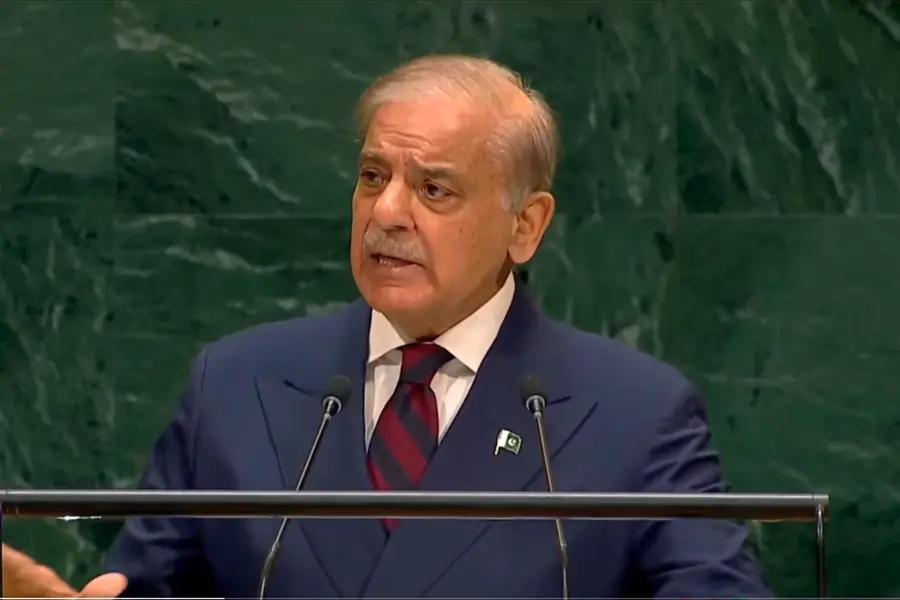
United Nations/New York: Pakistan Prime Minister Shehbaz Sharif on Friday warned that any attempt to stop, impede or divert Pakistan’s share of the Indus River waters would be treated as an “act of war”, making the water-sharing dispute a central point of his address to the 81st United Nations General Assembly.
Sharif described the Indus river system as the “lifeblood” of Pakistan and the wider region. He criticised India’s decision to hold the Indus Waters Treaty in abeyance, saying the move had “no legal basis whatsoever”. He also claimed that India’s position and actions had been rejected by UN experts and the Court of Arbitration.
“Water must never be weaponised. Rivers should nourish nations, not divide them,” Sharif said, warning that any attempt to stop, impede or divert Pakistan’s share of the waters would be treated as an “act of war”.
The Indus Waters Treaty, signed by India and Pakistan in 1960, governs the use and sharing of waters of the Indus river system. Under the treaty, the eastern rivers- Ravi, Beas and Sutlej- are allocated for India’s unrestricted use, subject to specified provisions, while Pakistan receives the waters of the western rivers- Indus, Jhelum and Chenab- subject to treaty provisions allowing certain uses by India.
Sharif revisits 2025 India-Pakistan conflict
Sharif also referred to the military confrontation between India and Pakistan in May 2025, which followed the April 22 Pahalgam terror attack and India’s launch of Operation Sindoor.
He said Pakistan had exercised its “inherent right of self-defence” under Article 51 of the UN Charter and credited US President Donald Trump with a “timely intervention” that, he said, helped prevent the two nuclear-armed neighbours from sliding into an all-out war.
India has maintained a different account of the ceasefire that followed the fighting. New Delhi said on May 10, 2025, that the understanding to halt military action was reached directly between the two sides after Pakistan’s Director General of Military Operations contacted his Indian counterpart.
Sharif said South Asia must never again reach the brink of a wider conflict and linked regional peace to what he described as a just solution to the Kashmir dispute.
Also read | UNHRC panel backs India's decision to keep Indus Waters Treaty in abeyance
‘Red line’ for attacks on Mecca
Sharif also strongly condemned recent Houthi attacks against Saudi Arabia, including an attempted drone attack targeting the vicinity of the holy city of Mecca.
He said any threat to the safety and sanctity of Mecca and other Islamic holy sites would be a “red line that must never be crossed” and expressed Pakistan’s solidarity with Saudi Arabia.
Saudi Arabia had accused the Houthis of targeting Mecca with a drone last week, an allegation the Houthis denied. Saudi authorities also reported intercepting Houthi ballistic missiles on Thursday following warnings issued for several regions, including Mecca, according to the AFP report.
Also read | ‘A terrorist country is asking me’: EAM Jaishankar shuts down Pakistani journalist at UNGA
Call for diplomacy and open waterways
Sharif called for diplomacy amid renewed fighting and tensions in the wider Middle East.
He said the Strait of Hormuz and Bab el-Mandeb must remain open, describing the waterways as vital to regional and global trade. He also said Pakistan had brought Washington and Tehran together in Islamabad in an effort to promote dialogue.
“We have chosen dialogue over confrontation. We have chosen cooperation over coercion. We have chosen peace over war,” Sharif said. The UN General Debate is being held from September 22 to 28 under the theme “Restoring trust, managing transformation: A United Nations that delivers for all.”
Kashmir, Gaza and Afghanistan
Ensuring South Asia never again reaches “that precipice”, he said, requires a just solution to the Kashmir dispute, adding that Kashmiris had waited eight decades for a UN plebiscite.
“Generations have endured illegal occupation, arbitrary detention, extrajudicial killings, enforced disappearances, sexual violence and collective punishment,” he said.
On Islamophobia, he said, “RSS [Rashtriya Swayamsevak Sangh] driven Hindutva ideology is fanning religious hatred, leading to lynching, communal violence, attacks on places of worship and restrictions upon religious freedom.”
On Gaza, Sharif recalled the death of eight-year-old Wafa Akilah and questioned whether Palestinian children should have the same opportunities for life and a future as children elsewhere. He also accused Israel of pursuing what he called a genocidal agenda in the West Bank and Gaza.
Sharif said terrorist groups were operating from sanctuaries in Afghanistan and called on Afghan authorities to take what he described as “verifiable, decisive action” to prevent Afghan territory from being used to destabilise Pakistan.
His speech combined a strong warning to India over the Indus waters with calls for diplomacy in the Middle East and his positions on Kashmir, Gaza and terrorism.
(With agency inputs)
Published: 26 Sept 2026, 07:56 am IST
ABOUT THE AUTHOR

Related Topics
Disclaimer: Kindly avoid objectionable, derogatory, unlawful and lewd comments, while responding to reports. Such comments are punishable under cyber laws. Please keep away from personal attacks. The opinions expressed here are the personal opinions of readers and not that of Mathrubhumi.