
While all crew members were safely evacuated, Turkish authorities are investigating the cause, which could range from naval mines to a targeted attack
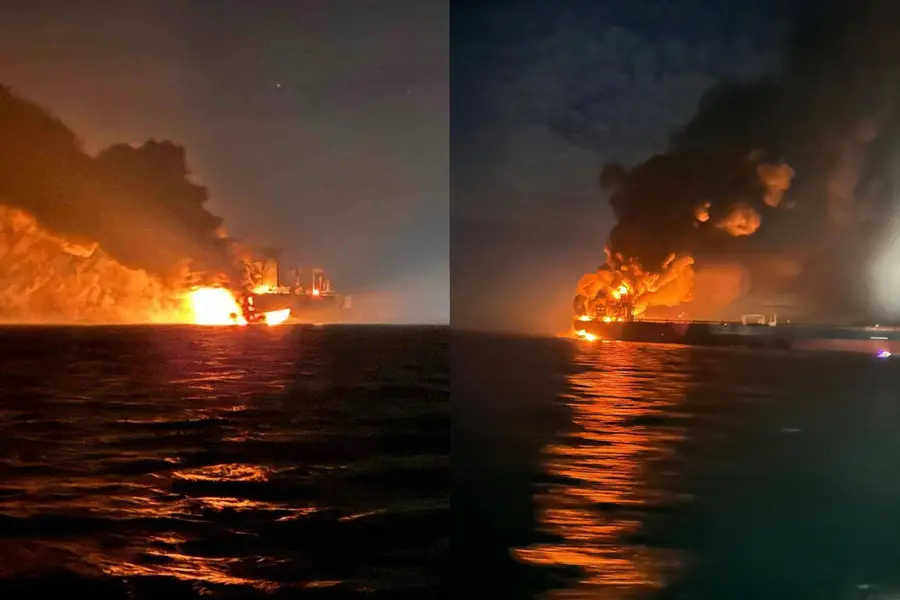
Kyiv: Two oil tankers linked to Russia’s shadow fleet caught fire in the Black Sea near Turkey on 28 November 2025, triggering rescue operations and raising questions about the cause and environmental impact.
Explosion and fire near Turkish coast
Also Read

Turkish authorities reported that two oil tankers, the Gambia-flagged Kairos and the Virat, both on international sanctions lists, caught fire on Friday in the Black Sea near the Bosporus Strait. The Kairos exploded approximately 28 nautical miles off the Turkish coast of Kocaeli province while sailing empty from Egypt to Novorossiysk, Russia. Shortly afterward, the Virat was reported to have been ‘struck’ 35 nautical miles off the Turkish coast.
Cause remains unclear
Turkish maritime authorities stated that the Kairos incident was caused by an “external impact,” but did not specify the source. Possibilities include a naval mine or a targeted attack. The region has a history of ships encountering drifting mines, and authorities are monitoring maritime traffic closely to prevent further incidents.
Crews rescued safely
Rapid intervention by the Turkish coast guard and rescue units ensured the safety of all crew members. The 25 people aboard the Kairos and 20 on the Virat were evacuated and reported to be in good condition.
History of sanctions against the vessels
Both ships are part of the so-called “shadow fleet,” used by Moscow to circumvent sanctions on Russian crude oil following the 2022 invasion of Ukraine.
- Virat: Sanctioned by the US in January 2025, later by the EU, Switzerland, the UK and Canada. Built in 2018, it has previously sailed under the flags of Barbados, Comoros, Liberia and Panama.
- Kairos: Sanctioned by the EU in July 2025, then by the UK and Switzerland. Built in 2002, it has previously flown the flags of Panama, Greece and Liberia.
According to OpenSanctions, the shadow fleet generates multibillion-dollar revenues for Moscow while disguising ownership and operations under third-country flags, posing both financial and environmental risks.
Environmental and safety concerns
The incidents have raised fears about potential environmental damage in the Black Sea, already considered high-risk due to previous conflicts and the presence of unexploded ordnance. Authorities continue to monitor the area closely.
Incident timeline and details
- Kairos: 900-foot tanker, en route from Egypt to Russia, suffered a blast and caught fire. Crew evacuated safely.
- Virat: 820-foot tanker, hit farther east, began emitting heavy smoke from its engine room. Crew of 20 reported safe.
The Turkish Directorate General for Maritime Affairs confirmed the ongoing rescue and monitoring operation to safeguard shipping in the Bosporus and surrounding Black Sea region.
On 28 November 2025, two oil tankers linked to Russia’s sanctioned shadow fleet, Kairos and Virat, caught fire in the Black Sea off Turkey’s coast. The explosions prompted an immediate response from the Turkish coast guard, which rescued all crew members.
The Kairos, flying a Gambia flag, was sailing empty from Egypt to Novorossiysk, Russia, when it exploded about 28 nautical miles off Kocaeli province. The Virat was struck approximately 35 nautical miles off the Turkish coast. Turkish authorities described the first explosion as caused by an “external impact,” leaving the exact origin unclear, though naval mines or targeted attacks have not been ruled out.
Both vessels are part of Russia’s shadow fleet, which bypasses Western sanctions following Moscow’s invasion of Ukraine in 2022. Virat has been sanctioned by the US, EU, UK, Switzerland and Canada, while Kairos has been sanctioned by the EU, UK and Switzerland. These tankers disguise ownership and operations under foreign flags, contributing to multibillion-dollar revenues for Russia, while also posing environmental risks.
The Black Sea remains a high-risk zone for shipping, with ordnance from previous conflicts and the potential for environmental damage from oil spills. Authorities continue to monitor the situation closely to ensure maritime safety in the Bosporus and surrounding waters.
Published: 29 Nov 2025, 09:20 am IST
Related Topics
Disclaimer: Kindly avoid objectionable, derogatory, unlawful and lewd comments, while responding to reports. Such comments are punishable under cyber laws. Please keep away from personal attacks. The opinions expressed here are the personal opinions of readers and not that of Mathrubhumi.