
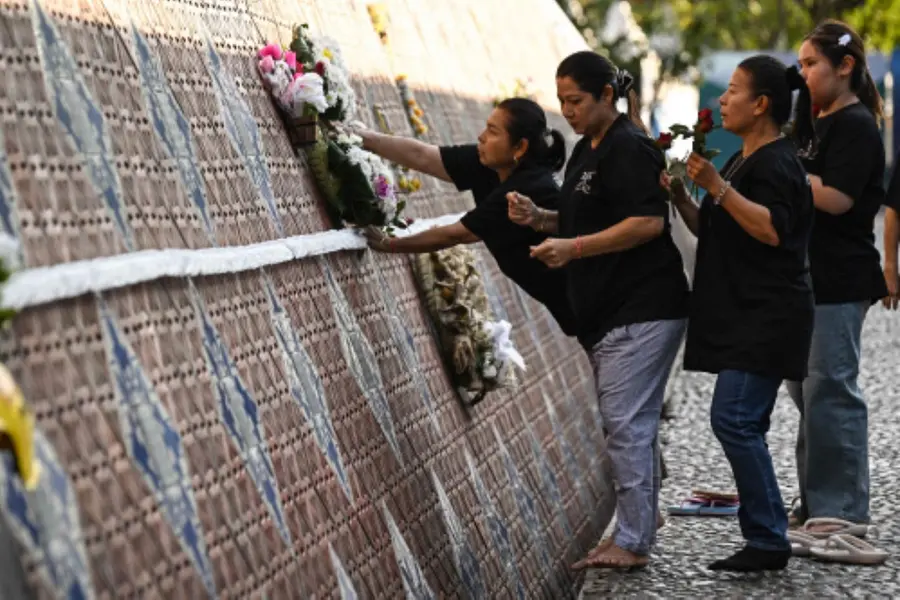
Banda Aceh: People started gathering in prayer on Thursday and visiting the mass graves in Indonesia's Aceh province to mark 20 years since the massive Indian Ocean tsunami, one of modern history's worst natural disasters.
Many openly wept at the mass grave in Ulee Lheue village, where more than 14,000 unidentified and unclaimed tsunami victims are buried. It is one of several mass graves in Banda Aceh, the capital of Indonesia's northernmost province. It was one of the areas worst-hit by the earthquake and tsunami, along with the district of Aceh Besar.
A powerful 9.1-magnitude earthquake off the coast of the Indonesian island of Sumatra on Dec. 26, 2004, triggered a tsunami that killed around 230,000 people across a dozen countries, reaching as far as East Africa. Some 1.7 million people were displaced, mostly in the four worst-affected countries: Indonesia, Sri Lanka, India and Thailand.
Tragedy in India
The tsunami reached the Andaman and Nicobar Islands merely 20 minutes after the undersea earthquake and travelled an astounding 1,200 kilometres to Chennai and Sri Lanka within just two hours. At the time, the absence of an early warning (EW) system left the Indian and Sri Lankan coastlines vulnerable to the devastating waves.
India's seismic monitoring infrastructure was notably limited, with a heavy dependence on international seismic data. This lack of a robust domestic network resulted in significant delays in detecting the earthquake and issuing a timely tsunami warning.
While the Indian National Centre for Ocean Information Services (INCOIS) in Hyderabad had a tsunami detection mechanism in place, it was not equipped to handle events triggered by distant earthquakes. The system relied predominantly on seismic data and was incapable of providing real-time detection of tsunami waves, underscoring a critical gap in disaster preparedness.
The disater claimed the lives of 16,389 people in the country.

More than 170,000 people died in Indonesia alone.
Even though 20 years have passed, the grief remains and survivors still remember their loved ones, lost to the giant waves that flattened buildings in most of the coastal areas of Aceh — all the way to the city of Banda Aceh.
The infrastructure in Aceh has been rebuilt and is now more resilient than it was before the tsunami struck. Early warning systems have been installed in coastal areas to alert residents of potential tsunamis, providing crucial time to seek safety.
The rebuilding efforts were made possible by the support of international donors and organizations, who contributed significant funds to help the region recover. Schools, hospitals, and essential infrastructure that were destroyed by the disaster have been reconstructed with enhanced strength and durability, ensuring better preparedness for future challenges.
The tsunami also claimed the lives of over 8,000 people in Thailand, including many who remain missing, leaving a deep scar on the nation's history. Nearly 400 bodies remain unidentified and unclaimed. (AP)
Published: 26 Dec 2024, 08:02 am IST
Related Topics
Disclaimer: Kindly avoid objectionable, derogatory, unlawful and lewd comments, while responding to reports. Such comments are punishable under cyber laws. Please keep away from personal attacks. The opinions expressed here are the personal opinions of readers and not that of Mathrubhumi.