
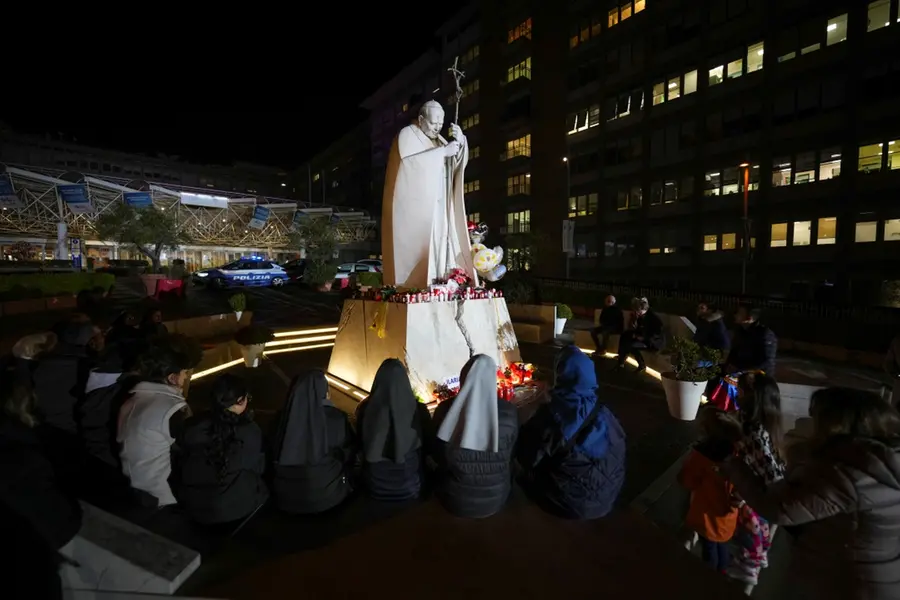
Vatican City: While the Vatican has detailed laws and rituals to ensure the transition of power when a pope dies or resigns, no such norms exist for cases where a pope becomes severely ill or unconscious. As a result, despite being hospitalised in critical condition with a complex lung infection, Pope Francis remains in charge.
His hospital stay, which has now reached the 10-day mark—matching the length of his 2021 hospitalisation for colon surgery—has raised pressing questions about the governance of the Catholic Church in such scenarios. With Francis now 88, the absence of formal provisions for an incapacitated pope has become a focal point of discussion.
How the Vatican currently operates
Despite his condition, the Vatican continues to function as usual, with the day-to-day running of the Church managed by a team of officials. Chief among them is the Secretary of State, Cardinal Pietro Parolin, who oversees administrative affairs. Other Vatican functions, including preparations for the 2025 Holy Year celebrations, are also proceeding as planned.
Canon law does outline steps for when a bishop is unable to perform his duties. Canon 412 states that a diocese is considered 'impeded' if its bishop, due to 'captivity, banishment, exile, or incapacity,' is unable to fulfil his pastoral functions. In such cases, responsibilities shift to an auxiliary bishop or vicar general.
However, no explicit provision exists for the pope under similar circumstances. Canon 335 merely states that when the Holy See is 'vacant or entirely impeded,' nothing can be altered in the governance of the Church. However, it does not define what 'entirely impeded' means or how power should be transferred in such a situation.
Calls for legislative reforms
Recognising this legal gap, a group of canon lawyers in 2021 launched a crowdsourcing initiative to propose new norms regulating papal incapacity. Their proposal suggests that, given medical advancements, it is increasingly likely that a pope could be alive but unable to govern. They argue that provisions should be made to declare a 'totally impeded see' and transfer governance to the College of Cardinals.
Under the proposed norms, in cases of temporary incapacity, a commission would govern the Church, with medical evaluations every six months. If the pope’s condition were deemed irreversible, the College of Cardinals would intervene.
“At first, the promoting group was accused of imprudently choosing topics that were too sensitive and controversial,” said canon lawyer Geraldina Boni, one of the coordinators of the initiative. However, she added, “a widespread consensus formed.”
Even Francis’ personal canon lawyer, Cardinal Gianfranco Ghirlanda, acknowledged the necessity of such norms if a pope 'incurably, then irreversibly, lost consciousness or otherwise the ability to perform human acts.'
He posed the crucial question: “The problem is, who declares that the pope is in a situation where he cannot govern?”
Ghirlanda largely supported the initiative’s proposal for a committee of medical experts to assess the pope’s condition. If they confirmed irreversible incapacity, the Rome-based cardinals would be summoned to declare the pope unfit to govern, triggering a conclave.
Papal resignation and historical precedents
Pope Francis has previously stated that he prepared a resignation letter shortly after his election, in case he became medically incapacitated. He gave it to the then-Secretary of State, Cardinal Tarcisio Bertone, assuming it was passed on to Parolin’s office upon Bertone’s retirement. However, the text of this letter has never been made public, and it remains unclear whether such a resignation would be considered canonically valid. Under current law, a pope’s resignation must be “freely and properly manifested,” as was the case with Pope Benedict XVI in 2013.
In 1965, Pope Paul VI wrote a letter to the Dean of the College of Cardinals instructing them to accept his resignation in case of severe illness. However, this letter was never invoked, as Paul VI lived another 13 years and remained in office until his death.
The role of Vatican officials during Papal transition
Under current Church law, papal authority changes hands only upon the pope’s death or resignation. This initiates a formal transition period known as the “sede vacante” (empty See). During this time, the camerlengo (chamberlain) assumes temporary administrative control, certifies the pope’s death, seals the papal apartments, and prepares for the conclave. The current camerlengo is Cardinal Kevin Farrell, head of the Vatican’s laity office.
However, if a pope is merely sick or incapacitated, the camerlengo has no official role. Similarly, the Dean of the College of Cardinals, currently Cardinal Giovanni Battista Re, 91, who presides over papal funerals and conclaves, has no special responsibilities in such cases. Earlier this month, Pope Francis extended Re’s term, keeping him in office beyond his five-year tenure.
AP
Published: 24 Feb 2025, 12:03 pm IST
Related Topics
Disclaimer: Kindly avoid objectionable, derogatory, unlawful and lewd comments, while responding to reports. Such comments are punishable under cyber laws. Please keep away from personal attacks. The opinions expressed here are the personal opinions of readers and not that of Mathrubhumi.
