
Viral videos show buildings collapsing and residents fleeing after a 7.8-magnitude earthquake struck southern Philippines.
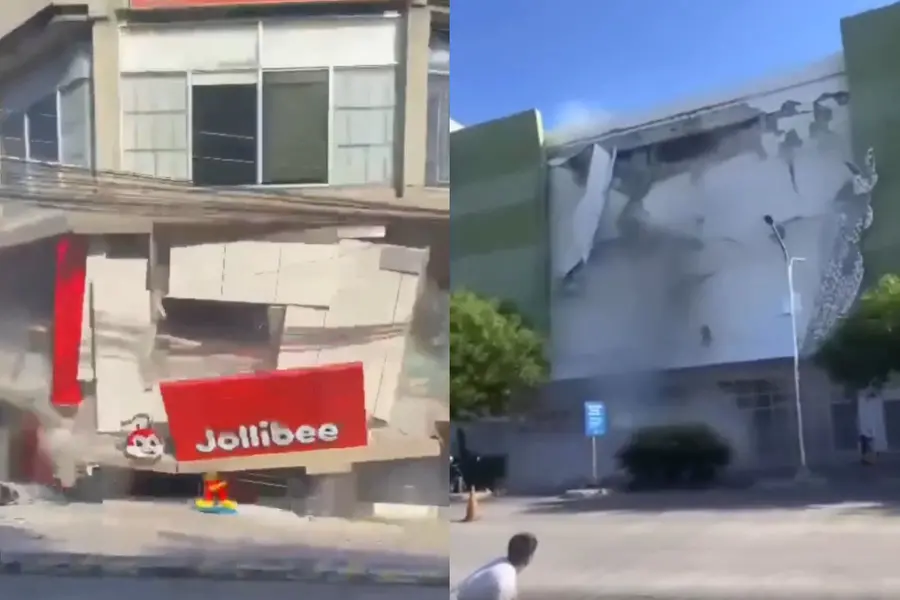
Videos circulating on social media showed buildings collapsing and residents fleeing into the streets after a powerful 7.8-magnitude earthquake struck the southern Philippines on Monday morning, triggering tsunami warnings across parts of Southeast Asia and causing widespread alarm in coastal communities.
The earthquake struck near General Santos City on the island of Mindanao at 7:37 a.m. local time, sending strong tremors through southern regions of the country. Footage shared online captured scenes of panic as people rushed out of homes, offices and shopping centres while structures shook violently.
At least one person was reported killed in the quake, while authorities continued assessing damage in affected areas. Several buildings suffered significant structural damage, including commercial properties and educational facilities.
Videos capture extend of damage
Among the most widely shared videos was footage showing a shopping complex in General Santos City collapsing into a pile of rubble. The building housed a branch of the popular Jollibee fast-food chain.
Other clips appeared to show a building within a local school campus crumpling during the earthquake. Witnesses could be heard screaming as debris fell and people scrambled to safety.
Local media also reported damage to a four-storey commercial building that housed a provincial branch office of DZRH radio. Staff members reportedly evacuated to the ground floor without injuries after part of the structure collapsed. It remained unclear whether anyone was trapped inside the damaged building.
Tsunami warnings issued across region
The earthquake prompted tsunami alerts in parts of the Philippines and neighbouring countries. The Pacific Tsunami Warning Center said waves of up to three metres could reach some Philippine coastlines, while smaller waves of up to one metre were possible in parts of Indonesia and Malaysia.
Authorities immediately urged residents in vulnerable coastal areas to seek higher ground.
Philippine President Ferdinand Marcos suspended classes in affected parts of Mindanao and called for immediate evacuations.
"Move to higher ground now. Do not wait," he said. "Your life is more important than anything left behind."
Teresito Bacolcol, head of the Philippine Institute of Volcanology and Seismology, also warned coastal residents of potential tsunami threats.
“We advise people to evacuate to higher grounds or go further inland,” Bacolcol said.
Epicentre near General Santos
According to the Philippine Institute of Volcanology and Seismology, the epicentre was located about 13 kilometres southwest of General Santos City at a depth of 10 kilometres.
The United States Geological Survey provided a different depth estimate of 55 kilometres, noting that variations between agencies are common in the immediate aftermath of major earthquakes.
General Santos, home to more than 700,000 residents, is one of Mindanao's principal commercial centres and is widely known for its tuna-processing industry.
The quake caused power outages in some areas and sent residents pouring onto streets as buildings swayed.
Strong aftershocks follow main quake
A series of powerful aftershocks followed the initial earthquake, including one measuring 6.1 magnitude. The US Geological Survey reported additional aftershocks reaching magnitudes as high as 6.5.
Residents across southern Philippines continued to feel tremors hours after the main shock, raising concerns about further structural damage.
The earthquake was also felt in parts of Indonesia, particularly in northern regions facing the Philippines.
Indonesia orders evacuations
Indonesian authorities ordered precautionary evacuations in several northern coastal areas after tsunami warnings were issued.
Officials in the North Sulawesi capital of Manado, northern Gorontalo province and the Sangihe Islands were instructed to move residents to safer locations.
The country's disaster management agency said local authorities in high-risk areas "are instructed to immediately direct their residents to evacuate in an orderly manner to higher ground".
Agency spokesman Abdul Muhari urged calm while stressing the importance of protecting vulnerable residents.
"The public is urged not to panic, to prioritise the safety of vulnerable groups such as the elderly, people with disabilities, and children, and to always comply with official instructions," said Muhari.
"Residents are also reminded not to spread unverified rumours or information and to always refer to regular data updates from relevant agencies and officers in the field."
Officials later reported tsunami waves measuring up to 18 centimetres along some coastlines in North Sulawesi and North Maluku provinces.
The agency also advised people living outside the highest-risk zones to avoid beaches, riverbanks and waterway activities until authorities declared conditions safe.
Why Philippines is prone to earthquakes
The Philippines and Indonesia sit along the Pacific "Ring of Fire", a seismically active belt where tectonic plates frequently interact, making earthquakes and volcanic eruptions common.
The Philippines experiences dozens of significant earthquakes each year and is also regularly struck by tropical storms and typhoons.
The latest earthquake comes months after eastern Mindanao was shaken by magnitude 7.4 and 6.7 earthquakes in October that killed at least eight people.
Those tremors followed a magnitude 6.9 earthquake that killed 76 people and damaged or destroyed around 72,000 buildings in Cebu province, according to government figures.
Indonesia has also suffered some of the world's deadliest seismic disasters, including the 2004 Indian Ocean earthquake and tsunami, when a magnitude 9.1 quake off Aceh province triggered massive waves that killed more than 170,000 people in Indonesia alone.
(With agency inputs)
Published: 08 Jun 2026, 08:09 am IST
Related Topics
Disclaimer: Kindly avoid objectionable, derogatory, unlawful and lewd comments, while responding to reports. Such comments are punishable under cyber laws. Please keep away from personal attacks. The opinions expressed here are the personal opinions of readers and not that of Mathrubhumi.
