
Analysts suggest the move, influenced by global conflicts, seeks to bolster military leverage ahead of upcoming high-profile diplomatic summits.
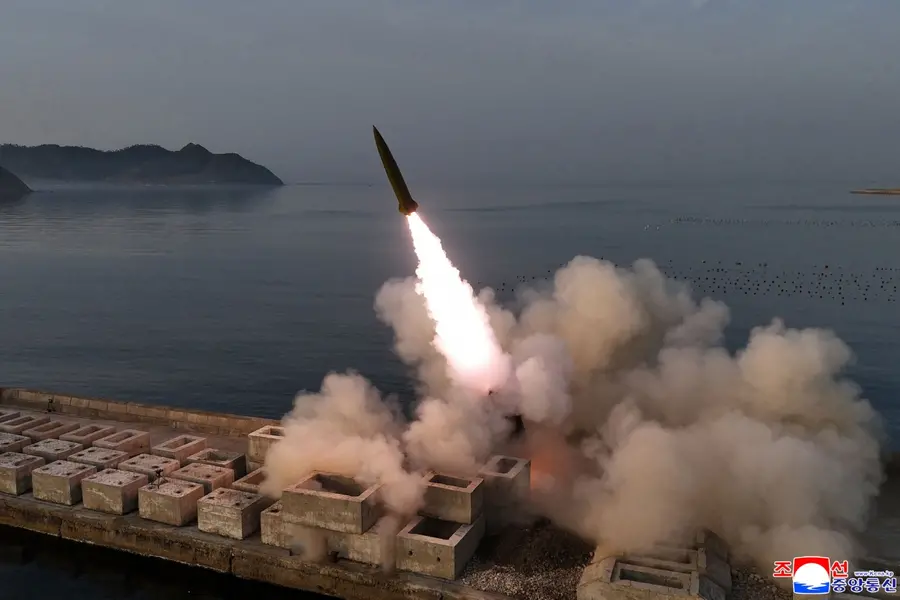
Seoul: North Korea announced on Monday that it conducted a second test-launch of ballistic missiles equipped with cluster bomb warheads this month, a move widely viewed as an attempt to enhance its capability to bypass the missile defences of the United States and South Korea.
The state-run Korean Central News Agency (KCNA) reported that leader Kim Jong Un oversaw the firing of five upgraded Hwasong-11 Ra surface-to-surface tactical ballistic missiles. These projectiles, fitted with both cluster bomb and fragmentation mine warheads, reportedly struck an island target with "very high density."
Photographs released by KCNA depicted the North Korean leader alongside his teenage daughter, Kim Ju Ae, both clad in black leather jackets at a coastal observation post. South Korea’s National Intelligence Service recently issued its most definitive assessment to date regarding the teenager, informing lawmakers that she is now considered the likely heir to the Kim dynasty.
Advancing High-Density Strike Capabilities
According to the official report, the five missiles travelled approximately 136 kilometres (85 miles) before impact. Kim expressed "great satisfaction" with the results, emphasising that increasing "high-density striking capability" is of "weighty significance" for the nation's military operations.
Earlier in April, Pyongyang tested the Hwasong-11 Ka variant, claiming those warheads could "reduce to ashes" any target spanning up to 17 acres. While North Korea has explored cluster technology previously, analysts suggest the ongoing war involving Iran has spurred Pyongyang to accelerate these developments.
In that conflict, Israel has alleged that Iran utilised cluster munitions to overwhelm air defences. Such weapons are designed to detonate at high altitudes, dispersing numerous smaller bomblets that are significantly more difficult to intercept than a single warhead.
Strategic Context and Diplomacy
The recent flurry of weapons testing coincides with a period of heightened regional tension. North Korea has prioritised the expansion of its nuclear and high-tech arsenal—including hypersonic weapons and multi-warhead missiles—since the collapse of nuclear diplomacy with U.S. President Donald Trump in 2019.
Despite the recent escalation, the diplomatic door remains ajar. President Trump has voiced a desire to revive talks with Kim, while the North Korean leader has signalled an openness to dialogue, provided Washington abandons its demand for the North’s unilateral nuclear disarmament.
Observers believe the timing of the launches is intended to secure leverage ahead of a high-profile summit between President Trump and Chinese President Xi Jinping, scheduled to take place in Beijing this May. The meeting is expected to address North Korea’s nuclear program as a primary agenda item.
While more than 120 nations have signed a global treaty prohibiting cluster munitions, North Korea, Iran, Israel, and the United States are not signatories to the pact.
With inputs from AP
Published: 20 Apr 2026, 07:47 am IST
Related Topics
Disclaimer: Kindly avoid objectionable, derogatory, unlawful and lewd comments, while responding to reports. Such comments are punishable under cyber laws. Please keep away from personal attacks. The opinions expressed here are the personal opinions of readers and not that of Mathrubhumi.
