
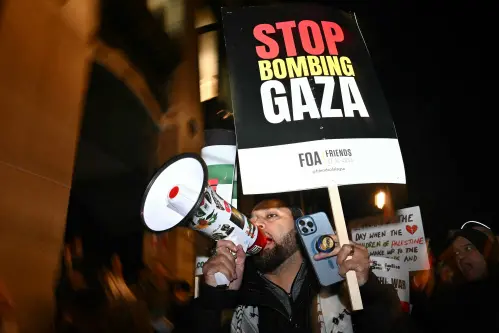
In 2024, global tensions reached new heights as major conflicts, political upheavals, and technological advancements dominated headlines. The ongoing Israeli-Palestinian conflict escalated, with thousands of casualties, while tensions between Israel and Hezbollah in Lebanon further fueled regional instability. Meanwhile, the Russia-Ukraine war continued to ravage Eastern Europe with limited progress. In the U.S., former President Donald Trump sought re-election, sparking debates over democracy and populism, while a failed assassination attempt on his life added to the political turmoil.
As we head into 2025, let's reflect on some of the key incidents that defined 2024.
Israeli Conflicts in the Middle East
In 2024, the ongoing Israeli conflict escalated significantly, with devastating effects on both Palestinians and Israelis. Israeli forces engaged in widespread military operations in Gaza, which resulted in thousands of Palestinian casualties, many due to airstrikes and blockades. Alongside the Gaza conflict, tensions with Hezbollah in Lebanon also heightened, as Israeli forces and Hezbollah engaged in skirmishes along the Israel-Lebanon border.
The U.N. General Assembly overwhelmingly approved resolutions in December demanding an immediate ceasefire in Gaza and expressing support for the U.N. agency for Palestinian refugees that Israel has moved to ban. General Assembly resolutions are not legally binding, although they reflect world opinion.
Israel has faced growing international criticism over its conduct in Gaza as it fights Hamas militants, especially when it comes to humanitarian aid for desperate people in the besieged and heavily destroyed territory.
The war in Gaza began when Hamas-led militants stormed into Israel on Oct. 7, 2023, killing some 1,200 people, mostly civilians, and abducting around 250 people, including children and older adults. Around 100 hostages are still inside Gaza, at least a third of whom are believed to be dead.
Israel’s retaliatory offensive has killed more than 44,800 Palestinians in Gaza, according to local health officials. They say women and children make up more than half the dead but do not distinguish between fighters and civilians in their count. Israel says it has killed over 17,000 militants, without providing evidence.
Ukraine conflict continues
The war between Russia and Ukraine continues into 2024, with limited progress on the frontlines and concerns over diminishing support from Western allies. The conflict remained marked by intense Russian airstrikes targeting Ukrainian cities like Kyiv, Dnipro, and Kherson, causing significant civilian casualties and widespread destruction.
Around half of Ukraine's energy infrastructure has been destroyed during the war, and rolling electricity blackouts are common and widespread.
Kyiv's Western allies have provided Ukraine with air defence systems to help it protect critical infrastructure, but Russia has sought to overwhelm the air defences with combined strikes involving large numbers of missiles and drones called “swarms.”
Russia has held the initiative this year as its military has steadily rammed through Ukrainian defences in the east in a series of slow but steady offensives.
U.S. Presidential Elections
The 2024 U.S. presidential race, with Donald Trump seeking re-election, has become a focal point for debates on democracy, populism, and America's international role. Trump secured a significant victory over Vice President Kamala Harris and triumphed in key battleground states such as Florida, Georgia, Michigan, and Pennsylvania, flipping several states that had gone to Joe Biden in the 2020 election.
Syrian Civil War
In December, Syrian President Bashar al-Assad fled the country as rebels closed in on Damascus in December 2024. His regime, which had been in power for over five decades, collapsed after a sweeping offensive by Islamist and rebel groups. Assad, along with his family, sought asylum in Russia, where they were granted refuge on humanitarian grounds. This marks the end of a brutal civil war that has devastated Syria for over 13 years. Russia has been a long-time ally of Assad, providing military support throughout the conflict.
Bangladesh Protest and Haseena fleeing to India
In a dramatic turn of events, Bangladesh Prime Minister Sheikh Hasina fled the country on August 5, 2024, amid escalating violence during widespread anti-government protests. The protests, which began in early July over demands for job quotas, intensified when clashes between demonstrators and government forces resulted in over 300 deaths, including 100 fatalities in the most recent unrest. Faced with mounting pressure, Hasina boarded a military helicopter from the capital Dhaka, heading to India. Her departure left behind chaos, with protesters storming her official residence and other government buildings. The unrest led to significant disruptions, including the suspension of transportation services and factory operations. In response to the crisis, Bangladesh's army chief, General Waker-Uz-Zaman, announced the formation of an interim government. The military has called for peace and stability while engaging in talks with political leaders. Meanwhile, Bangladesh's political future remains uncertain, as the nation grapples with the economic and social fallout from the unrest. Notably, the violence against the Hindu minority in the country further strained its relationship with India.
Artificial Intelligence (AI) Act
The European Union's Artificial Intelligence (AI) Act, enacted in 2024, establishes a comprehensive framework for regulating AI technologies, prioritizing safety, transparency, and innovation. It introduces a risk-based classification system, categorizing AI systems into three groups: unacceptable risk, high risk, and general-purpose AI. Unacceptable risks, such as social scoring or facial recognition, are banned, while high-risk applications in fields like healthcare and law enforcement must comply with strict requirements, including human oversight and transparency. General-purpose AI models, such as language models, must ensure data documentation and address potential harms.
The Act also mandates robust compliance measures for organizations deploying high-risk AI, requiring audits, risk assessments, and technical documentation. Penalties for non-compliance are significant, reinforcing the law's enforcement capacity.
Iran attacks Israel
In October 2024, Iran launched a missile strike on Israel, targeting military sites in retaliation for the killing of Hezbollah leader Hassan Nasrallah. The attack prompted air raid sirens across Israel, and while Israel's air defence intercepted many missiles, some caused damage. The U.S. provided support to Israel's defence efforts.
In response to the Iranian missile strike, Israel conducted airstrikes targeting Iranian military sites in Syria and Lebanon. Israel’s military confirmed it had attacked key infrastructure linked to Iranian forces, including weapons storage facilities and missile launch sites. The retaliatory strikes are part of Israel's ongoing efforts to weaken Iran's military presence in the region, as tensions between the two countries continue to escalate.
Hajj extreme heat disaster
The 2024 Hajj pilgrimage, held in Saudi Arabia, was marred by a devastating heatwave that claimed the lives of hundreds of pilgrims. Temperatures soared as high as 51°C, leading to widespread heat-related illnesses and fatalities. More than 1.83 million Muslims participated in the pilgrimage this year, and the intense heat left many struggling to complete the demanding rituals. At least 1,301 people died, with the majority succumbing to heatstroke and dehydration, including large numbers of Egyptians and Indonesians. Several other nations, such as Algeria, India, and Tunisia, also reported casualties.
Assange returns home
Julian Assange, the founder of WikiLeaks, has returned to his home country of Australia after years of legal battles and incarceration. Assange left the UK following a plea agreement with U.S. authorities. In this deal, he agreed to plead guilty to charges related to the leaking of classified U.S. documents, primarily concerning the wars in Iraq and Afghanistan. Assange had spent nearly five years in a high-security prison in London before his release, during which global campaigns for his freedom gained significant support. His return to Australia marks the conclusion of a long legal saga, which has sparked debates over press freedom and government accountability.
Upon his arrival in Australia, Assange was greeted by his wife, Stella Assange, and his father, John Shipton. The Australian government had been actively involved in securing his return, with Prime Minister Anthony Albanese expressing support for Assange's homecoming.
Trump assassination attempt
On July 13, 2024, former U.S. President Donald Trump survived an assassination attempt during a campaign rally in Butler, Pennsylvania. As he was speaking, a 20-year-old gunman, Thomas Matthew Crooks, fired multiple shots from an elevated position, striking Trump in the ear and injuring two others. The shooter was quickly neutralized by the U.S. Secret Service. Trump, though injured and bleeding, was shielded by his security team and rushed to the hospital. He later confirmed on social media that he was aware something was wrong immediately after hearing the shots and feeling the bullet wound.
The attack has sparked widespread concern over security at political events, with calls for an investigation into how the gunman managed to get so close to Trump. The Secret Service came under scrutiny for the breach, especially since the rally was held outdoors, outside the standard security perimeter. Despite the traumatic event, Trump resumed his campaign schedule, attending the Republican National Convention just days later.
Polar Dawn Mission
The Polaris Dawn mission, launched on September 10, 2024, was a private crewed spaceflight operated by SpaceX on behalf of Shift4 CEO Jared Isaacman. This mission, the first of three in the Polaris program, saw Isaacman and his crew — Scott Poteet, Sarah Gillis, and Anna Menon — aboard the Crew Dragon spacecraft. They flew in an elliptical orbit that took them 1,400 kilometres (870 miles) from Earth, setting a new record for the farthest distance travelled by humans since NASA's Apollo program. This mission marked the 14th crewed orbital flight for the Crew Dragon spacecraft and demonstrated significant progress in private space exploration. Later in the mission, the crew performed the first commercial spacewalk.
During the mission, the crew conducted scientific experiments, including medical research, and tested advanced spaceflight technology. The Polaris Dawn mission also provided valuable data for future deep space missions, such as those targeting the Moon and Mars.
Other Major events of 2024
Iran’s President Ebrahim Raisi killed in helicopter crash
An Iranian Air Force helicopter crashed near the village of Uzi, East Azerbaijan, killing several top officials, including President Ebrahim Raisi. The crash also claimed the lives of Foreign Minister Hossein Amir-Abdollahian, Governor-General of East Azerbaijan Malek Rahmati, Supreme Leader’s representative Mohammad Ali Ale-Hashem, the head of the president's security team, and three flight crew members. The helicopter was en route as part of a convoy traveling from the Giz Galasi Dam to Tabriz.
Former Pak PM Imran Khan sentenced to 10 years
Former Pakistani Prime Minister Imran Khan was sentenced to an additional 10 years in prison for leaking state secrets. The verdict, handed down by a special anti-terrorism court in Islamabad, came as part of ongoing legal troubles for the former cricketer-turned-politician, who has faced a series of legal challenges since his ousting from power in a no-confidence vote in April 2022. He termed the charges against him as politically motivated. The conviction under the secrets act comes the week before general elections in Pakistan. Later, in a surprise comeback, Khan's Pakistan Tehreek-e-Insaf (PTI) party win the most seats in the election with 97, PML-N win 76, PPP 54.
Navalny's death
On February, Russian authorities confirmed the death of prominent opposition leader and political prisoner Alexei Navalny while he was serving a 19-year sentence in a correctional facility in Kharp, located in the Russian Arctic. Navalny's spokeswoman announced his passing the following day, demanding that his body be returned to his family for burial. He was 47 years old at the time of his death.
Navalny's death has ignited protests and demonstrations around the world, with gatherings held in cities across Russia and abroad. In Russia, where the government has long sought to silence Navalny’s outspoken opposition to President Vladimir Putin's regime, hundreds of mourners were detained during protests. The Russian government has yet to provide a full explanation of the circumstances surrounding his death, further fueling suspicions about foul play.
Trump stands trial: First former US president to face criminal charges
Donald Trump made history as the first former U.S. president to stand trial on criminal charges. The case, which centers around allegations of hush money payments made to adult film actress Stormy Daniels during the 2016 election campaign, opened in a New York court. Trump is accused of orchestrating the payments to prevent Daniels from going public about their alleged affair, an action that prosecutors argue violated campaign finance laws.
Iraq criminalizes same-sex relationships
On April, Iraq's parliament passed a controversial law criminalizing same-sex relationships, making it punishable by up to 15 years in prison. The law, which has drawn significant international condemnation, further restricts the rights of the LGBTQ+ community in the country. Supporters of the law argue that it aligns with Iraq's conservative societal values and Islamic teachings, while critics label it as a violation of human rights.
Published: 15 Dec 2024, 11:11 am IST
Related Topics
Disclaimer: Kindly avoid objectionable, derogatory, unlawful and lewd comments, while responding to reports. Such comments are punishable under cyber laws. Please keep away from personal attacks. The opinions expressed here are the personal opinions of readers and not that of Mathrubhumi.
