
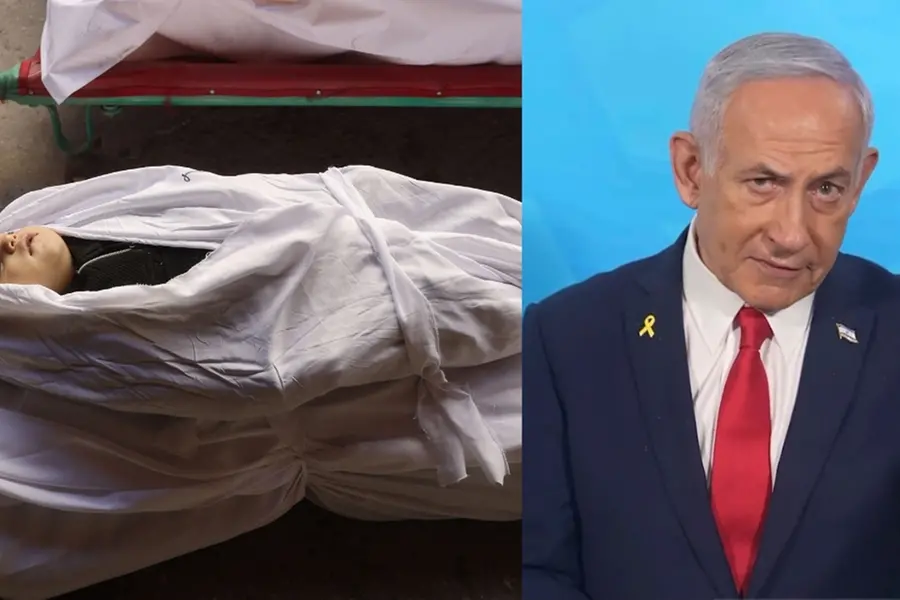
Deir Al-Balah, Gaza Strip: Israel launched a series of airstrikes across the Gaza Strip on Tuesday, killing at least 404 Palestinians and injuring more than 560, according to Gaza's Health Ministry. The attacks came after Hamas rejected Israel’s demand to release half of the remaining hostages as a precondition for extending the ceasefire.
Prime Minister Benjamin Netanyahu justified the strikes as a "necessary condition for freeing hostages", vowing that Israel’s military campaign was “only the beginning.” He stated that all future ceasefire negotiations would take place “under fire.” The White House confirmed it had been consulted and expressed support for Israel’s actions.
The Israeli military has instructed civilians in eastern Gaza to evacuate, raising the likelihood of renewed ground operations. The strikes have further exacerbated the humanitarian crisis, as Gaza has been cut off from essential supplies—including food, medicine, and fuel—for nearly two weeks. Aid groups warn that the lack of resources is putting 2 million Palestinians at extreme risk.
Escalation and political fallout
The latest Israeli offensive comes amid political turmoil within Netanyahu’s government. His decision to resume attacks has faced both domestic protests and support from far-right allies. Mass demonstrations erupted in Tel Aviv, with families of Israeli hostages accusing the government of abandoning their loved ones.
Hamas officials condemned the attacks, with senior leader Izzat al-Risheq calling the move a “death sentence” for the remaining captives. The militant group reported that six senior members were killed in the strikes, including key security and government officials.
Meanwhile, Yemen’s Houthi rebels launched rockets toward Israel for the first time since the ceasefire began, though Israeli air defenses intercepted them before they reached Israeli territory.
Human toll and civilian casualties
Medical workers describe the aftermath as catastrophic, with entire families wiped out. A single strike in Rafah killed 17 members of one family, while another in Gaza City left 27 dead. Hospitals are overwhelmed, with doctors treating severely wounded children with limited resources.
Dr. Tanya Haj-Hassan, a volunteer with Medical Aid for Palestinians, recounted treating a 6-year-old girl found with shrapnel in her brain. “We don’t know if her family survived,” she said.
Gaza's Health Ministry reports the war has now claimed over 48,500 Palestinian lives, with women and children making up more than half of the casualties.
Stalled ceasefire talks and future uncertainty
The ceasefire, which began in mid-January, initially saw Hamas release 25 hostages and the bodies of eight more, in exchange for 1,700 Palestinian prisoners. However, Israel rejected further negotiations over a second phase, instead demanding that Hamas unilaterally release half of the remaining 24 hostages before considering an extended truce.
Hamas insisted on adhering to the original agreement, which required ongoing ceasefire talks before further hostage releases. Netanyahu’s decision to resume full-scale war has now removed any immediate diplomatic path forward, leading to fears of prolonged conflict.
With Netanyahu’s government under pressure from both far-right coalition partners and protesters demanding a hostage deal, the resumption of war offers short-term political gains but deepens Israel’s strategic dilemma. The dual objectives of defeating Hamas and freeing hostages may prove increasingly difficult to achieve.
Published: 19 Mar 2025, 07:47 am IST
Related Topics
Disclaimer: Kindly avoid objectionable, derogatory, unlawful and lewd comments, while responding to reports. Such comments are punishable under cyber laws. Please keep away from personal attacks. The opinions expressed here are the personal opinions of readers and not that of Mathrubhumi.
