
The military-backed USDP is expected to win, while violence and repression prevent voting in many areas.
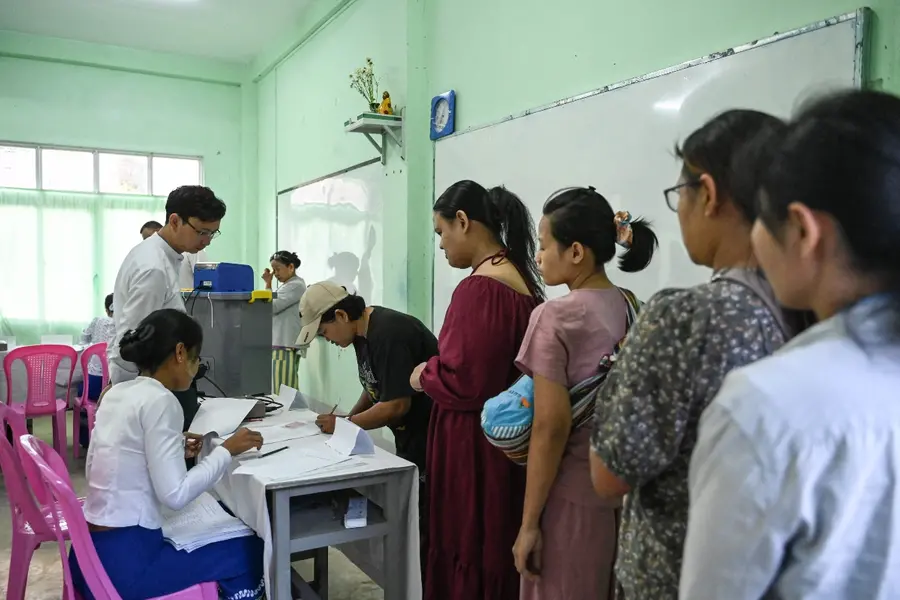
Yangon: Myanmar’s military government launched a heavily restricted, phased general election on Sunday, framing the vote as a transition back to civilian rule five years after the 2021 coup plunged the country into a devastating civil war.
The polls opened at 6:00 a.m. in junta-held territories, including Yangon, Mandalay, and the capital, Naypyidaw. However, the election has been widely denounced by the United Nations, Western diplomats, and human rights groups as a "sham" designed to legitimise military control.
Aung San Suu Kyi, the 80-year-old former civilian leader whose party won a landslide victory in 2020, remains in prison serving a 27-year sentence. Her National League for Democracy (NLD) was dissolved by the military-appointed election commission and is not participating. Her son, Kim Aris, told reporters from Britain, "I don't think she would consider these elections to be meaningful in any way."
The military-backed Union Solidarity and Development Party (USDP) is expected to dominate the ballot. According to the Asian Network for Free Elections (ANFREL), roughly 90% of the seats won in the 2020 election were held by parties that are now banned or defunct.
"These elections are clearly taking place in an environment of violence and repression," said UN High Commissioner for Human Rights Volker Turk. He noted that there are "no conditions for the exercise of the rights of freedom of expression, association or peaceful assembly."
In Yangon, early voter turnout appeared low. Downtown polling stations near the Sule Pagoda—once a hub for massive pro-democracy protests—saw more journalists and security personnel than voters. Bo Saw, 63, the first to vote in Yangon’s Kamayut Township, stated, "The first priority should be restoring a safe and peaceful situation."
The election arrives as the junta struggles to maintain control over large swaths of the country. Fighting between the military and an alliance of ethnic minority armies and pro-democracy People's Defence Forces (PDF) has made voting impossible in many regions. The junta has admitted that elections cannot be held in nearly one-fifth of the lower house constituencies.
The military has also used a new "election protection law" to arrest more than 200 people for "disrupting" the polls, including those who called for a boycott. In Sagaing, PDF officer Zaw Tun dismissed the process, saying, "There are many ways to make peace in the country, but they haven't chosen those—they've chosen to have an election instead. We will continue to fight."
The month-long process is scheduled in three phases, with subsequent rounds of voting on Jan. 11 and a final round on Jan. 25, 2026.
With inputs from AFP
Published: 28 Dec 2025, 07:14 am IST
Related Topics
Disclaimer: Kindly avoid objectionable, derogatory, unlawful and lewd comments, while responding to reports. Such comments are punishable under cyber laws. Please keep away from personal attacks. The opinions expressed here are the personal opinions of readers and not that of Mathrubhumi.
