
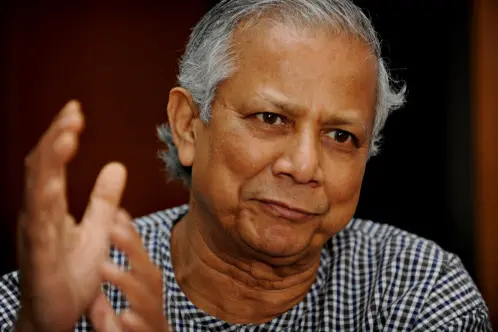
Dhaka: Nobel laureate Muhammad Yunus will head Bangladesh's interim government after longtime Prime Minister Sheikh Hasina fled the country amid a mass uprising that left hundreds of people dead and pushed the South Asian nation to the brink of chaos.
The decision, announced early Wednesday by Joynal Abedin, the press secretary of the country’s figurehead President Mohammed Shahabuddin, came during a meeting that included military chiefs, organizers of the student protests that helped drive Hasina from power, prominent business leaders and civil society members.
This proposal came swiftly after President Mohammed Shahabuddin announced the dissolution of Parliament and the imminent formation of an interim administration. Yunus, currently in Paris serving as an advisor for the 2024 Olympic Games, welcomed the ousting of Hasina’s regime, hailing it as the “second liberation” for Bangladesh.
Who is Muhammad Yunus?
Muhammad Yunus, born in Chittagong in 1940, is renowned for his groundbreaking work in microfinance and poverty alleviation. After earning his PhD in economics from Vanderbilt University in 1969, Yunus served as an assistant professor at Middle Tennessee State University before returning to Bangladesh following its independence in 1971. He was appointed head of the economics department at Chittagong University.
At 84, Yunus has had a contentious relationship with Hasina’s administration and is currently embroiled in legal controversies within Bangladesh, though he has firmly denied allegations of corruption.
Pioneering Microfinance: The Grameen Bank
Yunus’s notable achievement is the establishment of the Grameen Bank in 1983, a pioneering institution that provides small, collateral-free loans to impoverished individuals who lack access to traditional banking services. This innovative model has since been replicated in over 100 countries. The Grameen Bank has disbursed $34.01 billion in loans to 9.55 million people, boasting an impressive recovery rate of 97.22%.
In 2006, Yunus and Grameen Bank were jointly awarded the Nobel Peace Prize for their efforts in fostering economic and social development from the grassroots level. Yunus earned the moniker "Banker to the Poor" for his role in revolutionising microfinance.
Strained Relations with Hasina
Yunus’s relationship with Hasina deteriorated following his decision to form a political party after receiving the Nobel Prize. Upon Hasina’s return to power in 2009, her government initiated several investigations into Yunus’s activities, accusing him of coercive tactics in loan recovery through Grameen Bank.
Yunus has been vocally critical of the Bangladeshi government, accusing officials of fabricating lies and becoming ensnared in their own falsehoods. Despite the legal challenges and political friction, Yunus remains a significant figure in Bangladesh’s socio-economic landscape.
The call for Yunus as chief adviser reflects a broader desire for reform and stability in the wake of the current political upheaval. (With inputs from Agencies)
Published: 07 Aug 2024, 06:43 am IST
Related Topics
Disclaimer: Kindly avoid objectionable, derogatory, unlawful and lewd comments, while responding to reports. Such comments are punishable under cyber laws. Please keep away from personal attacks. The opinions expressed here are the personal opinions of readers and not that of Mathrubhumi.
