
Britain’s newly appointed MI6 chief, Blaise Metreweli, is facing scrutiny after reports revealed her grandfather was a notorious Nazi spy.
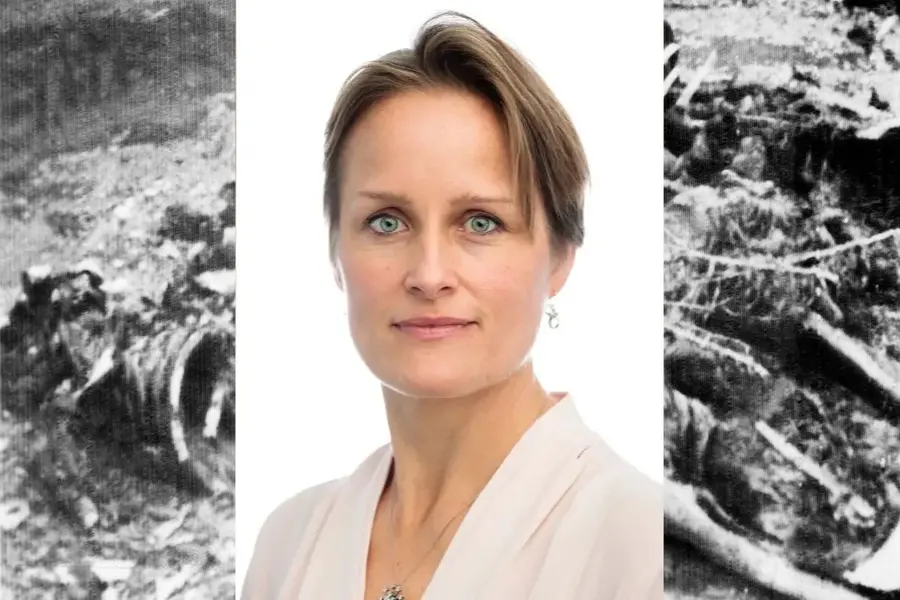
Britain’s incoming MI6 chief, Blaise Metreweli, is making history as the first woman to lead the Secret Intelligence Service. But her appointment has also unearthed disturbing details about her family’s past. According to reports by the Daily Mail and the BBC, Metreweli’s paternal grandfather was none other than Constantine Dobrowolski, a Nazi collaborator dubbed "The Butcher" and “Agent No. 30,” who spied and killed for Adolf Hitler’s Germany in occupied Ukraine during World War II.
Metreweli, 47, is currently MI6’s Head of Technology, known by the codename “Q”, and is set to replace current chief Richard Moore in the autumn. She joined MI6 in 1999 and has held key operational roles in Europe and the Middle East. Her appointment was hailed as a landmark for gender representation in the intelligence community.
Nazi past surfaces
Archival records found by Daily Mail from Germany show that Dobrowolski was a Red Army defector who later became the Nazis’ lead informant in the Chernihiv region of Ukraine. Files unearthed from Freiburg detail a grim account of Dobrowolski’s collaboration with Nazi forces — including boasting of taking part in the extermination of Jews and being complicit in the killings of Ukrainian resistance fighters. Handwritten letters to Nazi commanders signed off with “Heil Hitler” further strengthen the chilling picture of his role.
He allegedly looted bodies of Holocaust victims and was accused of mocking the assault of female prisoners. These actions earned him the Soviet nickname “the worst enemy of the Ukrainian people,” and a 50,000-rouble bounty was placed on his head, roughly £200,000 today.
While Metreweli never met her grandfather, the Foreign Office has issued a statement saying she had no knowledge of, nor any contact with, him. “Blaise's family history, marked by conflict and division, common among those with Eastern European roots, is only partly known. It is this very complexity that fuels her dedication to preventing conflict and defending the UK from today's hostile threats as the next MI6 chief,” a government spokesperson said.
From shadows to spotlight
Metreweli’s own career remains distinguished. Raised in Hong Kong in a multilingual household, she studied anthropology at Pembroke College, Cambridge, and was part of the winning crew in the 1997 Women’s Boat Race. After university, she vanished from public view, her only mentions coming from civil service postings and award citations.
Sources close to the agency say her track record in operational missions post-9/11 and her leadership in cyber and tech roles earned her widespread respect. Insiders had long expected her to rise to the top job, with her dual background in MI6 and MI5 making her uniquely positioned to face threats from Russia, China and Iran.
Kremlin reaction anticipated
The timing of these revelations could offer propaganda ammunition to the Kremlin, which has repeatedly accused Ukrainians and their allies of being Nazi sympathisers to justify its invasion of Ukraine. Russian state media and nationalist commentators have already highlighted her Ukrainian roots to stoke controversy.
Historian Beka Kobakhidze, who helped trace Metreweli’s lineage, warned the information could be weaponised. “This will become a favourite talking point for Kremlin propagandists for years to come,” he told the Mail. “Children should not be held responsible for the sins of their fathers – or grandparents, for that matter.”
Metreweli’s family name, traditionally spelt with a ‘v’, is of Georgian origin. However, investigations show that the surname was adopted from her step-great-grandfather, David Metreweli, who married her grandmother Barbara Dobrowolska in Yorkshire in 1947. Her biological grandfather, Constantine Dobrowolski, had remained in Nazi-occupied Ukraine, while his family fled Soviet advances.
A complex legacy
Dobrowolski, born in 1906, came from a noble background. After the Bolsheviks destroyed his family estate and killed most of his relatives during the 1917 Revolution, he survived by going into hiding. In 1926, he was arrested and sentenced to 10 years in Siberia for anti-Soviet activity and anti-Semitism.
His grandson, Metreweli’s father, Constantine Jr., was born in 1943 in Snovsk, Ukraine, before relocating to Britain. Official records from the London Gazette list his nationality as “uncertain,” a detail that piqued curiosity in intelligence and historian circles, and ultimately helped unravel the family history.
While critics say the story offers unnecessary fuel to hostile regimes, supporters argue Metreweli’s career proves her loyalty and merit. One MI6 insider noted that her ascent to the top speaks volumes about Britain’s confidence in her capabilities, regardless of heritage.
Published: 28 Jun 2025, 02:17 pm IST
Related Topics
Disclaimer: Kindly avoid objectionable, derogatory, unlawful and lewd comments, while responding to reports. Such comments are punishable under cyber laws. Please keep away from personal attacks. The opinions expressed here are the personal opinions of readers and not that of Mathrubhumi.
