
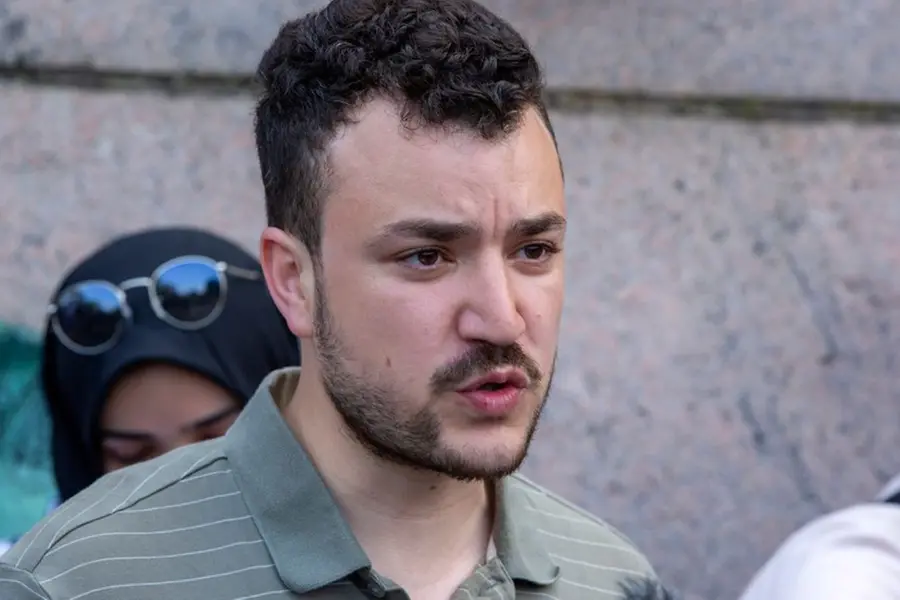
Mahmoud Khalil, a prominent figure in the pro-Palestinian protests at Columbia University, was arrested last week by federal immigration authorities under the Trump administration. The move has sparked widespread condemnation from free speech advocates, who accuse the government of suppressing political dissent.
What happened?
Khalil was detained Saturday night as he and his wife were returning to their Columbia University-owned apartment in upper Manhattan by officials from the U.S. Department of Homeland Security.
The agents told the couple that Khalil was being detained because his student visa had been revoked.
When his wife provided documents proving he was a green card holder, the agents said that was also being revoked and took him away in handcuffs, according to a lawsuit Khalil’s attorneys filed challenging his detention.
Arrest and deportation threat
A video released on Friday captured the moment of Khalil’s arrest, showing at least three federal agents confronting him in the lobby of his apartment building near Columbia University. The agents inform him that he is “going to be under arrest," then repeatedly order him to “turn around” and “stop resisting.” Khalil, appearing calm, replied, “There’s no need for this… I’m going with you. No worries.” His wife, Noor Abdalla, who is eight months pregnant, pleaded in Arabic, “My love, how can I call you?” before being told by an agent that they do not disclose their names.
Federal officials stated Khalil’s arrest is part of a wider crackdown on pro-Palestinian student activism, which the Trump administration claims has fuelled antisemitism and anti-American sentiment. Secretary of State Marco Rubio revoked Khalil’s residency, alleging his role in protests at Columbia amounted to support for Hamas. “The White House is requesting an update,” one agent reportedly told another during Khalil’s detention.
Khalil, a legal U.S. resident with no criminal record, was swiftly transferred from New York to Louisiana, where he is now being held in an ICE detention centre surrounded by barbed wire fences. His lawyers claim he was denied access to legal counsel, forced to spend a night in a cold holding cell without a blanket, and flown across multiple states before arriving at his current facility.
Why is he facing deportation?
The Department of Homeland Security, confirming his arrest Saturday, accused Khalil of leading “activities aligned to Hamas, a designated terrorist organization.”
The White House, elaborating more on its position Tuesday, claimed Khalil organized protests where pro-Hamas propaganda was distributed.
“This administration is not going to tolerate individuals having the privilege of studying in our country and then siding with pro-terrorist organizations that have killed Americans,” said Karoline Leavitt, Trump’s press secretary.
A lawyer for Khalil, Samah Sisay, said there is no evidence that his client provided support of any kind to a terrorist organization.
“They’re trying to make an example of him to chill others from making similar speech,” Sisay told The Associated Press. “Not agreeing with your government’s foreign policy decision to support Israel is not a reason for you to be in deportation proceedings.”
Background and journey to the US
Khalil was born and raised in a Palestinian refugee camp in Syria. He had intended to study aviation engineering but was forced to flee due to the country’s civil war. In a 2017 essay, he wrote, “Where would I be if, like countless other Syrian refugees before me, I could not get a scholarship, could not work, or, worst of all, could not leave Syria in the depths of the ongoing war?”
He relocated to Beirut, where he worked with a non-profit supporting Syrian children’s education. He later earned a bachelor’s degree in computer science from a Lebanese university. During this period, he met his future wife, Noor Abdalla, an American citizen, while she was volunteering with the same non-profit. They maintained a long-distance relationship for seven years before marrying in New York in 2023.
Khalil arrived in the U.S. in 2022 on a student visa before obtaining permanent residency last year. He completed a master’s degree at Columbia University’s School of International and Public Affairs in December and was due to start a job in April that would provide health benefits—critical for his growing family.
Wider crackdown on student protests
Khalil’s arrest follows a series of actions against pro-Palestinian student activists. On Thursday, Columbia University issued sanctions, including suspensions, temporary degree revocations, and expulsions for students involved in last spring’s Gaza protests. Federal authorities have also revoked visas of other foreign students, including Ranjani Srinivasan, an Indian doctoral student accused of “advocating for violence and terrorism.” She opted to leave the country voluntarily on March 5.
Columbia University has faced mounting pressure from the Justice Department, which recently launched an investigation into whether the university harboured undocumented immigrants among its student activists.
"With respect to other events taking place last spring, the UJB's determinations recognised previously imposed disciplinary action. The return of suspended students will be overseen by Columbia's University Life Office. Columbia is committed to enforcing the University's Rules and Policies and improving our disciplinary processes," the university said.
Legal battle and concerns for family
Khalil’s attorneys are challenging his detention in court, arguing that the government is targeting him for his political speech. His wife, Abdalla, described the arrest as “the most terrifying moment of my life.” According to Reuters, she revealed her fears that their child, due in April, may have to meet his father “behind a glass screen.”
(With inputs from agencies)
Published: 15 Mar 2025, 08:36 am IST
Related Topics
Disclaimer: Kindly avoid objectionable, derogatory, unlawful and lewd comments, while responding to reports. Such comments are punishable under cyber laws. Please keep away from personal attacks. The opinions expressed here are the personal opinions of readers and not that of Mathrubhumi.
