
Eight priceless royal jewels, including crowns and necklaces, were stolen from the Louvre in a four-minute heist.
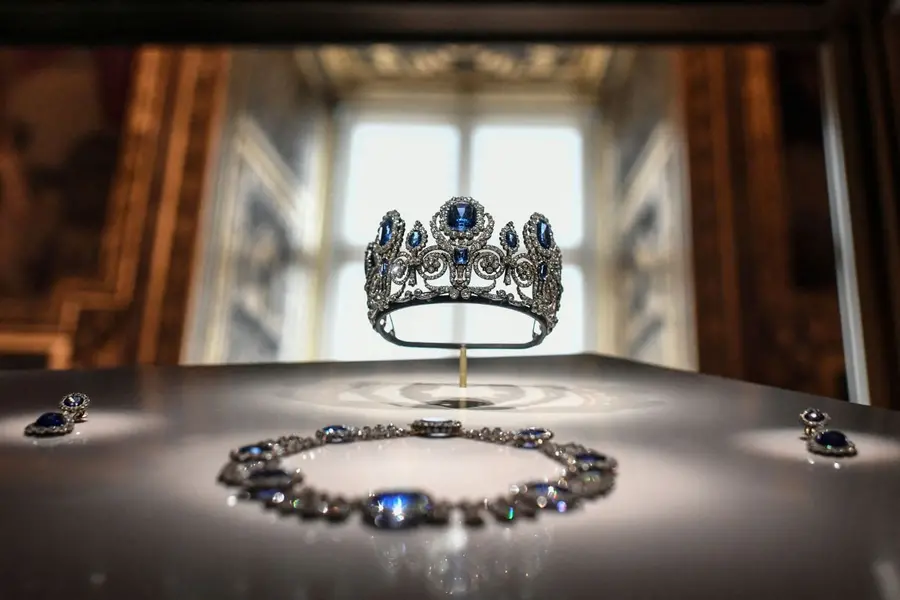
Paris: The glittering sapphires, emeralds, and diamonds that once symbolised France’s royal grandeur may have vanished forever. Experts fear the priceless treasures, stolen in a four-minute daylight heist at the Louvre, could soon be dismantled and sold off in fragments, erasing a vital piece of French history.
A daring four-minute theft
The heist took place on a quiet Sunday (October 19) morning, stunning the nation and prompting urgent questions over the Louvre’s security. According to Paris prosecutor Laure Beccuau, the robbers struck just after the museum opened, entering the Apollo Gallery at 9:34 am and escaping by 9:38 am. Two of the suspects reportedly used a cherry picker to reach the gallery, while two others waited with motorbikes for a swift getaway.
Authorities confirmed that eight pieces – including two crowns, necklaces, earrings, brooches, and a bodice bow – were taken. Together, the stolen jewels are estimated to be worth $102 million (88 million euros), excluding their immense historical and cultural value.
The Louvre reopened on Wednesday, though the Apollo Gallery remains closed as around 100 investigators continue the hunt for both the suspects and the missing gems.
Royal jewels turned to dust
The stolen collection included items dating back centuries, some originally belonging to French queens and empresses. Among them was a diamond and pearl crown gifted by Emperor Napoleon III to Empress Eugénie in 1853, and a sapphire-encrusted headpiece once worn by Queen Marie-Amélie. Another necklace – a wedding gift from Napoleon Bonaparte to Marie-Louise of Austria – featured dozens of emeralds and more than 1,000 diamonds.
The thieves also took a diamond-studded reliquary brooch and a large bow once worn by Empress Eugénie. One crown, decorated with gold eagles, 56 emeralds, and 1,354 diamonds, was dropped during the robbery and found damaged on the street.
Experts fear the jewels are already being disassembled and sold piece by piece. “It’s extremely unlikely these jewels will ever be retrieved and seen again,” said Tobias Kormind, managing director of 77 Diamonds, in a statement. “If these gems are broken up and sold off, they will, in effect, vanish from history and be lost to the world forever.”
France faces another Louvre scandal
The theft has deepened embarrassment for the French government, which has faced repeated issues at the world’s most visited museum. Last year, activists hurled a can of soup at the Mona Lisa, and in June, striking Louvre staff brought operations to a halt, citing overcrowding and crumbling infrastructure.
President Emmanuel Macron has already announced plans to relocate the Mona Lisa to a new, dedicated gallery as part of a major renovation. Now, the theft of the crown jewels has added fresh urgency to the Louvre’s ongoing challenges.
Earlier, director Laurence des Cars told the French Senate that she had offered her resignation over the security failures that allowed the robbery, but the culture minister refused. “We are experiencing a terrible failure at the Louvre, and I take my share of responsibility,” des Cars said, also acknowledging gaps in surveillance and other security measures at the museum.
A blow to national pride
The emotional loss resonates deeply across France. Conservative lawmaker Maxime Michelet told Parliament that the theft represented more than a security failure. “These are family souvenirs that have been taken from the French,” he said. “Empress Eugenie’s crown – stolen, then dropped and found broken in the gutter, has become the symbol of the decline of a nation that used to be so admired. It is shameful for our country, incapable of guaranteeing the security of the world’s largest museum.”
The cinematic nature of the robbery has drawn comparisons to the hit Netflix series ‘Lupin’, in which a gentleman thief pulls off an elaborate Louvre heist. But investigators say the real crime is far from romantic.
Christopher A Marinello, a lawyer with Art Recovery International, dismissed the notion of a “theft-to-order” for a secret collector. “These criminals are just looking to steal whatever they can,” he said. “They chose this room because it was close to a window. They chose these jewels because they figured that they could break them apart, take out the settings, take out the diamonds and the sapphires and the emeralds” overseas to “a dodgy dealer that’s willing to recut them and no one would ever know what they did.”
A race against time
Dutch art detective Arthur Brand warned that selling the jewels in their original form would be nearly impossible. “Nobody will touch these objects. They are too famous. It’s too hot. If you get caught you will end up in prison,” he said. “You cannot sell them, you cannot leave them to your children.”
While the Louvre still houses treasures like the massive Regent Diamond, once part of France’s crown jewels, the loss of these irreplaceable artefacts is seen as a devastating cultural wound.
(With inputs from AP)
Published: 23 Oct 2025, 02:55 pm IST
Related Topics
Disclaimer: Kindly avoid objectionable, derogatory, unlawful and lewd comments, while responding to reports. Such comments are punishable under cyber laws. Please keep away from personal attacks. The opinions expressed here are the personal opinions of readers and not that of Mathrubhumi.
