
Officials emphasise that the tragedy likely resulted from multiple systemic failures rather than a single error.
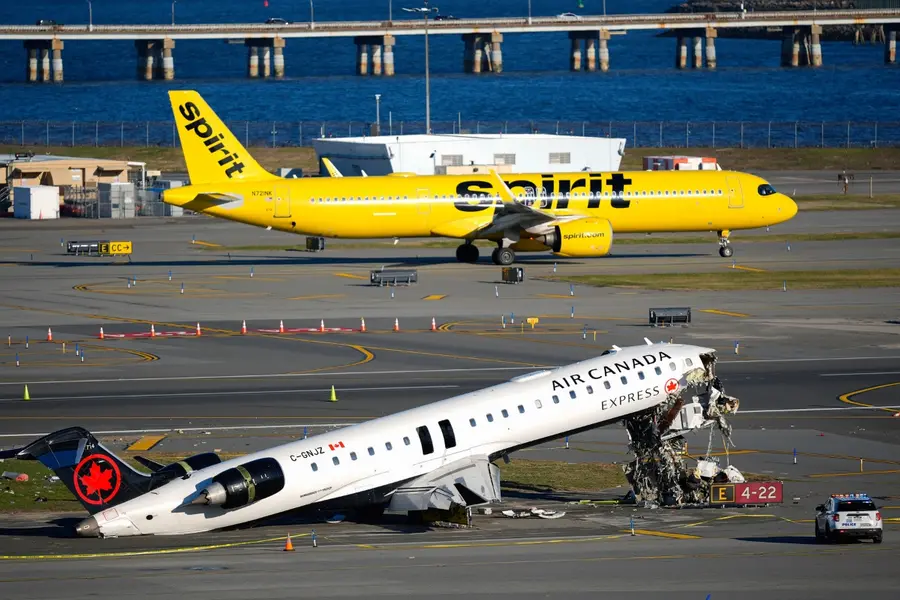
New York: Federal investigators revealed on Tuesday that a sophisticated runway warning system failed to trigger an alarm before an Air Canada jet struck a fire truck at LaGuardia Airport, a catastrophic collision that resulted in the deaths of both pilots.
The National Transportation Safety Board (NTSB) is currently examining whether the absence of that alert, or broader lapses in the airport's multi-layered safety protocols, led to the Sunday night disaster. Investigators are scrutinising air traffic control staffing, the coordination of ground versus aerial traffic, and whether the fire crew heard desperate, last-second commands from the tower to stop.
“We rarely, if ever, investigate a major accident where it was one failure," said NTSB Chairwoman Jennifer Homendy. "When something goes wrong, that means many, many things went wrong.”
The aircraft, a Jazz Aviation flight operating for Air Canada with more than 70 people aboard, slammed into the emergency vehicle shortly after touching down. While the cockpit crew perished, most passengers escaped the wreckage, including a flight attendant who survived after being ejected onto the tarmac while still restrained in her seat.
Tower Workload and Distractions
At the time of the impact, two controllers were managing a volume of traffic that was significantly higher than scheduled due to earlier flight delays. Data from aviation firm Cirium indicated that arrivals after 10 p.m. were more than double the expected rate.
In addition to the high landing frequency, the tower was coordinating an emergency response for an outbound United Airlines flight reporting a strange odour that was sickening its crew.
Homendy cautioned against prematurely blaming the controllers. “I would caution against pointing fingers at controllers and saying distraction was involved. This is a heavy workload environment,” she said, noting that both individuals had just started their shifts.
Technological Failures
LaGuardia is among 35 major U.S. airports equipped with ASDE-X, a surface surveillance system designed to map every plane and vehicle on the tarmac. However, Homendy stated the system did not function as intended because the fire truck lacked a transponder.
Although the FAA urged airports to install transponders on all ground vehicles last May, the NTSB has not yet made it a formal requirement. “Air traffic controllers should know what's before them, whether it's on airport surface or in the airspace,” Homendy remarked.
The Port Authority of New York and New Jersey, which manages the airport, declined to comment on the lack of a transponder, citing the ongoing probe.
Fatal Timeline
A preliminary timeline established from the jet's cockpit voice recorder—retrieved by cutting through the plane's roof—shows a rapid sequence of events:
- 25 seconds before impact: The fire truck requested permission to cross the runway.
- 20 seconds before impact: A controller cleared the truck to cross, despite the Air Canada jet being just 100 feet above the ground.
- 9 seconds before impact: The tower frantically commanded the truck to stop, just one second before the plane's wheels touched the runway.
Homendy noted that runway status lights, which turn red automatically when a strip is occupied, appeared to be functional, raising questions as to why the truck proceeded.
Travel Disruption and Casualties
The crash, the first fatal accident at LaGuardia in 34 years, has exacerbated a period of high frustration for U.S. travellers already facing government shutdown-related delays and winter storms. On Tuesday, approximately 25% of flights at the airport were cancelled, with remaining departures delayed by an average of four hours.
Of the 76 people on the flight from Montreal, about 40 were hospitalised, including the two injured firefighters. While some sustained serious injuries, many were treated and released shortly after.
With inputs from AP
Published: 25 Mar 2026, 08:35 am IST
Related Topics
Disclaimer: Kindly avoid objectionable, derogatory, unlawful and lewd comments, while responding to reports. Such comments are punishable under cyber laws. Please keep away from personal attacks. The opinions expressed here are the personal opinions of readers and not that of Mathrubhumi.
