
Galloway’s run-walk-run method began in 1974, two years after he competed in the 10,000 metres at the Olympics
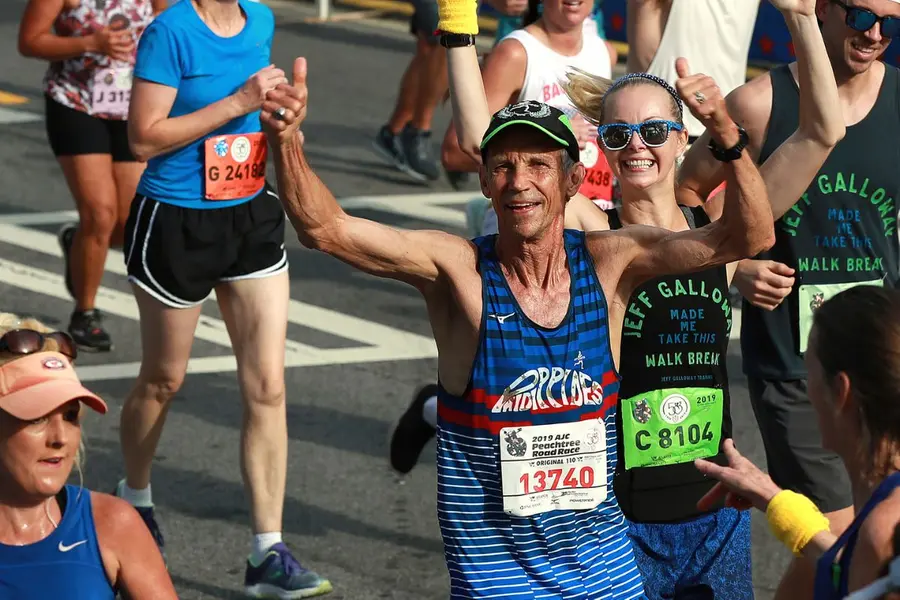
Jeff Galloway, a member of the 1972 US Olympic team who inspired both elite athletes and recreational runners with his run-walk-run strategy, has died at the age of 80.
Galloway passed away in a hospital in Pensacola, Florida, after suffering a haemorrhagic stroke, his daughter-in-law Carissa Galloway said.
In the days before his death, Galloway’s influence was evident online, with many posting videos expressing hope for his recovery following emergency neurosurgery, while thanking him for advice that had helped them cross race starting lines with confidence.
His family announced the surgery on 20 February and invited the public to show support.
Jim Vance, a leading endurance sports consultant in San Diego, described Galloway as a “pioneer” in encouraging people to run.
“He removed the barrier to entry, which was mostly mental,” Vance told the Associated Press. “Running isn’t supposed to be a suffer-fest. It should be peaceful and enjoyable, so people can love running rather than dread it.”
ALSO READ | Can 5 extra minutes of sleep, 2 minutes of brisk walking add a year to your life?
Galloway, who had survived heart failure in 2021, had hoped to complete another marathon, having logged more than 230 over his lifetime.
“My mission now, at the age of 80-plus, is to show that people can do things that are normally not done, and can do them safely,” he told The New York Times in December.
Run-walk-run Method
Galloway’s run-walk-run method began in 1974, two years after he competed in the 10,000 metres at the Olympics, when he started teaching a running class at Florida State University. He hoped the class would attract customers to Phidippides, his newly opened running store.
“None had done any running for at least five years. So we started walking with a few one-minute jogs,” Galloway explained.
“I spent time with each group to adjust the frequency of walk breaks so that no one was huffing and puffing — even at the end. Walk breaks kept the groups together. Everyone passed the final exam: finishing either a 5K or a 10K with smiles on their faces.”
ALSO READ | Why your knees crack and what it means | Joint noises explained
Galloway believed walking during runs reduced injury risk, conserved energy, and maintained confidence.
He even applied his own method in competition. At the 1980 Houston Marathon, he walked through every water station and finished with a personal best of 2:16:35, faster than previous run-only marathons.
Galloway shared his philosophies through books, websites, and retreats, and served as the official training consultant for runDisney, a series of races at Walt Disney Company resorts.
Many admirers paid tribute online following his surgery.
“I never thought I would be a runner. I never thought I’d run a half marathon,” said Karen Bock-Losee of Jacksonville, Florida. “I’m 70 years old and I’ve run several since my 60th birthday when I discovered Galloway running. I just want to say thank you.”
Susan Williams recalled seeing Galloway while struggling near the end of a half marathon in Murray, Kentucky, in 2011.
“You passed me, and my butt was cramping,” she said. “You turned around and came back. You talked me through it. It was awesome.”
Bobby McGee, a Colorado-based running coach, said Galloway’s method made running accessible to everyone.
“When groups get together after a run — from marathons to fun runs — they talk about their times. Nobody asks if they ran the whole thing,” he said.
Galloway is survived by two sons and six grandchildren.
Published: 26 Feb 2026, 10:47 am IST
Disclaimer: Kindly avoid objectionable, derogatory, unlawful and lewd comments, while responding to reports. Such comments are punishable under cyber laws. Please keep away from personal attacks. The opinions expressed here are the personal opinions of readers and not that of Mathrubhumi.
