
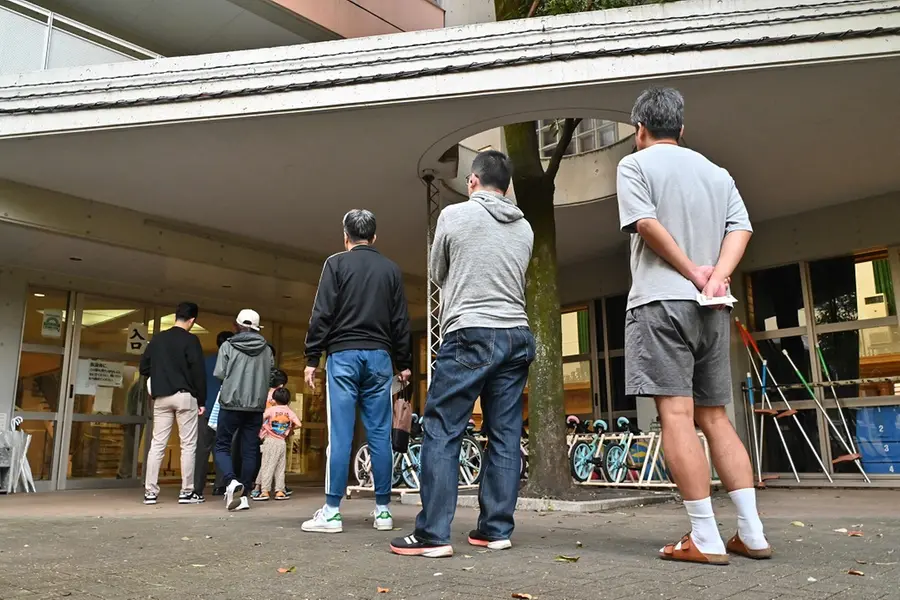
Japan headed to the polls on Sunday for what many consider its tightest election in years. New Prime Minister Shigeru Ishiba and his ruling Liberal Democratic Party (LDP) face one of their most significant challenges since 2009. The conservative LDP, along with its junior coalition partner Komeito, risks losing its majority, according to several opinion polls.
This election could have far-reaching consequences for Ishiba, who has set a goal of securing 233 seats in the lower house of parliament to maintain a stable government. Failure to achieve this threshold could jeopardise his position as LDP leader, forcing him to seek alternative coalition partners or govern with a minority government.
Economic concerns dominate voters' minds
One of the major issues influencing voters is the rising cost of living. Many have expressed frustration over the fallout from a party slush fund scandal that had previously plagued former premier Fumio Kishida.
Tokyo voter Yoshihiro Uchida, 48, said his vote was driven by economic concerns: "I made my decision first and foremost by looking at their economic policies and measures to ease inflation. I voted for people who are likely to make our lives better."
Ishiba has campaigned on revitalising Japan's rural regions and addressing the country’s declining population through family-friendly policies such as flexible working hours. However, his position on other issues, including his stance on allowing married couples to have separate surnames, has been less consistent.
Security policy and international relations
A key element of Ishiba’s platform is his backing for a regional military alliance similar to NATO to counter China’s growing influence. While he supports the idea, Ishiba has cautioned that it "would not happen overnight." His foreign policy stance has made some voters uneasy, especially given his relative inexperience on the international stage.
Mitsuyuki Ikezoe, 86, expressed concerns over Japan's security: "I voted for the LDP because I was worried North Korea or Russia may invade Hokkaido in northern Japan. But Ishiba may be treated dismissively by the United States because he is new."
Opposition challenge from CDP
The Constitutional Democratic Party (CDP), led by former Prime Minister Yoshihiko Noda, poses a significant challenge to the LDP. Noda has criticised the government for ignoring vulnerable communities, especially in the aftermath of the recent earthquake in central Japan.
"The LDP’s politics is all about quickly implementing policies for those who give them loads of cash," Noda said at a rally. "But those in vulnerable positions... have been ignored." Despite these criticisms, political analysts note that Noda’s policies are not vastly different from those of the LDP.
Masato Kamikubo, a political scientist at Ritsumeikan University, said, "The CDP or Noda can be an alternative to the LDP. Many voters think so."
Ishiba’s future uncertain
Local media have speculated that Ishiba could potentially resign if the LDP fails to secure a majority, which would make him Japan’s shortest-serving prime minister in the post-war period.
Despite this uncertainty, Ishiba has pledged to focus on younger candidates and steer away from supporting those with long political careers.
"I want to focus on young candidates rather than those who have had a long career, because they may bring something different," said a 63-year-old voter, Taniyama.
As the results begin to roll in, the future of Japan's political landscape remains in the balance.
AFP
Published: 27 Oct 2024, 08:26 am IST
Related Topics
Disclaimer: Kindly avoid objectionable, derogatory, unlawful and lewd comments, while responding to reports. Such comments are punishable under cyber laws. Please keep away from personal attacks. The opinions expressed here are the personal opinions of readers and not that of Mathrubhumi.
