
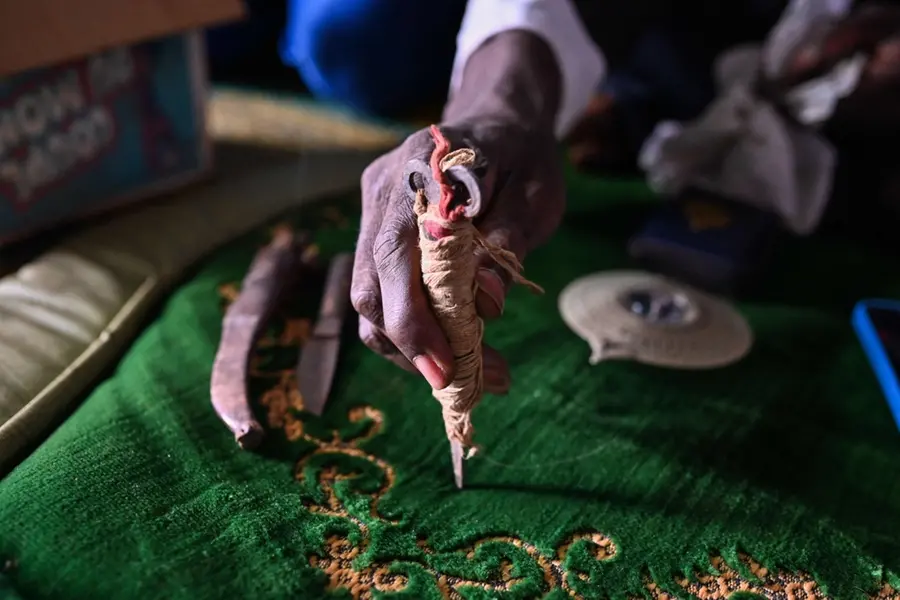
Touba, Ivory Coast: In West Africa, a troubling underground trade involving female genitalia persists, despite decades of efforts to end female genital mutilation (FGM). Moussa Diallo, a former witch doctor, has revealed that he used to apply a lotion made from clitoris tissue obtained through illegal circumcision practices."I wanted to be a big chief, I wanted to dominate," said the small but charismatic fifty-something from northwest Ivory Coast.
"I put it on my face and body" every three months or so "for about three years", said Diallo, who asked AFP not to use his real name.
Also Read
This tissue, often used in magical ointments or "love potions," is believed by some to bring success, wealth, or political power, according to Labe Gneble, head of the National Organisation for Women, Children and the Family (ONEF).
A ground down clitoris can sell for up to $170, a significant amount in Ivory Coast. Although Diallo stopped using these substances a decade ago, Lieutenant N'Guessan Yosso, the regional police chief, confirmed that dried clitorises are still sought after for mystical rituals.
Interviews with former faith healers, circumcisers, social workers, and NGOs reveal a thriving market for these body parts, undermining efforts to combat FGM, which has been illegal in Ivory Coast for over 25 years. Despite this, about one in five women in the country undergo FGM, with rates reaching one in two in certain northern regions.

Female circumcision has been practised by different religions in West Africa for centuries, with most girls cut between childhood and adolescence. Many families consider it a rite of passage or a way to control and repress female sexuality, according to UN children's agency UNICEF, which condemns cutting as a dangerous violation of girls' fundamental rights.
Beyond the physical and psychological pain, cutting can be fatal, lead to sterility, birth complications, chronic infections and bleeding, not to mention the loss of sexual pleasure.
Diallo, who now campaigns against FGM, used to accompany the women who do the cutting out into the forest or to a home where dozens of girls would be circumcised, often surrounded by fetishes and sacred objects. So it was relatively easy for the former faith healer to obtain the precious powder.
"When they would cut the clitorises they would dry them for a month or two then pound them with stones," he said.
The result was a "black powder" which was then sometimes mixed with "leaves, roots and bark" or shea butter that is often used in cosmetics.
They could then sell it for around "100,000 CFA Francs (152 euros) if the girl was a virgin" or "65,000 (99 euros) if she already had a child" or barter it for goods and services, Diallo added.
The ex-witch doctor said he was able to get some of the powder recently -- a mix of human flesh and plants, he believes -- from a cutter in his village. The powder was shown but it couldn’t be analysed without buying.
Former circumcisers interviewed insisted that clitorises cut from girls are either buried, thrown into a river or given to the parents, depending on local custom. But one in the west of the country admitted some end up being used for magic. "Some people pretend they are the girls' parents and go off with the clitoris," she said. Witch doctors use them for "incantations" and sell them afterwards, she claimed. Another circumciser said some of her colleagues were complicit in the trade, "giving (genitalia) to people who are up to no good" for occult purposes.
Mutilated when she was still a child, one victim said that her mother warned her to bring home the flesh that had been cut.
The trade is regarded as "organ trafficking" in Ivorian law and is punishable -- like FGM -- with fines and several years in prison, said lawyer Marie Laurence Didier Zeze. But police in Odienne, who are in charge of five regions in the country's northwest, said no one has ever been indicted for trafficking. "People won't say anything about sacred practices," lamented Lieutenant N'Guessan Yosso.
The cutters themselves are both feared and respected, locals said, often seen as prisoners of evil spirits. "A clitoris cannot give you magical powers, it's just nuts," said gynaecologist Jacqueline Chanine based in the country's commercial capital Abidjan. Even so, the practice is still stubbornly widespread in some parts of the country, according to researchers.
Dieudonne Kouadio, an anthropologist specialising in health, was presented with a box of the powder in the town of Odienne, 150 kilometres north of Touba. "It contained a dried cut organ in the form of a blackish powder," he said. His discovery was included in a 2021 report for the Djigui foundation, whose conclusions were accepted by the Ministry for Women.
Farmers in Denguele district, of which Odienne is a part, "buy clitorises and mix the powder with their seeds to increase the fertility of their fields", said Nouho Konate, a Djigui foundation member who has been fighting FGM in the area for 16 years. He said parents of young girls were "gutted" when he told them of the trafficking.
Further south and in the centre west of the country, women use clitoris powder as an aphrodisiac, hoping to prevent their husbands straying, said criminologist Safie Roseline N'da, author of a 2023 study on FGM which also pointed to the trade. She and her two co-authors discovered that blood from cut women was also being used to honour traditional gods. They are far from the only Ivorian folk remedies that use body parts, according to lawyer Didier Zeze.
"The mystic has a central place in daily life" in the Ivory Coast -- where Islam, Christianity and traditional animist beliefs co-exist -- said the Canadian anthropologist Boris Koenig, a specialist in occult practices there. "It touches every sphere of people's social, professional, family and love lives," he said, and there is generally nothing illegal about it.
The trade, however, is "one of the reasons that FGM survives" in the Ivory Coast, NGOs argue, where the rate of cutting is generally falling and is below the West African average of 28 percent, according to the OECD.
Back near Touba, the former witch doctor Diallo recalled how up to 30 women would be cut in a day in the places his magic protected. The dry season between January to March was the favoured period for circumcisions, when the hot Harmattan wind from the Sahara helps scars heal, he said. Staff at the region's only social work centre say the cutting is still going on but hard to quantify because it never happens in the open.
Instead it goes on in secret, hidden behind traditional festivals which have nothing to do with the practice, kept going they say by circumcisers from neighbouring Guinea -- only a few kilometres away -- where FGM rates are over 90 percent.
AFP
Published: 11 Sept 2024, 10:44 am IST
Related Topics
Disclaimer: Kindly avoid objectionable, derogatory, unlawful and lewd comments, while responding to reports. Such comments are punishable under cyber laws. Please keep away from personal attacks. The opinions expressed here are the personal opinions of readers and not that of Mathrubhumi.