
Once the fastest ocean liner in the world, the historic SS United States has reached its final resting place beneath the waters of the Gulf of Mexico. After a lengthy, carefully controlled sinking operation off Florida's coast, the 990-foot vessel is set to begin a new life as the world's largest artificial reef, attracting divers, fishing enthusiasts and marine life.
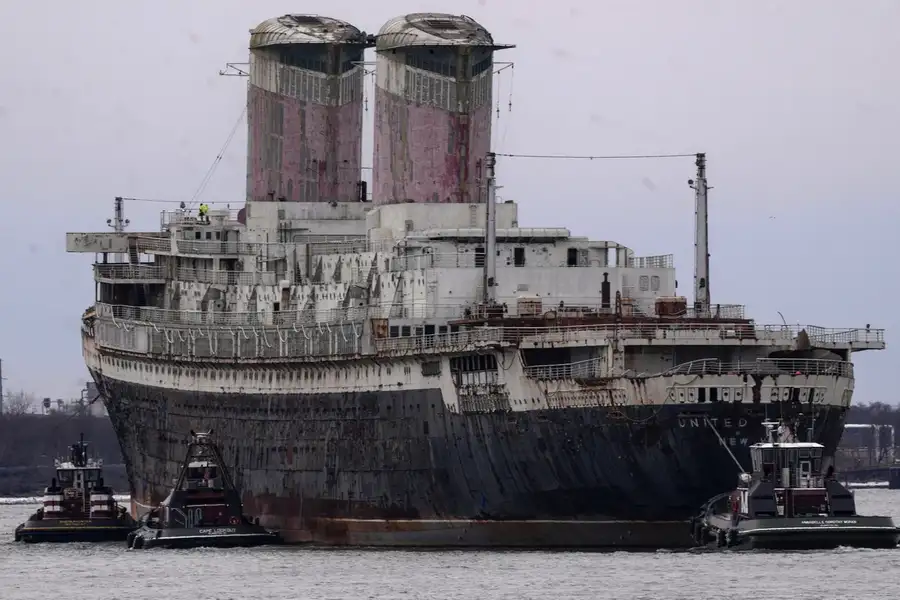
Washington DC: The SS United States, once celebrated as the fastest ocean liner in the world, has been deliberately sunk off the coast of Florida to become the world's largest artificial reef.
The historic vessel disappeared beneath the waters of the Gulf of Mexico at around 9 pm on Wednesday, following several hours of controlled flooding. The sinking took place approximately 25 miles (40 kilometres) south-west of Destin, Florida.
The operation was part of a $13.5 million project led by Okaloosa County and its contractor. The aim is to transform the former luxury liner into an underwater attraction for divers and fishing enthusiasts while creating a habitat for marine species, including tuna, marlin and swordfish.
A long and emotional farewell
The sinking did not happen as quickly as organisers had initially expected. Although the process was predicted to take as little as an hour, much of the ship remained visible above the water several hours after the operation began.
Workers had filled 128 fuel and lubricant tanks with water to help the vessel descend evenly and settle on the seabed. The process took longer than anticipated because of the ship's enormous size.
“She is an amazing lady who will not lay down without a fight,” Coleen O’Malley, president of Coleen Marine, the company responsible for sinking the vessel, said before it disappeared beneath the water. “Much like the amazing nation she was named after.”
A record-breaking ocean liner
The SS United States was built in Virginia in 1950 and 1951, with more than 3,000 workers involved in its construction. It made its maiden voyage in 1952, carrying approximately 1,700 passengers, including an Associated Press reporter and Margaret Truman, daughter of then-US President Harry Truman.
Measuring 990 feet (302 metres), the vessel is 108 feet (33 metres) longer than the Titanic. It became famous for its speed, setting a transatlantic crossing record during its maiden voyage.
The ship averaged nearly 41 mph (66 kmph), surpassing the record previously held by Britain's RMS Queen Mary. It achieved the feat despite encountering a powerful storm during the journey, with winds reaching 69 mph (111 kmph).
Over its career, the SS United States crossed the Atlantic more than 800 times and carried several prominent passengers. Hollywood stars Grace Kelly and Elizabeth Taylor travelled aboard the liner, along with US presidents Harry Truman, Dwight Eisenhower and John F. Kennedy. Britain's former King Edward VIII was also among its passengers. A young Bill Clinton travelled on the ship in 1968 while heading to Oxford University.
Its luxurious dining experience was another part of its appeal, with menus featuring dishes such as caviar, roast duckling, smoked ox tongue and calf's head en tortue.
From luxury travel to an underwater attraction
The ship was decommissioned in 1969 after years of service. Attempts to revive it as a hotel and later as part of a cruise line did not succeed.
From 1996 until recently, it remained docked in Philadelphia, with its future uncertain. The artificial reef project has now given the vessel a new purpose, preventing it from being dismantled for scrap.
Before the sinking, organisers removed its two 65-foot (20-metre) smokestacks. These are expected to become part of a new museum dedicated to the ship.
The vessel was also prepared for the operation in accordance with environmental and federal safety regulations. Explosives could not be used to sink it. Instead, workers opened sections of the hull and decks, removed more than 400 portholes and prepared the ship's seawater systems to allow controlled flooding.
What happens to the ship now?
The SS United States is expected to rest in approximately 180 feet (55 metres) of water, with its upper deck around 60 feet (18 metres) below the surface. This depth is intended to make the wreck accessible to recreational divers, including those with less experience.
The site is located near an existing network of more than 500 artificial reefs. It is also close to the USS Oriskany, an aircraft carrier that was deliberately sunk in 2006 and previously held the record for the world's largest artificial reef.
At 911 feet (278 metres), the USS Oriskany is shorter than the SS United States. The proximity of the two wrecks could allow experienced divers to visit both locations on the same day.
“We're trying to be the best diving destination in the world,” said Nick Tomecek, a spokesperson for Okaloosa County.
Susan Gibbs, the granddaughter of the SS United States' designer, described the ship as a symbol of American pride and resilience. She also expressed relief that parts of the vessel had been preserved rather than lost entirely.
Why are decommissioned ships turned into artificial reefs?
Artificial reefs are structures deliberately placed underwater to provide habitats for marine organisms. They can offer surfaces for corals, algae and other marine life to attach to, while creating shelter and feeding grounds for fish.
Decommissioned ships can serve this purpose because their large structures provide extensive underwater spaces. Once properly cleaned and prepared, they can also become attractions for recreational diving and underwater tourism.
However, converting a ship into an artificial reef requires extensive preparation. Fuel, lubricants, hazardous materials and other potential pollutants must be removed to reduce environmental risks. The vessel must also be modified to allow safe access for divers and prevent hazardous materials from remaining trapped inside.
A new chapter for a maritime landmark
The sinking of the SS United States marks the end of its life as an ocean liner but gives it a new role in marine tourism. The project also highlights how historic vessels can sometimes be repurposed rather than dismantled.
Its transformation from a record-breaking passenger ship into an underwater attraction brings together maritime history, tourism and artificial reef development. Whether it becomes one of the world's leading diving destinations will depend on how the site develops and how marine life establishes itself around the wreck.
Published: 12 Nov 2026, 12:51 pm IST


ABOUT THE AUTHOR

Related Topics
Disclaimer: Kindly avoid objectionable, derogatory, unlawful and lewd comments, while responding to reports. Such comments are punishable under cyber laws. Please keep away from personal attacks. The opinions expressed here are the personal opinions of readers and not that of Mathrubhumi.