
Israel’s airstrikes on Iran have triggered a global market shake-up, sending oil and gold prices higher
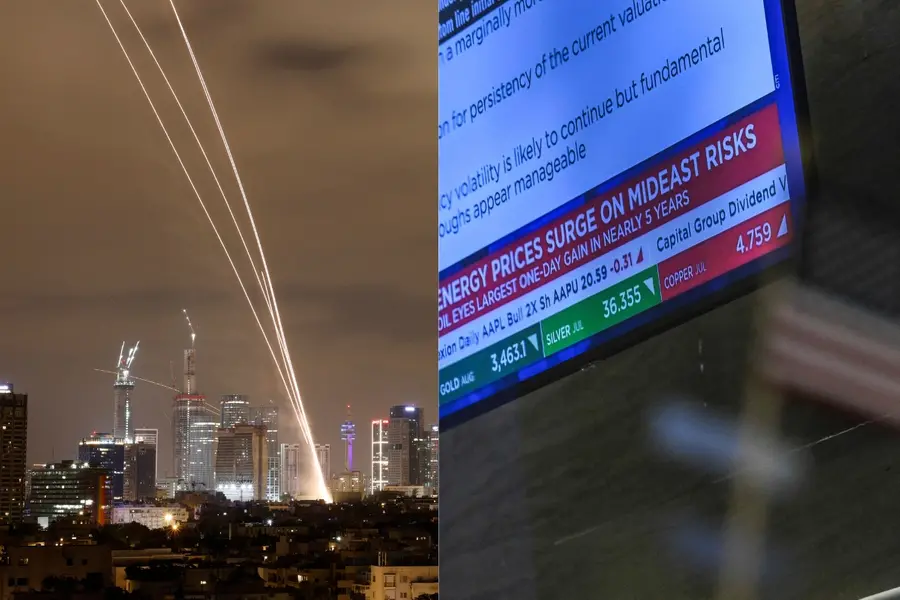
Tel Aviv: The third day of open conflict between Israel and Iran has rattled global markets, as investors seek protection from rising geopolitical risk.
Following Israel’s surprise offensive on Iranian nuclear and military sites on Friday, a chain reaction has begun to unfold across commodities, currencies, and equities.
On Sunday, Israel launched a new round of airstrikes across Iran, hitting key infrastructure targets, including fuel depots and missile launchers, and prompting further missile retaliation from Tehran. Analysts warn that the violence, which began with Israel’s pre-emptive strike on June 13, could spiral into a prolonged and unpredictable regional war.
Oil prices surge on supply fears
One of the most immediate economic consequences of the escalating conflict has been the surge in oil prices. Iran, the world’s ninth-largest oil producer in 2023, is seen as a critical node in the global energy supply chain. Investors fear that any sustained disruption in Iranian oil exports could tighten global supply and push prices even higher.
- As of early Monday in Singapore, US crude rose 2.22% to $74.62 a barrel, after gaining 7.26% on Friday.
- Brent crude, the international benchmark, jumped 2.22% to $75.88, building on Friday’s 7.02% rise.
Gold and dollar see inflows as safe havens
Investors also flocked to safe-haven assets such as gold and the US dollar, which typically perform well during crises.
- Spot gold was up 0.38%, while gold futures for August delivery gained 0.41%, following respective Friday increases of 1.4% and 1.5%.
- The US dollar index climbed 0.3% on Friday, and was up another 0.1% by Monday morning, outperforming other traditional safe currencies like the Swiss franc and Japanese yen.
Analysts referenced the "dollar smile" phenomenon, where the US dollar strengthens in both boom and bust conditions—either as a draw for risk investors or a refuge during turmoil. Despite ongoing debates over de-dollarisation and US debt concerns, the dollar’s dominant position remains unshaken.
Stock markets retreat amid uncertainty
While commodities and currency markets responded swiftly to the conflict, equities saw a more measured reaction. Stocks fell globally on Friday, but showed mixed signs by Sunday night local time.
- The Dow Jones Industrial Average dropped 1.79%, the S&P 500 fell 1.13%, and the Nasdaq Composite declined 1.3%.
- In Europe, the Stoxx 600 index slid 0.89%.
Airline and travel stocks on both sides of the Atlantic were particularly hard-hit, with major carriers suspending flights to Tel Aviv, citing safety risks.
Despite the slide, markets have shown signs of resilience. According to CNBC’s Michael Santoli, the oil price surge merely returned prices to where they were three months ago, after an extended period of declines. He also cautioned that while the geopolitical backdrop remains tense, investors should remain focused on the Federal Reserve’s policy meeting, which concludes Wednesday and could provide clarity on interest rate direction.
Looking ahead
The financial impact of the Israel-Iran conflict may only be beginning. As missile exchanges continue and diplomatic efforts stall, investors are preparing for a period of heightened volatility. Iran’s threats to target US, UK, and French bases if they interfere, and Israel’s stated goal to prevent Iran from achieving nuclear weapons capability, suggest that the crisis could escalate further.
With war tensions rising in the Middle East and a major Fed decision looming, global markets are likely to remain on edge through the week.
Conflict so far
In the deadliest escalation yet between two bitter rivals, Israel and Iran have exchanged waves of missile strikes following Israel’s surprise offensive on Friday that targeted nuclear and military sites deep within Iranian territory.
On Friday, Israel launched airstrikes on more than 100 strategic locations in Iran, including sites at Natanz and Isfahan. Among the dead are IRGC chief Gen Hossein Salami, Iran’s armed forces head Maj Gen Mohammad Bagheri, and at least six nuclear scientists. Though Natanz’s core fuel enrichment plant was undamaged, satellite images confirmed significant external damage.
Over the weekend, Israel continued its offensive, claiming control of Tehran’s airspace and striking over 80 more targets, including Iran’s defence ministry HQ and fuel depots. Iran’s health ministry says 224 civilians have been killed since the start of the conflict.
Iran retaliated with waves of missile attacks, killing 14 people and injuring 390 in Israel. Deadly hits in Bat Yam and Tamra resulted in multiple civilian deaths and heavy destruction.
As the situation worsens, Iran has warned the US, UK, and France not to intervene militarily or risk attacks on their bases and naval forces. The US has helped shoot down Iranian missiles using its air defence systems, while the UK is repositioning jets in the region. UK PM Keir Starmer has not ruled out military support for Israel.
Israeli PM Benjamin Netanyahu claimed the attack was pre-emptive, citing intelligence that Iran could build up to nine nuclear bombs. The IAEA recently ruled that Iran violated the Non-Proliferation Treaty and was withholding cooperation while amassing 400kg of highly enriched uranium.
Iran’s Ayatollah Khamenei vowed “severe punishment”, accusing Israel of deliberately targeting civilians. Nuclear negotiations have stalled, and Iran has refused ceasefire talks while under Israeli bombardment, according to messages passed to Qatar and Oman.
Meanwhile, US President Donald Trump initially denied involvement but later acknowledged Washington was aware in advance. He also reportedly vetoed a plan by Israel to assassinate Khamenei and is now claiming to work on a peace deal behind the scenes at the G7 summit in Canada.
With no signs of de-escalation, the region now stands on the edge of a broader war, involving global powers and deepening instability across the Middle East.
Published: 16 Jun 2025, 07:56 am IST
Related Topics
Disclaimer: Kindly avoid objectionable, derogatory, unlawful and lewd comments, while responding to reports. Such comments are punishable under cyber laws. Please keep away from personal attacks. The opinions expressed here are the personal opinions of readers and not that of Mathrubhumi.
