
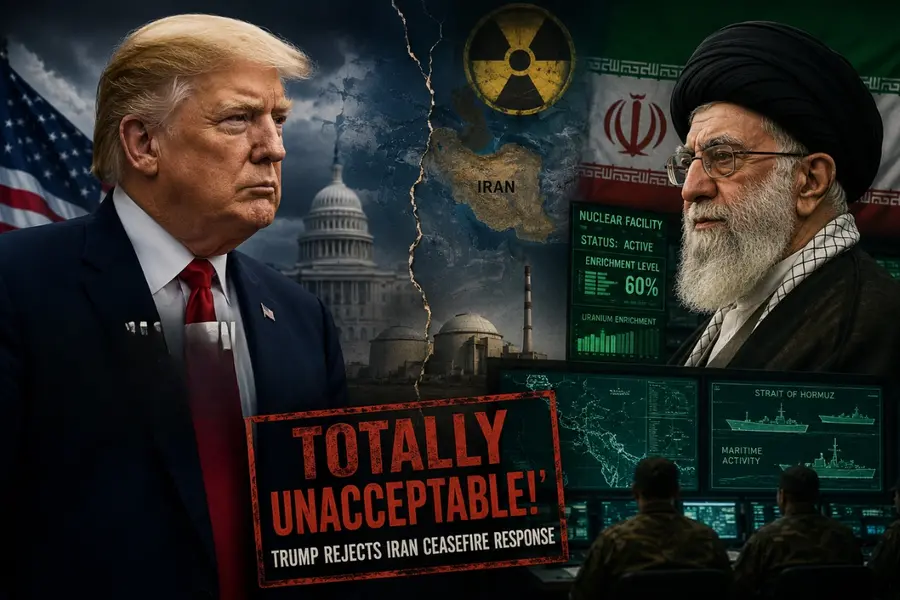
Iran has responded to the latest United States ceasefire proposal through Pakistani mediators, calling for a comprehensive end to the conflict, while US President Donald Trump has rejected the response
Tehran: Iran has responded to the latest United States ceasefire proposal through Pakistani mediators, signalling that it is willing to engage in negotiations but wants discussions to focus on a permanent end to the conflict rather than a temporary pause in hostilities. Iranian state media indicated that Tehran’s position extends beyond the current battlefield dynamics and includes broader regional considerations.
According to the report, Iran is seeking an end to fighting across multiple fronts, including in Lebanon, where Israel is engaged in military operations against the Iranian-backed Hezbollah group. It also wants assurances related to maritime security in key shipping routes, particularly in the Strait of Hormuz, a critical global energy corridor.
Also Read

US proposal and Trump’s rejection
The United States proposal reportedly included provisions aimed at ending the war, reopening the Strait of Hormuz, and rolling back Iran’s nuclear programme. However, US President Donald Trump rejected Iran’s response, describing it as “totally unacceptable” in remarks posted on social media.
Trump also accused Tehran of prolonged obstruction in diplomatic talks. “Iran has been playing games with the United States for 47 years,” he said, adding, “They will be laughing no longer.” He has maintained that while diplomacy remains the preferred path, military action has not been ruled out if negotiations fail.
US officials have echoed this dual-track approach. The US ambassador to the United Nations, Mike Waltz, said Washington is still prioritising diplomacy. “We are giving diplomacy every chance we possibly can before going back to hostilities,” he said in an interview.
Rising regional tensions and drone incidents
The ceasefire discussions come amid escalating tensions across the Gulf region. Several drone-related incidents have been reported in recent days, including an attack that caused a small fire on a ship near Qatar. The United Arab Emirates and Kuwait also reported unidentified drones entering their airspace, with the UAE stating it had intercepted and shot down two drones.
Qatar’s Foreign Ministry described the ship incident as a “dangerous and unacceptable escalation” that threatens maritime trade routes and regional stability. Kuwait’s defence authorities confirmed drone activity but did not specify its origin. No casualties were reported in any of the incidents.
Iran and allied groups, including Hezbollah, have been involved in hundreds of drone and missile strikes since the wider conflict escalated following US and Israeli military actions earlier in the year.
Nuclear programme remains central dispute
A key obstacle in negotiations remains Iran’s nuclear programme. The International Atomic Energy Agency has reported that Iran holds more than 440 kilograms of uranium enriched up to 60 per cent purity, which is close to weapons-grade levels.
Iranian officials maintain that the programme is peaceful. However, they have also emphasised readiness to defend nuclear facilities. Brigadier General Akrami Nia said Iranian forces are on “full readiness” to protect sensitive sites, warning of possible infiltration attempts.
Israel has taken a harder position. Prime Minister Benjamin Netanyahu said in an interview that the conflict cannot be considered over unless Iran’s enriched uranium is removed. He also suggested that physical operations could be used to address the issue.
Russia has proposed a diplomatic alternative, suggesting that enriched uranium could be transferred out of Iran as part of a negotiated settlement, although no agreement has been reached.
Strait of Hormuz and global security concerns
The Strait of Hormuz remains a central flashpoint. Iran has reportedly increased pressure in the waterway since the escalation of hostilities, while the United States has conducted naval operations in response. Washington has also claimed it has intercepted and turned back multiple commercial vessels in recent weeks.
Iran’s Revolutionary Guard has warned that any attacks on Iranian ships would trigger retaliation against US bases in the region. “Any aggression against our oil tankers will be met with a heavy assault,” Iranian military officials have said.
European nations are also discussing maritime security arrangements. France has indicated support for an international mission to protect shipping once conditions stabilise, though Iran has warned that any foreign military presence aligned with US operations would face “decisive and immediate response.”
Long-standing nuclear and regional tensions
The current crisis is rooted in long-standing disputes over Iran’s nuclear programme and regional influence. The programme has been under international scrutiny for years, with Western governments arguing it could enable weapon development, while Iran insists it is for civilian energy purposes.
Tensions escalated further after military strikes and counterstrikes involving Israel, Iran, and US forces in the region. The conflict has since expanded into maritime security threats, drone warfare, and economic pressure through shipping disruptions.
Analysts say the overlapping military, nuclear, and diplomatic dimensions have made the conflict one of the most complex geopolitical crises in recent years, with no immediate resolution in sight.
(With ANI inputs)
Published: 11 May 2026, 06:25 am IST
Related Topics
Disclaimer: Kindly avoid objectionable, derogatory, unlawful and lewd comments, while responding to reports. Such comments are punishable under cyber laws. Please keep away from personal attacks. The opinions expressed here are the personal opinions of readers and not that of Mathrubhumi.