
Sejjil is the first missile of its kind to go beyond testing and drills, entering actual battlefield use
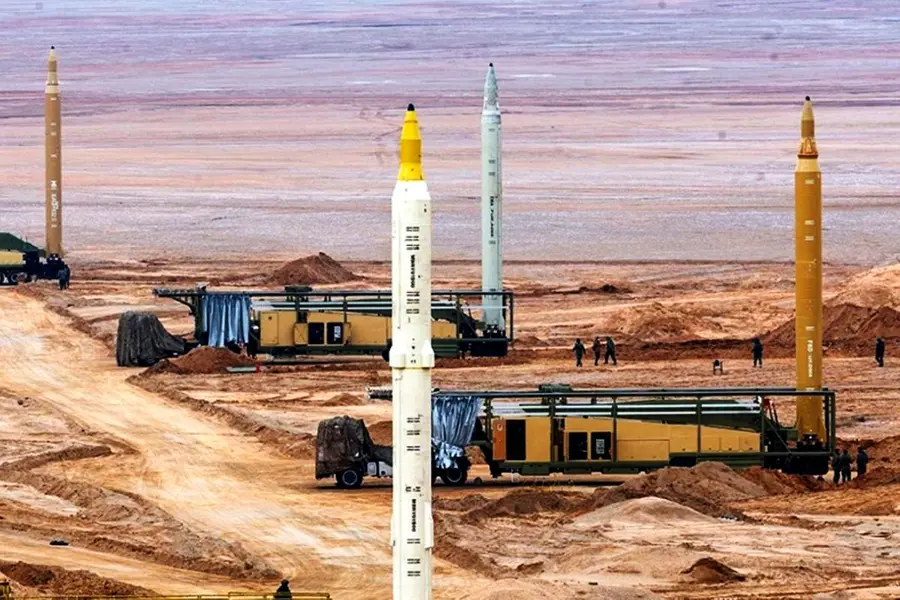
In a major escalation in West Asia, Iran has fired its powerful Sejjil missile -- classified as a Medium-Range Ballistic Missile (MRBM) -- at Israel for the very first time.
This missile, developed by Iran's Islamic Revolutionary Guard Corps (IRGC), uses solid fuel and has two stages, making it one of Iran's most advanced strategic weapons.
Medium-Range Ballistic Missiles (MRBMs) are missiles that can travel between 1,000 to 3,000 kilometers. They are used to strike distant targets quickly and powerfully. MRBMs follow a high-arching path, can carry explosive or nuclear warheads, and are often used for defense or retaliation without entering enemy territory.
Solid-fuel missiles offer key advantages over liquid-fuel ones. They can be launched quickly because they don’t require fueling just before launch, making them ideal for fast response or surprise attacks.
Solid fuel is more stable, allowing easier storage, transport, and handling. These missiles also need less maintenance and are safer to operate, making them more reliable and practical for real-time military use.
The launch was part of Iran's military operation, True Promise 3, which also included a large wave of missiles and drones aimed at key Israeli military and intelligence sites.
According to Iranian experts, this marks a big shift in how Iran uses its missile program. Earlier, it was mostly used to send warnings or show strength.
But now, Iran is clearly using its MRBM capability to carry out precision strikes with greater power and accuracy. This reflects a major change -- from merely threatening to actively using next-generation missile technology in real combat.
Military experts say that Iran's use of the Sejjil missile marks a major step up in its attacks against Israel and could change how the latter and its allies look at threats in the region.
The Sejjil is about 18 meters long and weighs between 22 to 24 tonnes. It runs on solid fuel, which means it can be launched quickly without the need for time-consuming fueling at the launch site. This makes it harder for enemy surveillance systems to detect and stop it in advance.
With a range of up to 2,500 kilometers, the Sejjil can easily hit any location in Israel. It can also reach NATO bases in Cyprus, parts of southern Europe, and United States military sites in the Arabian Peninsula -- all from within Iran's borders.
The missile can carry a powerful warhead weighing up to 650 kilograms -- either a high-explosive or possibly an unconventional one. It is guided by GPS and internal navigation systems, which makes it highly accurate, with the ability to hit within 100 meters of its target. This makes the Sejjil a serious threat to key military and strategic sites.
The IRGC confirmed that the Sejjil missile was launched from deep within Iran's territory. This gave the missile extra protection, as it was fired from areas beyond the range of most Israeli Air Force operations, which have mainly focused on western Iranian missile sites during the current conflict known as Operation Rising Lion.
Launching the missile from such a deep location, combined with its solid-fuel technology that allows for quick firing, gives Iran a major advantage. It can now carry out powerful retaliatory or offensive missile strikes without risking the destruction of its launch site. This kind of ability was earlier seen only in countries that had nuclear weapons.
According to Iran's state media, Press TV, the Sejjil missile struck multiple Israeli military targets, including sites run by Mossad and advanced air defense systems. However, these claims have not yet been fully confirmed with clear images or independent evidence.
The Israeli Defence Forces (IDF) said that most of the incoming missiles were stopped by its Arrow-3 and David's Sling air defense systems. Still, military officials admitted that at least one Sejjil missile reached its target area and caused minor structural damage in central Israel.
This partial success by Iran shows two important things: first, that its missile technology is becoming more advanced, and second, that Israel's layered air defense system is facing increasing pressure. The large number of incoming missiles, along with their improved speed and accuracy, is making it harder for Israel to stop every threat.
The use of a solid-fuel medium-range ballistic missile (MRBM) like the Sejjil in actual combat is a big moment for Iran’s military and missile experts. It proves that years of work on developing homegrown technology is paying off. Unlike older missiles such as the Shahab series that used liquid fuel and needed more time and preparation before launch, solid-fuel missiles are quicker and easier to fire. This makes them more effective in real battle situations.
More importantly, putting the Sejjil missile into active use means Iran no longer has to rely heavily on fixed launch sites like airbases or bunkers. This gives the country a big advantage in any future large-scale war. The missile can now be launched from different mobile platforms and locations, making it harder for enemies to find and destroy them. This increased flexibility and mobility improves Iran's chances of keeping its missile forces safe and useful during a major regional conflict.
Western intelligence officials say that Iran’s deployment of the Sejjil missile adds a new level of complexity to the region’s defense plans. Because the missile is mobile and can be launched quickly, it makes it harder for countries like Israel to carry out pre-emptive strikes. It also forces the US and Gulf nations to rethink how they design and position their missile defense and early-warning systems.
The Sejjil is believed to use advanced onboard electronics and may include tricks like last-minute movement (terminal phase maneuverability) or decoy systems in its final phase of flight. These features are designed to make it harder for defense systems -- such as THAAD, Israel's Arrow, and the European Sky Shield -- to detect and shoot it down while it is flying through space (exo-atmospheric interception) or just before it hits.
Although Iran insists its missile program is for defense only and not meant to carry nuclear weapons, experts in Israel, the US and Europe are still concerned. The Sejjil's long range, heavy payload, and flight path raise questions about whether it could one day be adapted to carry a smaller nuclear warhead. This has led to renewed attention and debate in key global capitals.
When compared with other missiles in its class, the Sejjil now stands alongside similar medium-range, solid-fuel missiles used by other regional powers -- like India's Agni-II, Pakistan's Shaheen-II, and North Korea's Pukguksong-2. These missiles are key parts of their countries' defense strategies and are designed to act as a strong warning to enemies, including the ability to strike back if attacked first.
However, what sets the Sejjil apart is that, unlike those other missiles which have not been used in actual combat, Iran has now used the Sejjil in a real, high-intensity conflict. This makes it the first missile of its kind to go beyond testing and drills, entering actual battlefield use – a point closely noted by Western military experts and defense planners.
For Israel, the Sejjil missile being used in combat highlights the urgent need to improve its missile defense systems. This has led to growing talk about speeding up the development of the Arrow-4 missile defense program. There is also interest in using new laser-based weapons that could stop missiles early in their flight, during the launch or "boost" phase.
On a bigger global scale, Iran's missile strike may set an example that affects military planning far beyond West Asia. Countries in Europe, Asia, and the Indo-Pacific region may now rethink their own defense strategies. This is especially important as more nations are developing solid-fuel missiles and hypersonic weapons at the same time, making the global missile landscape more complex and challenging.
The author is a defence, aerospace and geopolitical analyst
Published: 20 Jun 2025, 12:27 pm IST
Related Topics
Disclaimer: Kindly avoid objectionable, derogatory, unlawful and lewd comments, while responding to reports. Such comments are punishable under cyber laws. Please keep away from personal attacks. The opinions expressed here are the personal opinions of readers and not that of Mathrubhumi.
