
India, along with major powers like France and the UK, was absent as US President Donald Trump launched his "Board of Peace" to manage postwar Gaza and mediate global conflicts.
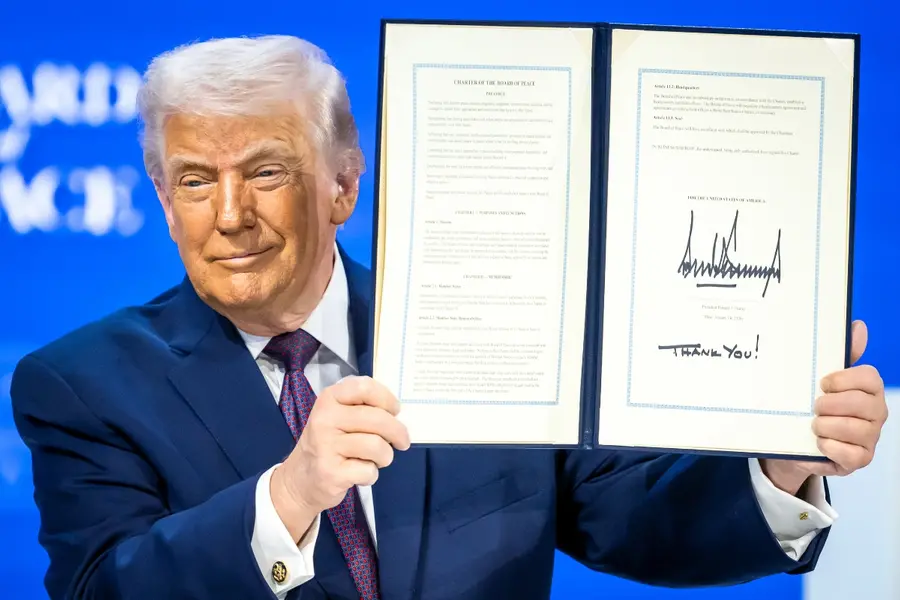
Davos: India remained conspicuously absent Thursday as US President Donald Trump formally inaugurated his "Board of Peace," a high-level international body aimed at managing postwar Gaza and mediating global conflicts.
While Prime Minister Narendra Modi was among dozens of world leaders invited to join the board, he did not attend the signing ceremony held on the sidelines of the World Economic Forum. India's absence mirrored that of other major powers, including France, the United Kingdom, China, and Germany, who also declined to participate in the launch.
Sources familiar with the matter stated that New Delhi has not yet reached a final decision on the invitation. Officials indicated that the government is carefully weighing the strategic implications of the initiative, which touches on highly sensitive geopolitical issues.
India has consistently advocated for a "two-state solution," envisioning an independent Palestine existing alongside Israel within recognised and secure borders.
The "Board of Peace," which Trump envisions as a "bold new approach" to international stability, was officially established under the second phase of a US-brokered ceasefire agreement between Israel and Hamas. While Washington projects the body as a necessary alternative to established institutions, critics suggest it could pose a direct challenge to the authority of the United Nations.
The board's charter defines it as an international organisation designed to "promote stability, restore dependable and lawful governance, and secure enduring peace." The document asserts that durable peace requires the "courage to depart from approaches and institutions that have too often failed."
A Multi-Tiered Governance Structure
Under the charter, the board's top tier consists exclusively of heads of state, with Trump serving as the permanent chairman. The organisation is tasked with overseeing a 20-point plan for Gaza’s transition, which aims to transform the territory into a "deradicalised terror-free zone" and mobilise international resources for large-scale reconstruction.
To operationalise this vision, the White House recently announced an executive board composed of high-profile figures, including:
- Marco Rubio: US Secretary of State
- Tony Blair: Former British Prime Minister
- Jared Kushner: Businessman and Trump’s son-in-law
- Steve Witkoff: US Special Envoy to the Middle East
- Ajay Banga: President of the World Bank
- Marc Rowan: CEO of Apollo Global Management
- Robert Gabriel: US National Security Adviser
This executive body will oversee the National Committee for the Administration of Gaza, a technocratic Palestinian group responsible for the territory’s day-to-day governance.
Global Participation and Hesitation
Despite the absence of major Western and Asian powers, several nations officially joined the board on Thursday, including Argentina, Armenia, Azerbaijan, Bahrain, Belarus, Egypt, Hungary, Kazakhstan, Morocco, Pakistan, Saudi Arabia, the United Arab Emirates, and Vietnam.
Meanwhile, a substantial number of countries, including Russia, Turkiye, Ukraine, Italy, and Slovenia, remain non-committal.
Diplomatic observers note that the board’s "pay-to-play" structure, where a $1 billion contribution reportedly secures a permanent seat, and its potential to bypass traditional U.N. frameworks, have contributed to the cautious response from many veteran world powers.
With inputs from PTI
Published: 22 Jan 2026, 05:37 pm IST
Related Topics
Disclaimer: Kindly avoid objectionable, derogatory, unlawful and lewd comments, while responding to reports. Such comments are punishable under cyber laws. Please keep away from personal attacks. The opinions expressed here are the personal opinions of readers and not that of Mathrubhumi.
