
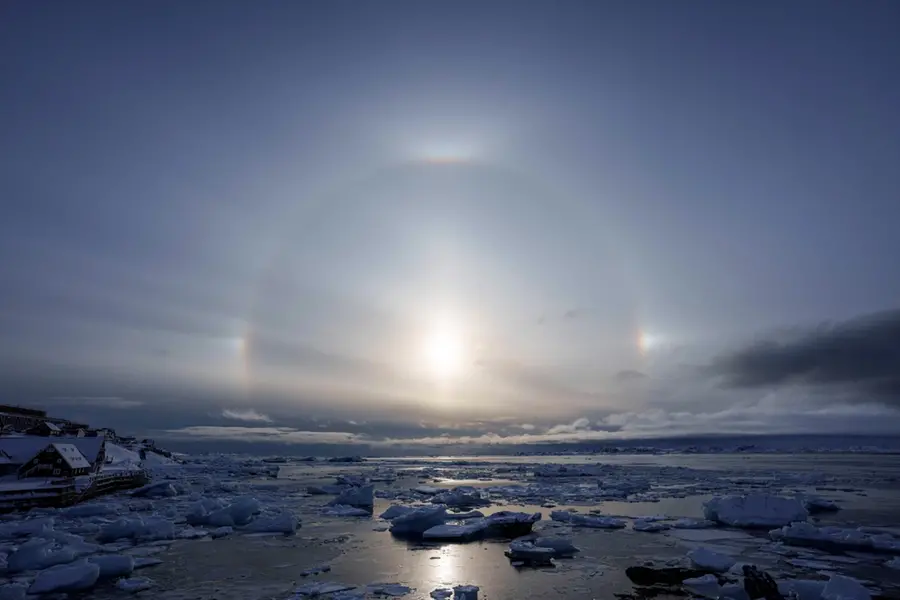
Greenland, a self-governing territory under Danish rule and recently sought after by former U.S. President Donald Trump, is set to hold legislative elections on Tuesday. The vote could provide a clearer timeline for independence, a goal supported by the majority of the island's population.
Trump, who had expressed strong interest in acquiring the vast Arctic region "one way or another," made attempts to influence the election until the last moment. His actions were met with a mix of surprise, rejection, and limited enthusiasm among Greenland’s 57,000 residents.
"He's brought Greenland back into international focus, which is beneficial in a way," said Nuuk resident Hans Kaali Davidsen, speaking under the city’s glacial rainfall. However, he added, "Trump himself—given how he's handling politics in his own country and the state of affairs in the U.S.—is not someone we want here."
In the lead-up to the election, debates primarily centred on key domestic issues such as healthcare, education, and Greenland’s future relationship with Denmark, which continues to oversee its foreign affairs, defence, and monetary policies.
Here is an in-depth look at the country through facts and figures.
Population and major settlements
Despite its enormous landmass, Greenland has a relatively small population of 56,699 people. The capital, Nuuk, is the most populous city with 19,880 residents, followed by Sisimiut (5,412), Ilulissat (4,963), Qaqortoq (3,047), and Aasiaat (2,951). These settlements are scattered along the coast, as the island’s interior is largely covered by an ice sheet that makes up around 80% of its total area.
Economy: Fishing, tourism, and mining potential
Greenland's economy is heavily dependent on its natural resources. Fishing accounts for about 90 percent of the country’s exports, with hunting still playing a crucial role in food security and local income. Traditional hunting practices involve the capture of seals, whales, reindeer, and musk ox, which remain essential to Greenlandic culture and sustenance.
Tourism is an emerging sector, with over 96,000 international passengers passing through the country’s airports in 2023, marking a 28 percent increase from 2015. Visitors are drawn to Greenland’s spectacular icebergs, fjords, and unique Arctic wildlife.
The workforce is largely employed in government jobs, which account for more than 40% of employment. Other key sectors include fishing, hunting, and agriculture (15 percent), wholesale trade (11 percent), construction (8 percent), and transportation (7 percent).
A land rich in natural resources
Greenland is believed to be rich in valuable minerals and energy resources. The island holds deposits of zinc, lead, iron ore, coal, molybdenum, gold, platinum, uranium, copper, nickel, and rare earth minerals. Additionally, the country’s vast hydropower potential and possible reserves of oil and gas have attracted international interest, particularly from economic powerhouses like the United States and China.
Economic dependency on Denmark
Despite its resources, Greenland relies heavily on financial support from Denmark. In 2023, Denmark provided an annual block grant of 4.144 billion kroner ($614.4 million), which constituted about 50 percent of Greenland’s government revenue and 20 percent of its gross domestic product (GDP). This financial dependence remains a key factor in discussions about Greenland’s autonomy and future economic prospects.
Political structure and leadership
Greenland is an autonomous territory within the Kingdom of Denmark. The country’s head of state is King Frederik X of Denmark, while the government is led by Prime Minister Múte Bourup Egede, who heads the Naalakkersuisut, Greenland’s executive body. The Inatsisartut, Greenland’s parliament, consists of 31 elected members representing various political parties.
Political landscape
Greenland’s political scene is shaped by several influential parties. In the most recent elections, the left-wing Inuit Ataqatigiit (United Inuit) secured the largest share of votes with 36.6 percent (9,933 votes), earning 12 seats in parliament. The centre-left Siumut (Forward) followed with 29.5 percent (7,986 votes), securing 10 seats. Other key parties include Naleraq (12 percent, 4 seats), Demokraatit (9.1 percent, 3 seats), and Atassut (6.9 percent, 2 seats).
A country of ice and vast wilderness
Greenland covers a staggering 2.16 million square kilometres (836,330 square miles), making it the 12th-largest country by area. However, much of this territory is covered by an ice sheet, which plays a crucial role in global climate regulation. With its stunning landscapes, rich cultural heritage, and untapped economic potential, Greenland continues to be a focal point for geopolitical and environmental discussions.
(Agency inputs)
Published: 11 Mar 2025, 03:40 pm IST
Disclaimer: Kindly avoid objectionable, derogatory, unlawful and lewd comments, while responding to reports. Such comments are punishable under cyber laws. Please keep away from personal attacks. The opinions expressed here are the personal opinions of readers and not that of Mathrubhumi.
