
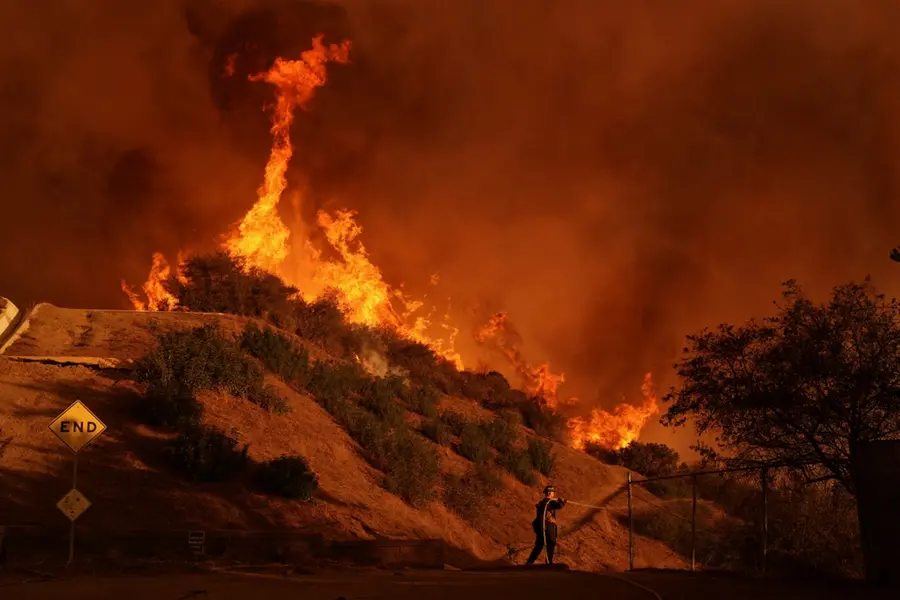
Los Angeles, United States: Firefighters worked tirelessly on Saturday to control the spread of massive wildfires threatening some of Los Angeles’ most iconic landmarks, including the J Paul Getty Museum and UCLA. With intense winds expected to return, the flames could quickly worsen, leaving residents anxious as new evacuation orders were issued.
The flames are particularly fierce in Mandeville Canyon, an area near the Pacific coast home to celebrities like Arnold Schwarzenegger. Helicopters swooped down to dump water, while firefighters on the ground battled the flames with hoses, trying to prevent them from spreading further. Thick smoke poured over the chaparral-covered hillsides as the fire advanced.
Also Read

Christian Litz, CalFire Operations Chief, stated, “We need to be aggressive out there,” emphasising the importance of stopping the fire from moving toward more populated areas.
Evacuations widen as flames spread
Los Angeles County Supervisor Lindsey Horvath described the situation as a “night of unimaginable terror” for residents, as new evacuation warnings affected more communities near the Palisades Fire. Despite some light winds, the National Weather Service warned that stronger Santa Ana winds—often responsible for fueling the fires -- could soon return, further threatening firefighting efforts.
The fire had already crossed major roadways like Interstate 405, putting heavily populated areas like Hollywood Hills and the San Fernando Valley in danger.
In the aftermath of the wildfires, Los Angeles County Sheriff Robert Luna shared that search teams are still combing through the wreckage with cadaver dogs. He urged residents to avoid the disaster areas, saying, "We have people driving up and around trying to get in just to look. Stay away."
The fires have already ravaged over 56 square miles of land, roughly the size of San Francisco, and displaced tens of thousands. The Palisades Fire in particular caused new evacuations Friday evening as it spread to the east.
Destruction of homes, structures
Since the fires began on Tuesday, more than 12,000 structures -- including homes, businesses, and vehicles -- have been destroyed. Preliminary estimates suggest that these wildfires could become the most costly in U.S. history, with damages potentially reaching USD 150 billion, according to AccuWeather.
Volunteer support has been overwhelming, with donation centers like the YMCA in Koreatown and Santa Anita Park receiving more help than they could manage. At Santa Anita, residents who lost their homes searched through donated goods like shirts, blankets, and household items. One such resident, Jose Luis Godinez, shared in Spanish, “Everything is gone. All my family lived in those three houses and now we have nothing.”
As residents return to the remnants of their homes, officials are warning them to stay cautious. Ashes left behind by the fires may contain dangerous substances such as lead, arsenic, and asbestos, putting people at risk if inhaled. Chris Thomas, a spokesman for the Palisades Fire, stressed, "All of that stuff is toxic," urging residents to avoid the area until damage assessments are complete and protective gear is provided.
Investigations, political fallout
In the wake of the fires, investigations into potential leadership failures have begun. California Governor Gavin Newsom ordered officials to investigate why a critical reservoir was out of service, and why some fire hydrants were dry. Los Angeles Fire Chief Kristin Crowley criticized city leaders for not providing sufficient funding or water resources for firefighting efforts, stating, “When a firefighter comes up to a hydrant, we expect there’s going to be water.”
At least 11 people have died in the fires -- five in the Palisades Fire and six in the Eaton Fire. Authorities expect this number to rise as search teams continue their work in devastated neighborhoods. A new center has been set up in Pasadena to help families report missing persons.
While the battle continues, firefighters made significant progress on the Eaton Fire, which has burned more than 7,000 structures. Most evacuation orders for the area have now been lifted.
A city in crisis
Los Angeles Mayor Karen Bass acknowledged the overwhelming scale of the fires, calling the disaster the city’s greatest crisis in decades. Despite the progress made in containing some of the smaller fires, the situation remains dire for the many residents whose lives have been upended by the wildfires.
As the fire season continues, the situation in Los Angeles serves as a stark reminder of the risks and challenges posed by wildfires in California. The fight to control the flames is far from over, and authorities are urging residents to stay alert and follow evacuation orders.
Agency
Published: 12 Jan 2025, 07:42 am IST
Related Topics
Disclaimer: Kindly avoid objectionable, derogatory, unlawful and lewd comments, while responding to reports. Such comments are punishable under cyber laws. Please keep away from personal attacks. The opinions expressed here are the personal opinions of readers and not that of Mathrubhumi.