
Zakir Naik's defence of the Taliban's restrictions on girls' education has drawn condemnation from Afghan activists, Malala Yousafzai's father and Indian scholars.
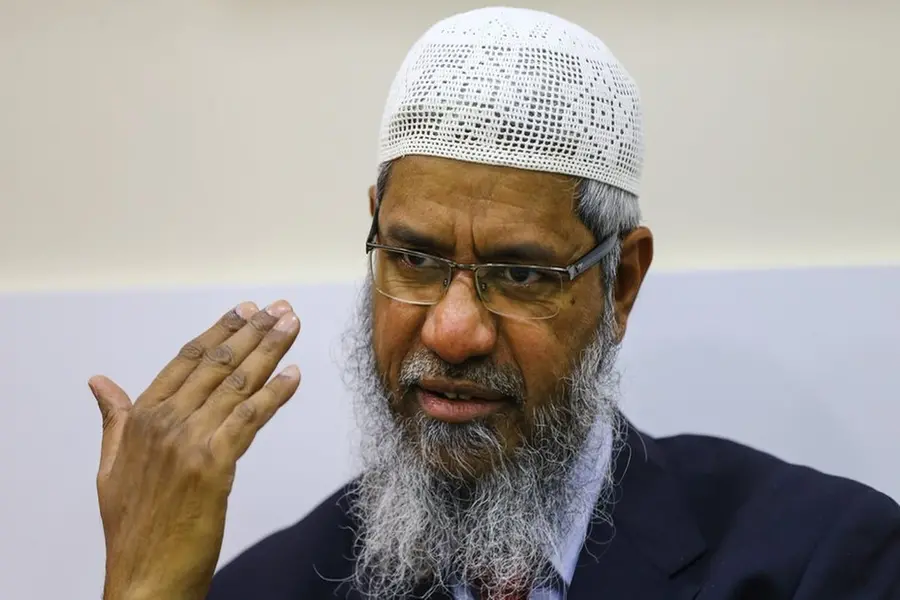
More than 2.6 million Afghan girls have been shut out of secondary education under Taliban rule.
Yet, fugitive Indian preacher Zakir Naik has sparked an international controversy by arguing that the restrictions are not an outright ban but merely a delay driven by security concerns and a lack of female teachers.
Naik's remarks have triggered a wave of criticism from journalists, academics, women's rights advocates and political figures across India, Pakistan and Afghanistan, with several accusing him of attempting to legitimise the Taliban's systematic exclusion of girls and women from education.
In a video that has circulated online, Naik claimed that he had personally spoken to Taliban representatives about the restrictions.
He argued that media reports did not always reflect the situation accurately and suggested that postponing education until suitable teachers and safer conditions were available was not unreasonable.
‘Everything that comes in the media is not true,’ he said, claiming that the Taliban had allowed girls to study up to Class 6 but had kept secondary and higher education on hold because of security concerns.
Naik also cited an alleged shortage of female teachers as a reason for the restrictions. He further claimed that Afghan women continued to pursue advanced studies in Islamic subjects, including Sharia, Arabic and the Quran, and could obtain master's degrees and PhDs.
His explanation, however, has been met with a pointed question from critics: how can Afghanistan produce qualified female teachers when girls themselves are being denied access to education?
Zakir Naik's claims contradict UN findings
The preacher's defence comes against the backdrop of an extensive education ban imposed by the Taliban since its return to power in August 2021.
According to UNICEF, more than 2.6 million Afghan girls have been denied secondary education.
Since September 2021, girls have been barred from formal schooling beyond Class 6, while women were excluded from universities in December 2022.
Afghanistan remains the only country in the world where secondary and higher education are effectively inaccessible to girls and women.
The restrictions have progressively expanded. In March 2022, the Taliban reversed its decision to reopen secondary schools for girls.
The following December, women were prohibited from attending public and private universities.
In December 2024, the restrictions were extended to medical training institutions, shutting women out of courses including nursing and midwifery.
The Taliban had also introduced gender segregation in classrooms and mandated female teachers for girls, further complicating access to education.
Afghans question Naik's explanation
Several Afghan voices quickly challenged Naik's argument, particularly his claim that the shortage of female teachers was responsible for the continued closure of schools.
Azim Shinwari, a Belgium-based former member of the Afghan security forces, questioned the logic behind the explanation.
‘If girls are prevented from studying, how are they supposed to become the qualified teachers Afghanistan needs?’ he asked on X, also demanding evidence for Naik's claims about Afghan women pursuing postgraduate degrees in Islamic studies.
Mariam Solaimankhil, a member of Afghanistan's Parliament in Exile, took a sarcastic swipe at the preacher's argument.
She pointed out the contradiction in blaming a shortage of female teachers when the Taliban had also restricted women's ability to work. ‘Brilliant logic, Doctor!’ she wrote.
Mahbob Shah Mahbob, editor of Afghan International Pashto, questioned the suggestion that the restrictions amounted to a temporary postponement rather than a ban.
‘But if schools are closed, where are those teachers supposed to come from? The sky?’ he wrote, adding that Afghan girls deserved education rather than excuses.
Afghan-born US-based journalist Lina Rozbih also challenged Naik, asking him to experience life under Taliban rule if he genuinely supported its policies.
Malala's father calls defence deeply troubling
Among those condemning Naik's remarks was Ziauddin Yousafzai, Pakistani education activist and father of Nobel Peace Prize laureate Malala Yousafzai.
Describing the preacher's position as deeply troubling and disappointing, Yousafzai argued that presenting an indefinite prohibition as a temporary delay did not make it any less damaging.
He also questioned the argument that Afghanistan lacked female teachers, pointing out that Naik had offered no credible explanation for how that shortage could be addressed while girls remained excluded from schools.
Yousafzai warned that such justifications risked providing religious legitimacy to the Taliban's restrictions on Afghan women.
Indian scholars question Malaysia's support for Zakir Naik
The backlash also reached India, where Islamic scholar A Faizur Rahman questioned why Naik still enjoyed considerable support in Malaysia despite his controversial views.
Tagging Malaysian Prime Minister Anwar Ibrahim, Rahman expressed surprise at the preacher's standing in the country and questioned the government's decision to allow him to remain there.
Indian historian S Irfan Habib also targeted the Malaysian leadership, remarking on what he described as Anwar Ibrahim's generosity towards Naik.
YouTuber and historian Ruchika Sharma joined the criticism, describing the Taliban's restrictions on women's education as among the gravest human rights violations in the world.
Why is Zakir Naik in Malaysia?
Naik left India in 2016 amid allegations that his speeches had inspired one of the terrorists involved in the Dhaka cafe attack. He has denied the allegations.
He subsequently faced cases involving alleged money laundering, unlawful activities and the promotion of religious hatred. Indian authorities have sought his extradition, but those efforts have so far been unsuccessful.
Naik sought asylum in Malaysia in 2017 and later obtained permanent residency.
The controversy surrounding his latest remarks comes as the Taliban's education restrictions enter their sixth year in 2026. No timeline has been announced for reopening secondary schools and universities to Afghan girls and women.
The consequences could extend well beyond the present generation. A separate UNICEF assessment published in April warned that Afghanistan could lose up to 20,000 female teachers and 5,400 healthcare workers by 2030 if restrictions on education and employment continued.
That warning also exposes the contradiction at the heart of Naik's argument. A country cannot address a shortage of qualified female teachers while simultaneously denying girls the opportunity to become educated professionals.
Published: 31 Oct 2026, 12:26 pm IST


ABOUT THE AUTHOR

Related Topics
Disclaimer: Kindly avoid objectionable, derogatory, unlawful and lewd comments, while responding to reports. Such comments are punishable under cyber laws. Please keep away from personal attacks. The opinions expressed here are the personal opinions of readers and not that of Mathrubhumi.