
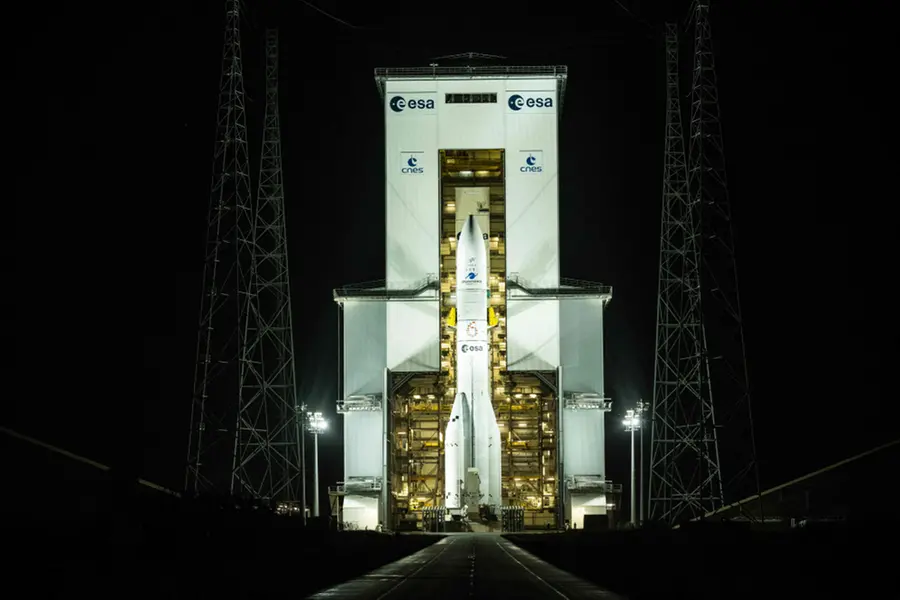
Kourou: Minutes before its scheduled launch on Monday, Europe's new heavy-lift rocket, Ariane 6, was grounded due to an "anomaly" detected on the ground.
This delay marks the latest in a series of setbacks for the rocket, as Europe aims to secure independent access to space in light of a surprising thaw in relations between Moscow and Washington.
"An anomaly was detected... a valve was found to be dysfunctional on one of the pipes that refuel the launcher," said Ariane chief David Cavailloles.
The launch was set to take place from Europe's spaceport in Kourou, French Guiana at 1:24 pm (1624 GMT) on Monday.
Although scattered rain had been reported in Kourou, the team on the ground had given the green light up until minutes before the scheduled liftoff.
"The only possible decision now is to postpone the launch," Cavailloles stated.
"I have no doubt that we will have another flight again soon," he added.
This mission holds particular importance as Europe strives to reduce its reliance on the United States for security, while the European space industry faces increasing competition from Elon Musk's SpaceX.
The rocket was intended to deploy a French military satellite into orbit at an altitude of approximately 800 kilometers (500 miles) above Earth.
Europe has been unable to rely on Russia's Soyuz rockets since the invasion of Ukraine in 2022, and with the retirement of the Ariane 5 in 2023, the Ariane 6 mission carries greater symbolic weight. This is especially true after the Trump administration's unexpected rapprochement with Russia, which has led European nations to tighten their ties.
"Europe must ensure its own security," ESA space transportation director Toni Tolker-Nielsen told a press conference in Kourou before the postponement was announced.
"We must be united," Cavailloles said, stressing the importance of "not depending on anyone else" to launch satellites "in today's world".
The space industry has been experiencing major upheaval -- and more is expected after SpaceX's billionaire founder Elon Musk recently became a prominent advisor to Trump.
"The concept of strategic autonomy, once mocked as a French whim, is at the heart of the Europe of tomorrow," France's research minister Philippe Baptiste told local media.
"The number of launches has exploded -- not only American, but also Chinese," said French General Philippe Steininger, a consultant at the space research institute CNES.
Initially planned for December, the Ariane 6 mission was delayed until February 26 and then to March 3. The next launch date is not yet known.
The mission is to take the CSO-3 satellite into space. CSO-3 will complete a network of three French military imaging satellites, with the first two launched in 2018 and 2020 on Soyuz rockets.
The satellites have "orbiting cameras that take images in both visible and infrared light all over the globe, which is very important for military operations," Michel Sayegh, the head of the French government's armament agency DGA, told AFP.
Given the military role of the satellite, strict security precautions were taken to limit access at the spaceport on the northern coast of South America, with French fighter jets deployed to patrol the surrounding skies.
Europe's smaller Vega-C launcher was earlier grounded for two years due to an accident that resulted in the loss of two satellites, only resuming flights in December 2024.
The mishap left Europe without a way to launch satellites into orbit for a year, following delays to Ariane 6 and the end of cooperation with Russia.
Europe has only a handful of military satellites, compared to the hundreds of the United States and China. AFP
Published: 04 Mar 2025, 06:18 am IST
Related Topics
Disclaimer: Kindly avoid objectionable, derogatory, unlawful and lewd comments, while responding to reports. Such comments are punishable under cyber laws. Please keep away from personal attacks. The opinions expressed here are the personal opinions of readers and not that of Mathrubhumi.
