
While Macron aims to pivot toward equal partnerships and announced a $27 billion investment, the incident has fueled scepticism regarding his "Pan-Africanist" claims.
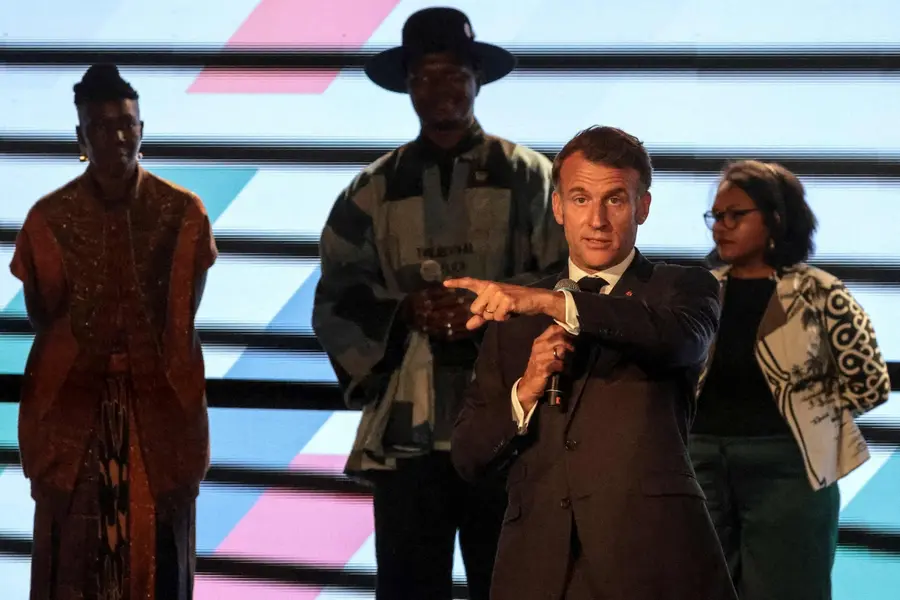
Dakar (Senegal): French President Emmanuel Macron is contending with a wave of condemnation after he disrupted a panel at the Africa Forward Summit to demand silence from attendees, an act critics have characterised as paternalistic.
Macron took to the stage to reprimand the audience for a "total lack of respect," asserting that the noise was hindering presentations by young entrepreneurs and artists. The confrontation occurred shortly after Macron had referred to himself as a "Pan-Africanist" during a press briefing.
The summit was designed to highlight France’s revamped continental strategy, a transition from a dominant colonial legacy toward what Paris frames as a "partnership of equals." On Tuesday, Macron reinforced this shift by announcing a $27 billion investment targeted at African agriculture, energy, and artificial intelligence.
However, footage of Monday's tense exchange circulated rapidly on social media, eliciting a polarising response of praise, ridicule, and sharp rebuke. Visibly irritated by the ambient noise, Macron walked onto the stage, took the microphone from a speaker, and declared his intent to "restore order." Speaking in English, he scolded the crowd for speaking over the panellists.
While some in the room applauded, others found the display demeaning. Thierno Mbaye, a history student at a university in Dakar, Senegal, questioned the double standard of the interaction.
"Just imagine what would happen if an African leader did the same thing in America or Europe," Mbaye told The Associated Press. "He acted like a schoolteacher scolding children."
The reaction in France was similarly critical. Daniele Obono, a legislator for the left-wing France Unbowed party, suggested in a post on X that Macron's behaviour reflected an inescapable colonial mindset.
"It's stronger than him: as soon as he sets foot on the African continent, he can't help but behave like a coloniser," Obono wrote.
Geopolitical Shifts and Military Retreats
The Africa Forward Summit is scheduled to conclude on Tuesday with a joint declaration signed by 30 heads of state. It takes place against a backdrop of deteriorating relations between France and several of its former colonies in West Africa.
For decades, Paris maintained a policy known as Françafrique, exerting significant military and economic influence through the stationing of thousands of troops. Following sustained opposition from local leaders who labelled the approach heavy-handed, France has largely withdrawn. The final French forces exited Senegal in July.
Macron’s claim to Pan-Africanism, an ideology centred on African unity and the eradication of colonial influence, has proven particularly controversial given France's history.
"Pan Africanism is not a brand, Mr Macron, neither is it a diplomatic posture," Togolese activist Farida Nabourema wrote in an open letter. "It is a political philosophy that said no to everything France spent three centuries saying yes to: slavery, colonialism and neocolonialism."
Beverly Ochieng, a senior analyst at Control Risks, observed that Macron appears to be pivoting toward East Africa to escape the diplomatic failures of the West. She noted that his rhetoric raises doubts about whether France seeks a true partnership or is merely employing convenient political branding. Neither the French Foreign Ministry nor the presidency offered immediate comment.
On Tuesday, Macron attempted to soften the tone, stating that Paris would respect the independence of every African nation. "Sovereignty and autonomy is shared, and your success is our success," he remarked.
Countering Global Influence
Alioune Tine, founder of the Afrikajom Centre, suggested that Macron’s "true Pan-Africanist" label might be a calculated strike against Russia, which has increased its security presence in West Africa at France’s expense.
"When Macron describes himself as the 'true' pan-Africanist, it is also a subtle response to the pro-Russian pan-Africanist voices online, which French officials tend to view as inauthentic or politically manipulated," Tine said.
Tine argued that while Western relations with Africa are fundamentally paternalistic, Macron has attempted to break from the colonial past through a more informal diplomatic approach.
Data suggests some success in this regard; an Ipsos survey conducted in nine African nations prior to the summit found that 74% of respondents viewed France positively, with the highest approval ratings among youth and in English-speaking regions. Macron, the first French president born after the end of the colonial era, has vowed to fundamentally reset these ties since taking office in 2017.
With inputs from AP
Published: 13 May 2026, 03:14 pm IST
Related Topics
Disclaimer: Kindly avoid objectionable, derogatory, unlawful and lewd comments, while responding to reports. Such comments are punishable under cyber laws. Please keep away from personal attacks. The opinions expressed here are the personal opinions of readers and not that of Mathrubhumi.
