
The death of Oseguera Cervantes raises questions about the future of the Jalisco New Generation Cartel.
The Mexican military has killed Nemesio Oseguera Cervantes, the leader of the Jalisco New Generation Cartel (CJNG) and one of the United States' most wanted fugitives, in a major operation in Jalisco state on Sunday. The killing of Oseguera Cervantes, also known as “El Mencho,” marks the highest-profile blow to Mexico's drug cartels since the recapture of Joaquín "El Chapo" Guzmán, the former head of the Sinaloa Cartel, a decade ago.
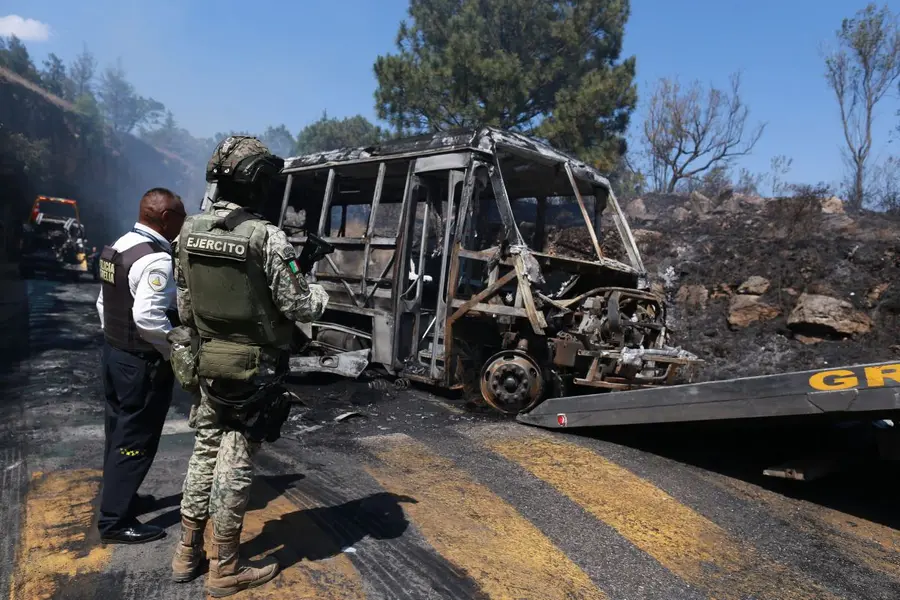
Oseguera Cervantes, 59, was killed during an attempt to capture him, which sparked a violent retaliation from his cartel. Following his death, cartel members unleashed widespread violence across Mexico, blocking roads in 20 states with burning vehicles. In Guadalajara, Jalisco’s capital and Mexico's second-largest city, residents locked themselves indoors, and schools were closed as security forces went on high alert. Even Guatemala reinforced its border security with Mexico.
The death of "El Mencho" may give the Mexican government an advantage in its dealings with the United States, which has pressured Mexico to show more decisive action against drug cartels. The Trump administration had previously threatened tariffs or unilateral military action if Mexico failed to curb cartel violence.
El Mencho’s Criminal Legacy
Oseguera Cervantes, originally from Michoacán state, had a long history of ties to organised crime, which began in the early 1990s. After serving a prison sentence in the U.S. for heroin trafficking, he quickly rose through Mexico's criminal ranks. In 2009, he founded the Jalisco New Generation Cartel, which became one of Mexico's most powerful and violent criminal organisations, trafficking cocaine, methamphetamines, fentanyl, and migrants to the U.S. The CJNG gained notoriety for its brutal tactics, including the use of drones and improvised explosive devices.
ALSO READ | Who was El Mencho? From farm boy to Mexico’s most wanted drug lord
The cartel became infamous for its attacks on Mexican security forces, including the downing of a military helicopter in 2015 and an assassination attempt on Mexico City’s Police Chief Omar García Harfuch in 2020.
The Operation and Fallout
The Mexican Defence Department reported that a joint operation involving the Mexican Air Force and special forces targeted Oseguera Cervantes in the southern part of Jalisco. The cartel mounted a counterattack, resulting in a gunfight that left four cartel members dead, including Oseguera Cervantes. Three other cartel members were injured and later died during transport to Mexico City. The operation also led to the seizure of heavy weaponry, including rocket launchers capable of shooting down aircraft.
The Mexican army confirmed that three soldiers were injured, and two individuals were detained during the operation. Following Oseguera Cervantes' death, a wave of violence swept the country, with cartel members blocking roads and burning vehicles, particularly in Jalisco, where "El Mencho" was based. In response, Mexico’s government placed security forces on high alert, and nearby Guatemala increased border patrols.
Impact on U.S.-Mexico Relations
Oseguera Cervantes was facing multiple charges in the U.S., and the State Department had offered a $15 million reward for information leading to his capture. The Trump administration had designated the Jalisco cartel as a foreign terrorist organisation, and U.S. officials lauded the operation as a significant step in the fight against international drug trafficking.
ALSO READ | Banks burn, vehicles ablaze, flights grounded: Why El Mencho killing plunged Mexico into turmoil
Christopher Landau, former U.S. Ambassador to Mexico, commended the operation via social media, writing, “The good guys are stronger than the bad guys. Congratulations to the forces of law and order in the great Mexican nation.” Former DEA chief Mike Vigil praised Mexico’s efforts, stating that the operation sent a strong message to the U.S. that Mexico was taking action against the cartels, with the majority of the intelligence for the operation coming from the Mexican armed forces.
What’s Next for the Jalisco Cartel?
The death of Oseguera Cervantes raises questions about the future of the Jalisco New Generation Cartel. It is uncertain who will succeed him or whether anyone will be able to fill his shoes. The CJNG operates in at least 21 of Mexico’s 32 states and is involved in trafficking across North America and beyond. The cartel’s operations have seen rapid growth in recent years, but experts believe that Oseguera Cervantes’ absence could slow the cartel’s expansion, especially with the Sinaloa Cartel engaged in its own internal power struggles following the arrest of “El Chapo’s” sons and the capture of Ismael “El Mayo” Zambada.
ALSO READ | Mexico’s most wanted drug lord El Mencho dead, violence erupts across six states
Mike Vigil suggested that Mexico should capitalise on this moment, launching a more effective and intelligence-driven offensive against the cartel. However, security analyst David Saucedo warned that if Oseguera Cervantes’ family or close allies take control, the violence seen in the aftermath of his death could persist. In the worst-case scenario, the CJNG could escalate its tactics, launching “narcoterrorism” attacks similar to those carried out by Colombian cartels in the 1990s, with bombings, assassinations, and other acts of terrorism targeting the government.
While the killing of “El Mencho” represents a significant victory for Mexico’s security forces, the long-term impact on the country’s cartel landscape remains uncertain, with fears of continued violence and retaliation across the nation.
(AP)
Published: 23 Feb 2026, 09:54 am IST
Related Topics
Disclaimer: Kindly avoid objectionable, derogatory, unlawful and lewd comments, while responding to reports. Such comments are punishable under cyber laws. Please keep away from personal attacks. The opinions expressed here are the personal opinions of readers and not that of Mathrubhumi.
