
US shoots down Iranian drone near carrier as maritime tensions rise, even while Washington and Tehran prepare for nuclear talks.
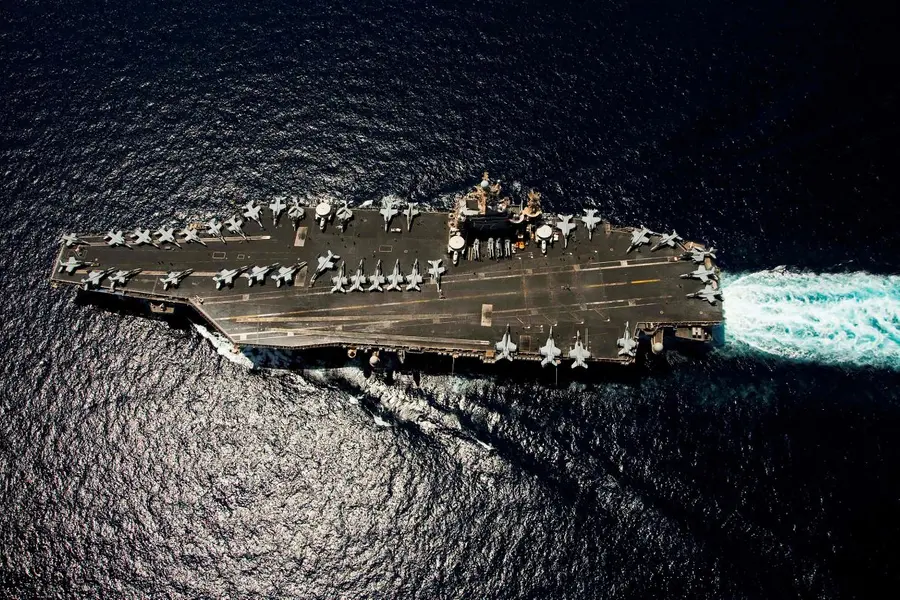
Washington: A US fighter jet shot down an Iranian drone that came close to an American aircraft carrier in the Middle East on Tuesday, US officials said, even as Washington signalled that planned nuclear talks with Tehran remain on track.
White House spokeswoman Karoline Leavitt told Fox News that US envoy Steve Witkoff is still expected “to have conversations with the Iranians late this week”, despite the latest confrontation at sea.
The drone incident marked the second maritime flashpoint between the two countries on the same day. Earlier, Iranian forces attempted to detain a US-flagged oil tanker transiting the Strait of Hormuz, further fuelling tensions in the strategically vital waterway.
Despite the flare-ups, Washington and Tehran have agreed to resume talks after US President Donald Trump repeatedly warned Iran of possible military action, prompting Tehran to caution that it would retaliate against US vessels and bases if attacked.
The United States bombed Iran’s nuclear facilities last summer and has since redeployed a naval battlegroup to the region following Tehran’s deadly crackdown on recent anti-government protests.
Negotiations are now scheduled for Friday. Trump has declined to rule out the use of force, while Iranian President Masoud Pezeshkian has stressed that talks can only proceed in an atmosphere free from threats.
“An F-35C fighter jet from Abraham Lincoln shot down the Iranian drone in self-defense,” US Central Command spokesman Captain Tim Hawkins said in a statement. The aircraft carrier had been deployed to the Arabian Sea last month as part of the US military buildup.
Trump had earlier told Iranians that “help is on its way” during the protests, which were violently suppressed by Iranian authorities. Pezeshkian confirmed on Tuesday that he had authorised negotiations with the United States, provided they were conducted without intimidation, after Trump warned that “bad things” would happen if no deal was reached.
Iran has yet to confirm the venue for the talks but said Turkey, Oman and “some other countries in the region” had offered to host them, adding that the location and timing were “not a complicated issue”.
Israeli Prime Minister Benjamin Netanyahu told Witkoff during a meeting in Jerusalem on Tuesday that Iran “cannot be trusted”, according to a statement from his office.
The United States opposes Iran’s nuclear programme, arguing that it is aimed at developing nuclear weapons, a claim Tehran denies, insisting its activities are limited to civilian purposes. Washington also seeks to restrict Iran’s ballistic missile programme and curb its support for proxy groups across the region.
“I have instructed my minister of foreign affairs, provided that a suitable environment exists — one free from threats and unreasonable expectations — to pursue fair and equitable negotiations,” Pezeshkian said in a post on X.
Iran has repeatedly maintained that any discussions must focus exclusively on the nuclear issue and exclude its missile capabilities or defence policies.
Even as both leaders reaffirmed their commitment to talks, US and Iranian forces remained on alert at sea. US Central Command said Iranian gunboats challenged a US-flagged tanker in the Strait of Hormuz on Tuesday.
Captain Hawkins said two Iranian vessels and a drone approached the M/V Stena Imperative and “threatened to board and seize the tanker.” A US destroyer responded with air support and escorted the ship safely onward.
British maritime security firm Vanguard Tech reported that the tanker was approached by three pairs of armed boats belonging to Iran’s Revolutionary Guards while sailing 16 nautical miles north of Oman. The vessel increased speed and maintained course, and did not enter Iranian waters.
Iran’s Fars news agency, however, claimed that a ship — without identifying its nationality — had entered Iranian territorial waters. “It was therefore warned and immediately left Iranian waters,” the report said.
Protests over rising living costs erupted in Tehran in December before spreading nationwide, evolving into broader anti-government demonstrations that were met with a violent crackdown.
Iranian officials have acknowledged more than 3,000 deaths during the unrest, saying most were members of the security forces or bystanders and blaming the violence on “terrorist acts.”
The US-based Human Rights Activists News Agency has reported at least 6,872 deaths, mostly protesters killed by security forces, while warning that the true toll could be significantly higher. The group said on Tuesday that at least 50,553 people have been arrested in connection with the protests, with detentions still ongoing.
Iranian authorities have accused the United States and Israel of fuelling what they describe as “riots”.
AFP
Published: 04 Feb 2026, 07:31 am IST
Related Topics
Disclaimer: Kindly avoid objectionable, derogatory, unlawful and lewd comments, while responding to reports. Such comments are punishable under cyber laws. Please keep away from personal attacks. The opinions expressed here are the personal opinions of readers and not that of Mathrubhumi.
