
Diplomacy remains stalled amid friction with global allies and concerns over internal Iranian leadership.
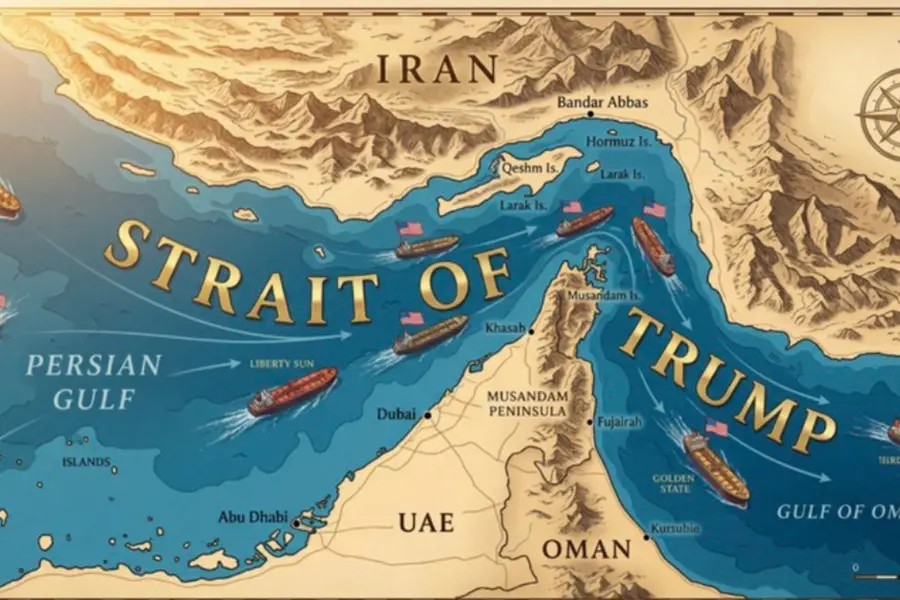
Washington: US President Donald Trump signalled a hardening stance against Tehran on Wednesday, suggesting a U.S. naval blockade of Iran could persist for months while provocatively sharing a modified map on Truth Social that renamed the Strait of Hormuz as the "Strait of Trump."
The president’s comments contributed to a dramatic surge in energy markets, with Brent oil futures climbing 7.6% to $119.69 per barrel—the highest valuation since the onset of the Ukraine conflict in 2022.
During a Tuesday meeting with petroleum executives, the president argued that the maritime cordoning of Iranian ports is a more potent tool than traditional airstrikes. A White House official, speaking on the condition of anonymity, noted that the administration is exploring "steps we could take to continue the current blockade for months if needed and minimise impact on American consumers."
In an interview with Axios, the president utilised blunt language to describe the economic pressure on the Islamic Republic. "They are choking like a stuffed pig," Trump said. "And it is going to be worse for them."
Stalled Diplomacy and Global Warnings
The escalation comes as diplomatic channels remain largely shuttered. President Trump held a telephone conversation with Russian President Vladimir Putin, who reportedly cautioned of "damaging consequences" should the United States and Israel intensify military operations.
The geopolitical friction has extended to America’s traditional allies. On Wednesday, Trump criticised German Chancellor Friedrich Merz, threatening a reduction of U.S. troop levels in Germany. The friction stems from Berlin's refusal to endorse the war or participate in a maritime peacekeeping force. Merz had previously aggravated the president by suggesting that Iran was "humiliating" Washington at the bargaining table.
Simultaneously, U.S. efforts to engage in neutral-site negotiations were hampered as Vice President JD Vance twice cancelled planned trips to Pakistan last week. Administration officials expressed uncertainty regarding which Iranian faction—the diplomatic corps or the Revolutionary Guards—is currently directing the nation’s response following the recent targeted killings of senior Iranian leaders by Israel.
Economic and Humanitarian Toll
The United Nations Development Programme warned Wednesday that the protracted conflict and rising fertiliser costs could force over 30 million people into poverty across 160 nations. "It's development in reverse," UNDP chief Alexander De Croo told AFP.
Within Iran, the rial has collapsed to unprecedented lows. Tehran residents, speaking through intermediaries in Paris, expressed a sense of profound exhaustion. "Every time in recent years that negotiations have taken place, the economic situation of the people has only gotten worse," a 52-year-old architect said anonymously. "The issue is always nuclear. There's no talk about people, the economy or freedom."
Iranian Parliament Speaker Mohammad Bagher Ghalibaf accused Washington of using the blockade to "make us collapse from within" by sowing internal domestic strife.
Fragility on the Lebanese Front
While a maritime stalemate persists, the terrestrial front in Lebanon remains volatile despite a tenuous ceasefire. The Lebanese army reported that Israeli strikes targeted its personnel for the first time since the truce began, resulting in the death of one soldier and the wounding of two others in the south.
Lebanese President Joseph Aoun emphasised that security can only be achieved through the full implementation of the ceasefire terms. Meanwhile, a U.N.-backed study released Wednesday projected that more than 1.2 million Lebanese citizens will face acute hunger as a direct consequence of the recent hostilities.
With inputs from AFP
Published: 30 Apr 2026, 07:44 am IST
Disclaimer: Kindly avoid objectionable, derogatory, unlawful and lewd comments, while responding to reports. Such comments are punishable under cyber laws. Please keep away from personal attacks. The opinions expressed here are the personal opinions of readers and not that of Mathrubhumi.
