
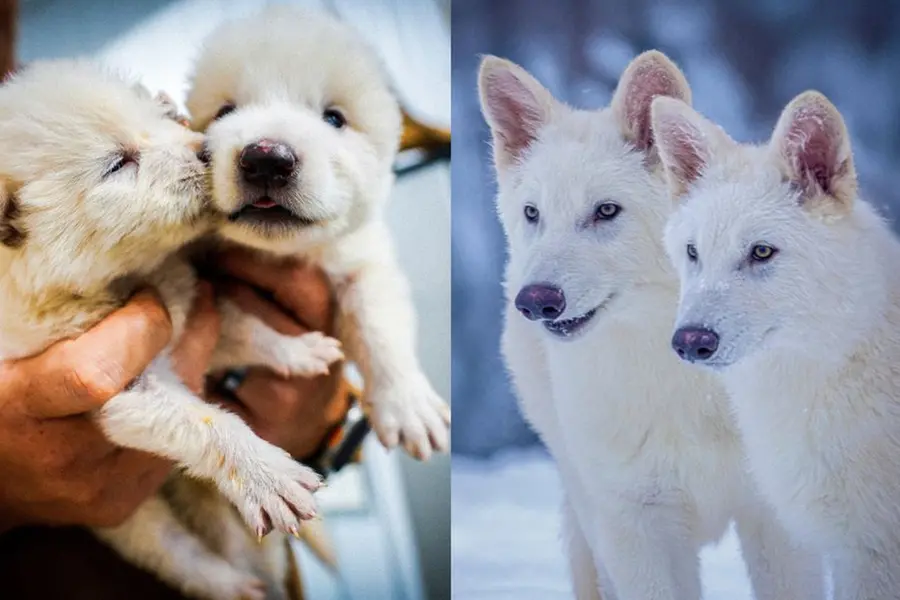
In a stunning breakthrough, scientists at US-based biotech firm Colossal Biosciences have claimed to resurrect a long-extinct species once feared across ancient America — the dire wolf. Using a mix of fossil DNA and advanced gene-editing tools, the company says it has successfully brought the legendary predator back to life, more than 12,000 years after its extinction.
Fossil to future: A bold scientific leap
Colossal revealed that three dire wolf pups — two males and one female — have been born following years of secret research. The animals are not purebred replicas but hybrids created by editing the genome of modern grey wolves, the dire wolf's closest living relative. The pups, named Romulus, Remus, and Khaleesi (after the 'Game of Thrones' character), were created using ancient DNA sourced from a 13,000-year-old tooth and a 72,000-year-old skull.
The scientists sequenced these ancient genomes, identified traits unique to dire wolves — including their distinctive white coats, muscular jaws and thick fur adapted to Pleistocene climates — and made 20 precise edits in 14 genes of grey wolf cells using CRISPR technology. These cells were cloned and implanted into surrogate animals, which reportedly included domestic dogs.
The births mark what Colossal is calling the “world’s first successful de-extinction,” and come amid the company's wider mission to revive extinct species such as the woolly mammoth, dodo, and Tasmanian tiger.
The return of a predator
The dire wolf (Aenocyon dirus), which roamed North America until around 10,000 years ago, has long fascinated scientists and pop culture enthusiasts alike. These powerful predators were larger than today’s grey wolves, with stronger skulls and stockier builds. Popularised globally through the HBO series 'Game of Thrones,' they now exist again — or at least, something very close to them does.
According to Colossal, Romulus and Remus were born on 1 October 2024 and weigh around 80 pounds each, already 20–25% larger than typical grey wolves of the same age. The younger female Khaleesi was born on 30 January 2025. The pups are being raised on a private 2,000-acre facility at a secret location in the US, surrounded by high-security fencing, drones, and 24/7 surveillance. The compound is reportedly certified by the American Humane Society and registered with the US Department of Agriculture.
The animals are fed a diet of beef, venison, horse meat, and specially formulated kibble. Colossal estimates the adult wolves could reach a weight of around 140 pounds.
A mixed reaction from the scientific community
While Colossal frames the achievement as a milestone for conservation and science, not everyone is convinced. Critics have questioned the ethics of creating hybrid animals, the use of surrogate species, and whether the considerable financial resources — Colossal has raised over $435 million since 2021 — could be better spent on protecting living species.
According to CNN, environmental ethicist Professor Christopher Preston noted that Colossal appears to be taking animal welfare seriously, citing the expansive living environment and third-party oversight.
Love Dalén, an evolutionary genomics expert from Stockholm University and an adviser to Colossal, explained that the project didn’t recreate an exact clone of the dire wolf, but rather a “genetic facsimile” using reconstructed traits based on fossil DNA.
In tandem with this effort, Colossal has also produced two litters of cloned red wolves — one of the world’s most critically endangered canid species — using less invasive methods developed through the dire wolf project.
Even Elon Musk is impressed
The resurrection has caught the attention of none other than Elon Musk. Taking to X (formerly Twitter), the tech mogul shared images of the pups and wrote, “Please make a miniature pet wooly mammoth.’ One image spoofed Time magazine with the word “Extinct” crossed out; another depicted the pups lounging on the ‘Game of Thrones’ Iron Throne.
What’s next?
While the revival of the dire wolf is a scientific marvel, it also raises profound questions about the limits of de-extinction. With plans to unveil woolly mammoth calves by 2028 and continued efforts on other lost species, Colossal’s ambitions show no sign of slowing.
CEO Ben Lamm says the same technologies could one day aid human healthcare and biodiversity conservation.
Published: 08 Apr 2025, 08:18 am IST
Disclaimer: Kindly avoid objectionable, derogatory, unlawful and lewd comments, while responding to reports. Such comments are punishable under cyber laws. Please keep away from personal attacks. The opinions expressed here are the personal opinions of readers and not that of Mathrubhumi.
