
Hasina blamed the interim administration for a surge in violence following the killing of Sharif Osman Hadi, whose death last week triggered widespread protests in Bangladesh.
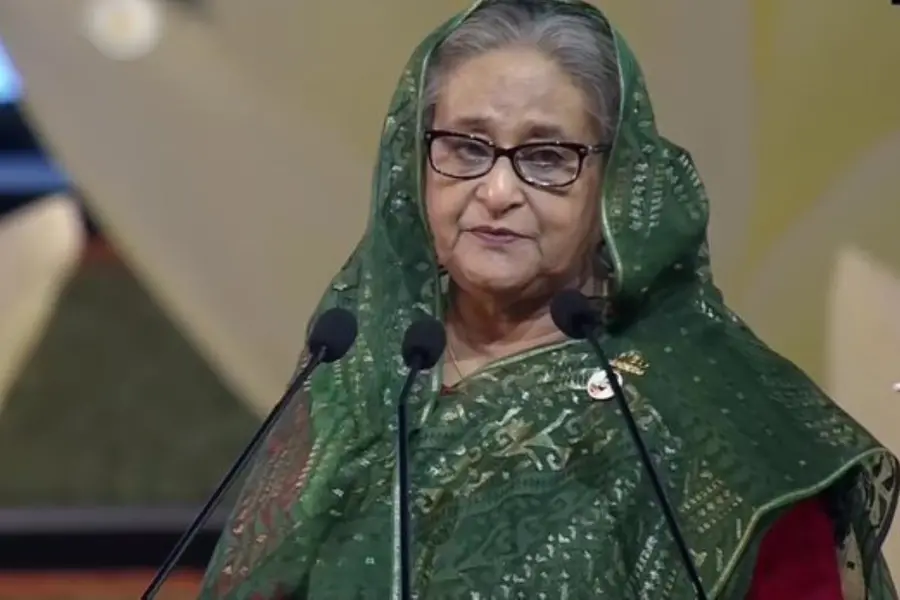
New Delhi: An uneasy calm has settled over Bangladesh’s capital after days of violent protests, as former prime minister Sheikh Hasina launched a fresh attack on the interim government led by Muhammad Yunus, accusing it of presiding over lawlessness, emboldening extremists and damaging relations with neighbouring countries, particularly India.
In an email interview with news agency ANI, Hasina blamed the interim administration for a surge in violence following the killing of Sharif Osman Hadi, convenor of the organisation Inqilab Moncho, whose death last week triggered widespread protests in Dhaka.
Also Read

Hadi, a young activist associated with last year’s July uprising, was shot at close range on December 12 while travelling in a rickshaw in the capital’s Bijoynagar area. He suffered a gunshot wound to the head and was airlifted to Singapore for treatment, but died on December 18. His death prompted demonstrations, with activists gathering at Shahbagh intersection to demand justice.
Hasina said the killing illustrated what she described as a collapse of law and order under the interim government. She claimed that violence, which she said had led to her own removal from power, had intensified since Yunus took charge.
“This tragic killing reflects the lawlessness that uprooted my government and has multiplied under Yunus,” she told ANI. “Violence has become the norm while the interim government either denies it or is powerless to stop it. Such incidents destabilise Bangladesh internally but also our relationships with neighbours who are watching with justified alarm.”
The former prime minister also raised concerns about the treatment of religious minorities, arguing that the unrest was being closely watched in New Delhi. “India sees the chaos, the persecution of minorities, and the erosion of everything we built together,” she said, warning that Bangladesh’s international credibility was at risk.
Hasina went on to accuse the interim administration of accommodating radical Islamist forces, alleging that convicted militants had been released from prison and that extremists had been appointed to senior positions. She also suggested that restrictions on Jamaat-e-Islami could be lifted under Yunus’s leadership.
“He is not a politician and has no experience governing a complex nation,” she said. “My fear is that radicals are using him to project an acceptable face to the international community while they systematically radicalise our institutions from within.”
She argued that this trajectory posed a threat not only to India but to regional stability across South Asia, adding that Bangladesh’s secular political tradition was being undermined.
Hasina also linked the current unrest to growing strains in India–Bangladesh relations, pointing to anti-India protests and the killing of Dipu Chandra Das, a 27-year-old Hindu man who was beaten to death by a mob over alleged blasphemy on December 18. His body was later set on fire, an incident that sparked nationwide outrage and led to the arrest of 10 suspects.
According to Hasina, the interim government had failed to protect minorities and had issued hostile statements towards India. “The strain you are witnessing is entirely of Yunus’s making,” she said, adding, "His government issues hostile statements against India, fails to protect religious minorities, and allows extremists to dictate foreign policy, then expresses surprise when tensions rise."
However, Hasina stressed that ties between the two countries were deep-rooted and would endure beyond the current political turmoil.
Her comments followed the decision by the Indian Visa Application Centre in Chittagong to suspend all visa operations with immediate effect after a security incident amid the unrest. Hasina said India’s concerns were justified, accusing extremists of attacking diplomatic interests and media organisations with impunity.
Bangladesh has seen sustained protests, vandalism and attacks on media buildings in recent weeks, as political tensions intensify ahead of elections scheduled for next year.
ANI
Published: 22 Dec 2025, 08:33 am IST
Disclaimer: Kindly avoid objectionable, derogatory, unlawful and lewd comments, while responding to reports. Such comments are punishable under cyber laws. Please keep away from personal attacks. The opinions expressed here are the personal opinions of readers and not that of Mathrubhumi.