
Eight people were killed after a US Air Force B-52 Stratofortress bomber crashed moments after takeoff from Edwards Air Force Base in Southern California during a routine test mission.
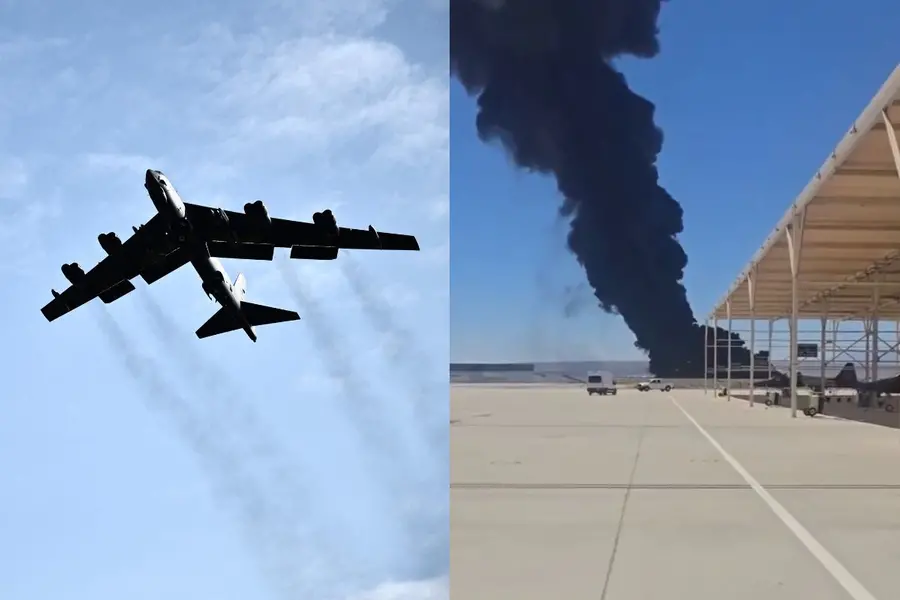
Edwards Air Force Base, California: Eight people were killed when a US Air Force B-52 Stratofortress bomber crashed moments after taking off from Edwards Air Force Base in Southern California on Monday, authorities said.
The aircraft went down at approximately 11:20 a.m. local time while carrying out a routine test mission linked to a radar modernisation programme. The bomber crashed within the boundaries of the sprawling desert installation and erupted into flames, sending a thick column of black smoke into the sky.
Military officials said the victims included a combination of active-duty personnel, government civilians and contractors.
“Today, Edwards Air Force Base experienced a terrible tragedy, and we lost eight great Americans,” Col James Hayes, deputy commander of the 412th Test Wing, told reporters.
Officials said families of those killed were being notified before the identities of the victims are released.
Crash under investigation
The cause of the crash remains unknown and investigators have begun a detailed inquiry into the incident.
Hayes said the aircraft had been supporting the base's radar modernisation programme and crashed immediately after departure. After reviewing available footage, officials concluded the accident was unsurvivable.
According to military officials, a preliminary investigation could take up to 30 days, while a full analysis into the cause of the crash may require six months or longer.
The accident forced the temporary closure of the airfield, with incoming aircraft diverted elsewhere. Visitor access to the base was also restricted as emergency teams worked to contain the fire and secure the crash site. Operations later resumed in stages.
Wreckage left scattered near runway
Aerial images from the scene showed a large scorched area near the runway, with little recognisable wreckage remaining. Emergency vehicles surrounded the crash site as crews battled lingering flames.
Hayes said the crash was "totally contained" within the base perimeter and occurred on the runway area shortly after takeoff.
The base earlier stated that initial indications suggested the accident "was not survivable".
Aircraft was part of radar upgrade programme
The bomber involved in the crash was supporting efforts to modernise the B-52 fleet's radar systems.
In 2025, Boeing delivered a B-52 fitted with a new Active Electronically Scanned Array (AESA) radar to Edwards Air Force Base for testing. The upgraded system is intended to replace the aircraft's ageing radar equipment and improve operational performance.
The Air Force had planned a series of ground and flight evaluations throughout 2026 before making future production decisions. Officials have not confirmed whether the aircraft involved in Monday's crash was the same bomber used in those testing activities.
Expert points to possible flight-control issue
While investigators have yet to identify a cause, aviation safety expert Jeff Guzzetti said the aircraft's rapid descent shortly after takeoff could suggest a serious controllability problem.
Guzzetti, a former crash investigator for both the Federal Aviation Administration and the National Transportation Safety Board, said several scenarios remained possible, including incorrectly configured flight controls following maintenance, a catastrophic engine failure or malfunction of equipment undergoing testing.
“I think it was definitely a controllability issue. Now, whether that was tied to an engine failure, a flight control failure, or some new testing device failure, I’m not sure,” Guzzetti said.
He noted that flight-testing operations carry greater risks than routine missions because aircraft are often operating with new or modified systems.
“A flight test is always riskier than normal operations, so that’s why you have specially trained test pilots, and you should have other safety protocols,” Guzzetti said.
A Cold War-era bomber still in service
The Boeing B-52 Stratofortress first entered service in 1955 and remains one of the longest-serving military aircraft in the world. Nicknamed "BUFF", partly short for "Big Ugly Fat Fellow", the bomber has participated in conflicts ranging from the Vietnam War to more recent operations involving Iran.
Capable of flying at altitudes of around 50,000 feet, the aircraft can carry both conventional and nuclear weapons. Its payload can include hundreds of bombs and dozens of nuclear cruise missiles, while aerial refuelling allows it to conduct extremely long-range missions.
A standard B-52 crew typically consists of five members: an aircraft commander, pilot, radar navigator, navigator and electronic warfare officer.
Key centre for Air Force testing
Edwards Air Force Base, located about 100 miles (160 kilometres) north of Los Angeles in the Mojave Desert, serves as one of the U.S. Air Force's primary centres for aircraft testing and development.
The installation's 412th Test Wing oversees developmental testing of aircraft, weapons systems, software and other military technologies throughout their service lives.
The base also holds a prominent place in aviation history. It was there in 1947 that Air Force test pilot Chuck Yeager broke the sound barrier, reaching Mach 1.05 in the Bell X-1 aircraft.
(With AP inputs)
Published: 16 Jun 2026, 06:20 am IST
Related Topics
Disclaimer: Kindly avoid objectionable, derogatory, unlawful and lewd comments, while responding to reports. Such comments are punishable under cyber laws. Please keep away from personal attacks. The opinions expressed here are the personal opinions of readers and not that of Mathrubhumi.
