
Albanese and Dutton face off in Australia's general election amid sharp divides on energy and trade.
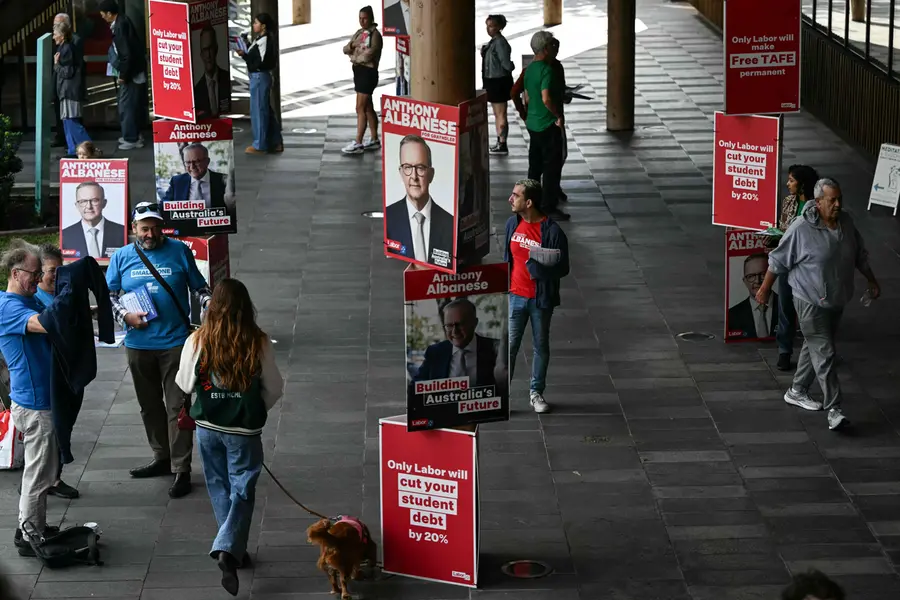
Sydney: Australians are casting their votes in a crucial general election on Saturday, choosing between Prime Minister Anthony Albanese and his conservative challenger Peter Dutton. The campaign has seen intense debates over economic direction, energy policy, and foreign trade, with both leaders presenting sharply contrasting visions for the country.
Both contenders come from working-class backgrounds. Albanese, 62, was raised by a single mother in a government-subsidised flat in inner-city Sydney. He spent his youth caring for his mother, Maryanne, who suffered from rheumatoid arthritis. Dutton, 54, is the son of a bricklayer from suburban Brisbane. He joined the state police after leaving university and briefly worked in a butcher's shop. His time as a drugs squad detective has influenced his hard-line stance on law and order.
Nuclear energy vs renewables: Sharp divide on Australia's power future
Energy policy has emerged as a key battleground. Australia holds vast uranium reserves but has maintained an almost complete ban on nuclear energy since 1998. Dutton has pledged to lift the ban and establish a domestic nuclear power industry, arguing it is the only viable way to cut emissions reliably.
Albanese has taken the opposite stance, investing heavily in solar, wind, and green manufacturing. He has pledged to position Australia as a renewable energy superpower.
US tariffs stir foreign policy tensions
The recent imposition of tariffs on Australia by former US President Donald Trump has also influenced the campaign. Some polls suggest the move has dented Dutton’s support, especially after he described Trump as a "big thinker" with "gravitas".
Both leaders have since adopted a more assertive tone. “If I needed to have a fight with Donald Trump, or any other world leader, to advance our nation's interest, I'd do it in a heartbeat,” Dutton said in April.
Albanese described the tariffs as “economic self-harm” and “not the act of a friend,” adding: “I support free and fair trade. He doesn’t.”
Rising independents and a potential hung parliament
While the election remains a contest between the centre-left Labor Party and the right-wing Liberal Party, growing public disillusionment has boosted support for independents focused on climate change and transparency. Labor had a slight edge in pre-election polling, but a close result could leave the balance of power with a crossbench of 10 or more independents—potentially leading to a minority government.
Voting process and turnout
Australia has enforced compulsory voting since 1924, with turnout consistently above 90 percent. Voters who abstain face a penalty of around Aus$20 (US$13). As part of election day tradition, thousands of polling stations offer barbecued sausages to raise money for local causes, tracked on the website democracysausage.org.
There are 18.1 million registered voters. Over one-third voted early. Polls are open from 8:00 am to 6:00 pm local time.
Voters will elect all 150 members of the House of Representatives for three-year terms. Labor held 77 seats in the outgoing parliament, with the Liberal-National coalition on 54. The Senate, where 40 of 76 seats are up for six-year terms, uses proportional representation. House elections operate via preferential voting, redistributing votes until a candidate secures a majority.
With AFP inputs
Published: 03 May 2025, 07:20 am IST
Related Topics
Disclaimer: Kindly avoid objectionable, derogatory, unlawful and lewd comments, while responding to reports. Such comments are punishable under cyber laws. Please keep away from personal attacks. The opinions expressed here are the personal opinions of readers and not that of Mathrubhumi.
