
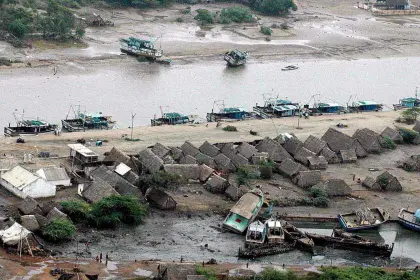
The 20th anniversary of the 2004 Indian Ocean tsunami, the deadliest in recorded history, will be observed next week by survivors and victims’ families. The disaster, triggered by a massive 9.1-magnitude earthquake near Indonesia's Sumatra island, claimed over 220,000 lives across 14 countries, leaving destruction on an unprecedented scale.
The earthquake and tsunami

Combination photo shows survivors walking along a road strewn with debris from the December 26, 2004 tsunami in Aceh | Photo: AFP
On December 26, 2004, at 7:59 am, a 9.1-magnitude earthquake struck off the western coast of Sumatra, Indonesia. The earthquake, caused by the rupture of a 1,200-kilometer (750-mile) faultline between the India Plate and Burma Microplate, unleashed waves over 30 meters (100 feet) high. The epicenter was located 150 miles from Sumatra’s coast at a depth of 30 kilometers (18.6 miles).
Initially measured at 8.8 on the Richter scale, the United States Geological Survey later revised the earthquake’s magnitude to 9.1. The energy released was equivalent to 23,000 Hiroshima atomic bombs, making it one of the most powerful earthquakes ever recorded.
The tsunami waves, traveling at speeds exceeding 800 kilometers per hour (500 mph)—more than twice the speed of a bullet train—spread across the Indian Ocean basin, reaching coastal areas of Indonesia, Sri Lanka, India, Thailand, and nine other nations.
Death and destruction
The tsunami caused the deaths of 226,408 people, according to EM-DAT, a recognized global disaster database. Indonesia was the worst hit, with over 165,708 fatalities, including more than 120,000 deaths in northern Sumatra.
The disaster spread devastation across Sri Lanka, where over 35,000 people perished, while India recorded 16,389 fatalities, and Thailand lost 8,345 lives. Somalia reported nearly 300 deaths, while the Maldives, Myanmar, and Malaysia also experienced significant casualties.
In addition to the tragic loss of life, the tsunami displaced over 1.5 million people. Entire communities were destroyed, leaving hundreds of thousands homeless. The international community pledged $14 billion in disaster relief efforts. Indonesia’s Aceh province saw more than 100,000 houses rebuilt, with reconstruction transforming the worst-hit city, Banda Aceh.
Unpreparedness and lessons learned
Chennai’s Marina beach covered in seawater after being affected by the tsunami | Photo: AFP
At the time, the Indian Ocean basin lacked a coordinated tsunami warning system, exacerbating the disaster's toll. Experts have since attributed much of the devastation to the absence of an alert mechanism. In the 20 years since, over 1,400 global warning stations have been established, significantly reducing warning times to just minutes after a tsunami wave forms.
Despite millions of dollars invested in these warning systems, scientists emphasize that the catastrophic impact of such disasters cannot be completely prevented. The 2004 tsunami served as a wake-up call for improving coastal preparedness, especially in vulnerable regions.
A global reckoning
The tsunami forced a reckoning with the seismic risks of regions along the Pacific "Ring of Fire," an arc of intense tectonic activity stretching from Japan through Southeast Asia. Indonesia, a vast archipelago located within this zone, remains one of the world’s most earthquake-prone countries.
In addition to claiming lives and displacing millions, the 2004 tsunami underscored the need for global cooperation in disaster management. The unprecedented scale of international aid and reconstruction efforts marked a turning point in how the world responds to natural calamities.
Today, ocean scientists credit advancements in monitoring systems with saving lives, though they stress that the impact of future catastrophic tsunamis could still be devastating.
Published: 18 Dec 2024, 01:55 pm IST
Related Topics
Disclaimer: Kindly avoid objectionable, derogatory, unlawful and lewd comments, while responding to reports. Such comments are punishable under cyber laws. Please keep away from personal attacks. The opinions expressed here are the personal opinions of readers and not that of Mathrubhumi.