
The partnership boosts Skyroot’s international presence and strengthens Axiom's supply chain resilience. Vikram-1’s 2025 launch is key, marking a significant step for India's burgeoning space sector and the future of commercial space endeavors.
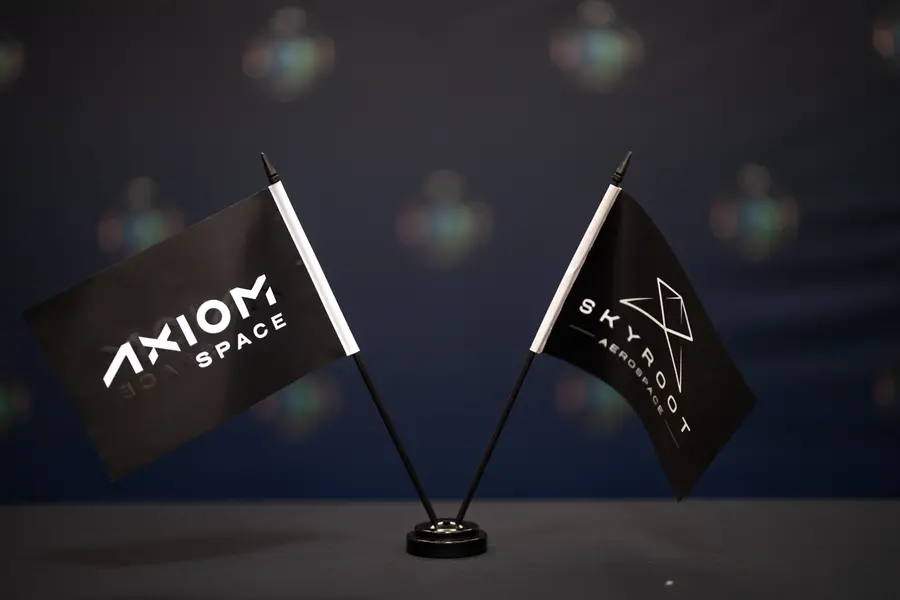
On the same day that Axiom Mission 4 (Ax-4) lofted Group Captain Shubhanshu Shukla and his crewmates toward the International Space Station, India’s launch vehicle start-up Skyroot Aerospace announced a landmark memorandum of understanding with US-based commercial station developer Axiom Space.
The partnership aims to knit together Skyroot’s forthcoming Vikram-1 launch capability with Axiom’s under-construction commercial space station and other low-Earth-orbit (LEO) initiatives, opening a fresh logistics corridor for research payloads, orbital data-centre nodes and future commercial missions.
Under the MoU, Axiom will evaluate Skyroot as a ride-to-orbit provider not only for India’s burgeoning space market but also for international customers who need dedicated or secondary launch opportunities to LEO.
“Enabling greater and equitable access to space, be it for research institutes, startups, or national agencies, is the guiding mantra at Skyroot,” said Pawan Kumar Chandana, co-founder and CEO of the Hyderabad-based company.
Chandana added that the maiden Vikram-1 orbital flight, expected later this year, will be a springboard for “integrated launch and orbital solutions that will shape humanity’s future in space.”
For Axiom, whose private astronaut missions (including Ax-4) are laying the operational groundwork for a commercial successor to the ISS, tapping an Indian small-satellite launcher broadens supply-chain resilience and gives the Houston firm a strategic foothold in South Asia’s rapidly expanding space economy.
“Since the day I visited Skyroot’s facility two years ago, I knew our companies had to work together to define humanity’s future in space. With our shared vision to transform access to space, we look forward to collaborating with Skyroot to serve the growing space ecosystem in India and globally,” said Tejpaul Bhatia, CEO of Axiom Space.
Why this matters
- Second Indian human-spaceflight milestone: Ax-4 marks only the second time an Indian national has flown in space and the first on a private mission, underscoring the importance of commercial pathways alongside ISRO’s Gaganyaan programme.
- Domestic launch capability meets private station market: Pairing Skyroot’s small-lift rockets with Axiom’s private outpost could create an end-to-end Indian-origin supply line for experiments, in-orbit manufacturing and data processing in microgravity.
- Strengthened global supply chain: Axiom’s pursuit of diverse launch suppliers like the US, Europe, the Middle East and now India mitigates schedule risk for its station modules and customer payloads.
- Vikram-1 debut: Skyroot plans its first orbital launch in 2025, carrying commercial nanosats and technology demonstrators.
With India positioning itself as a cost-effective launch alternative and Axiom preparing to transition from ISS attach-modules to an independent station by the early 2030s, the Skyroot-Axiom pact exemplifies the growing mesh of public, private and cross-border partnerships shaping the post-ISS era.
Published: 26 Jun 2025, 05:26 pm IST
Related Topics
Disclaimer: Kindly avoid objectionable, derogatory, unlawful and lewd comments, while responding to reports. Such comments are punishable under cyber laws. Please keep away from personal attacks. The opinions expressed here are the personal opinions of readers and not that of Mathrubhumi.
