
RBI Governor Sanjay Malhotra has said it is too early to conclude how proposed Merchant Discount Rate (MDR) charges on UPI business transactions above Rs 2,000 will be implemented, stressing that the cost of maintaining the payments ecosystem has to be borne by someone.
New Delhi: The Reserve Bank of India (RBI) Governor Sanjay Malhotra has commented on the Centre's proposal to allow Merchant Discount Rate (MDR) charges on certain UPI transactions, saying discussions are still underway and no final decision has been taken on how the costs will ultimately be shared.
The remarks come after the government introduced the Taxation and Other Laws (Amendment) Bill in Parliament. The proposed legislation seeks to remove the current restriction that prevents banks and payment service providers from charging MDR on notified electronic payment methods, including UPI.
Also Read

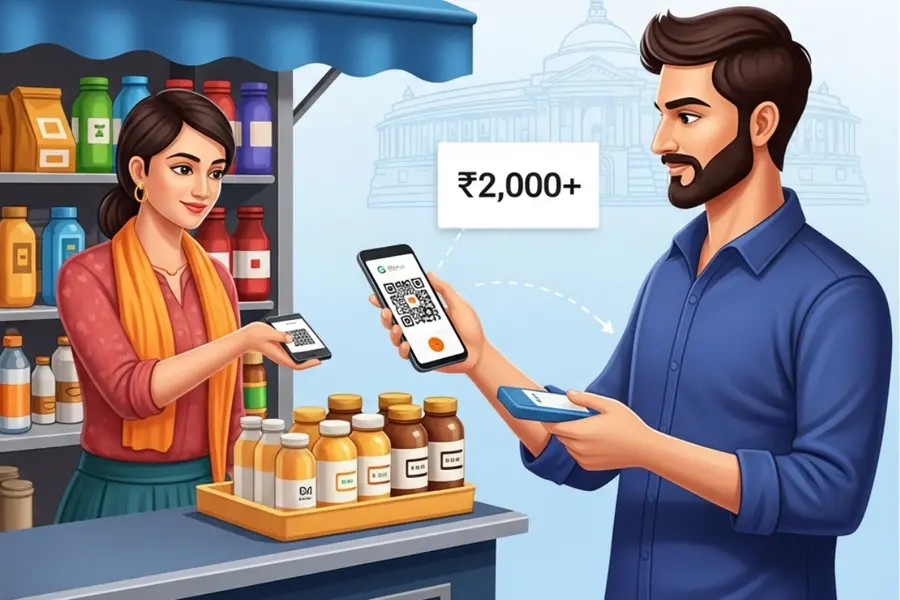
Under the proposal being considered, MDR of 0.25% to 0.4% could be levied only on business (merchant) UPI transactions above Rs 2,000. Person-to-person (P2P) UPI transfers are expected to remain free.
Addressing concerns over whether customers would have to pay extra while making purchases, Malhotra said it is premature to draw conclusions. He noted that maintaining and expanding India's digital payments infrastructure involves costs, which are already being borne somewhere within the financial ecosystem.
He explained that consumers ultimately pay these costs either directly or indirectly through the wider economy, but the exact mechanism will depend on the government's final decision. He added that the priority should remain ensuring continued investment in strengthening the country's public digital payments infrastructure.
According to government estimates, the proposed Rs 2,000 threshold would affect only around 5% of total UPI transactions by volume, although these transactions account for nearly 65% of the total value processed through the platform. This means most everyday payments, such as buying groceries, vegetables, milk or paying for taxis and auto-rickshaws, are unlikely to attract MDR if the proposal is implemented.
Officials have also indicated that many merchants may choose to absorb the charges instead of passing them on to customers. In addition, the government is expected to prescribe a ceiling on the maximum MDR that can be charged to prevent excessive fees.
UPI recorded 23.7 billion transactions worth Rs 29.9 lakh crore in July, underlining its position as India's dominant digital payments platform. The government has not yet announced when the proposed MDR framework, if approved, would come into effect.
What is Merchant Discount Rate (MDR)?
Merchant Discount Rate (MDR) is a small processing fee that banks or payment service providers charge businesses when customers make digital payments using UPI, debit cards, or credit cards. For example, if you pay ₹2,000 at a shop using UPI and MDR applies, the merchant may have to pay a small percentage of that amount as a transaction fee. In many cases, businesses absorb this cost themselves, though some may factor it into their pricing. Under the proposal being considered by the government, MDR could apply only to merchant UPI transactions above ₹2,000, while person-to-person (P2P) UPI transfers are expected to remain free.
Published: 05 Aug 2026, 02:11 pm IST
ABOUT THE AUTHOR
Related Topics
Disclaimer: Kindly avoid objectionable, derogatory, unlawful and lewd comments, while responding to reports. Such comments are punishable under cyber laws. Please keep away from personal attacks. The opinions expressed here are the personal opinions of readers and not that of Mathrubhumi.