
India and the European Union are close to finalising a landmark free trade agreement that would create a combined market of nearly 2 billion people
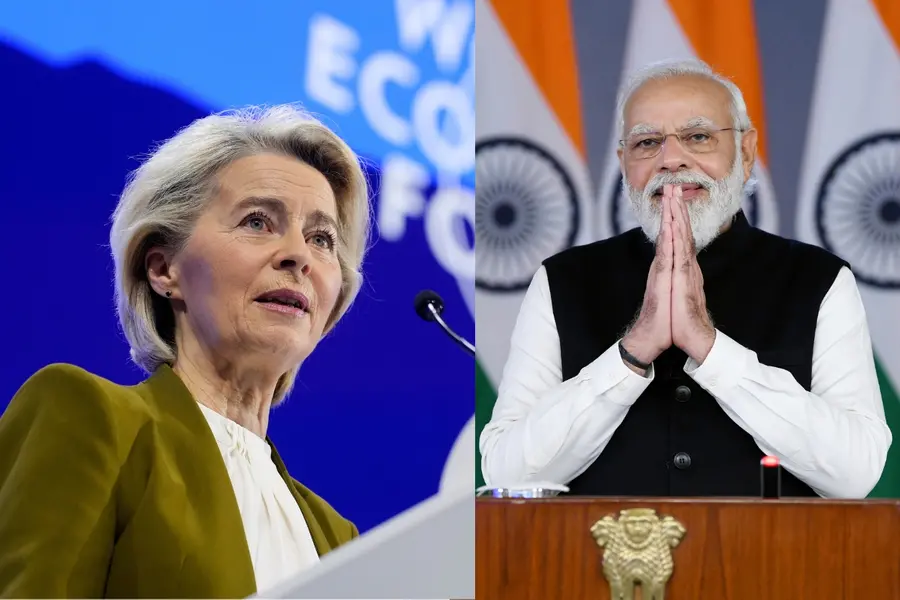
India and the European Union are nearing the conclusion of a long-negotiated free trade agreement (FTA) that European Commission President Ursula von der Leyen has described as the “mother of all deals”.
Speaking at the World Economic Forum in Davos, von der Leyen said negotiations were on the cusp of completion, noting that the agreement would create a market of nearly 2 billion people and account for close to one-quarter of global GDP.
The proposed India-EU FTA has gained urgency as trade relations between India and the United States face repeated friction under President Donald Trump, particularly over tariffs, agriculture and market access. Against this backdrop, the EU deal offers India a more stable, rules-based trading partner and a way to diversify its economic and strategic dependencies.
The scale of the agreement is unprecedented. Together, India and the 27-nation European Union would form one of the largest integrated markets in the world. India’s Commerce Minister Piyush Goyal has repeatedly underlined its importance, calling it the biggest and most comprehensive trade deal India has pursued with a group of developed economies. The agreement is expected to cover goods, services, investment, technology transfer and regulatory cooperation, helping integrate India more deeply into European supply chains while giving EU firms wider access to one of the world’s fastest-growing major economies.
Also read: US’s biggest fear, EU’s best weapon: How Europe’s $8 trillion leverage could rattle Washington
Negotiations between India and the EU began in 2007 but stalled for nearly a decade due to disagreements over tariffs, intellectual property rights and market access. Talks were revived in 2022 with renewed political momentum, and progress has accelerated since then. According to Commerce Secretary Rajesh Agrawal, negotiators have closed 20 of the 24 chapters, with the remaining issues expected to be addressed in the final phase. Parallel discussions under the India-EU Trade and Technology Council have also helped narrow differences on digital rules, standards and supply-chain resilience.
The deal’s significance is amplified by challenges in India-US trade relations. The US has imposed or threatened tariffs affecting Indian exports, while disputes over agricultural products such as pulses and concerns linked to energy and foreign policy have slowed progress toward any major bilateral trade breakthrough. Indian exporters have also faced uncertainty due to the US administration’s tariff-led trade strategy.
For the European Union, the agreement is part of a broader effort to diversify trade partnerships and reduce dependence on China, with India seen as a trusted partner offering scale, growth and geopolitical alignment. For India, improved access to the EU — already its second-largest trading partner — could boost exports and support domestic manufacturing. Goods trade between the two sides reached around €120 billion in 2024, while services trade stood at about €60 billion, driven largely by IT and digital services.
Despite strong momentum, some sensitive issues remain unresolved. The EU is seeking lower tariffs on automobiles, wines and spirits, while India wants greater mobility for skilled professionals and safeguards for agriculture, particularly dairy and grains. India has also raised concerns about the EU’s carbon border adjustment mechanism, which could affect exports of steel, aluminium and cement.
If finalised, the India-EU FTA would rank among India’s most consequential economic agreements and one of the EU’s most significant trade deals in years. At a time of rising protectionism and geopolitical uncertainty, the pact could give India scale, stability and strategic leverage in the evolving global trade order.
Published: 20 Jan 2026, 09:14 pm IST
Related Topics
Disclaimer: Kindly avoid objectionable, derogatory, unlawful and lewd comments, while responding to reports. Such comments are punishable under cyber laws. Please keep away from personal attacks. The opinions expressed here are the personal opinions of readers and not that of Mathrubhumi.
