
The State Vibe report represents the first round of pre-election polling for the upcoming Assembly elections.
A newly released political survey suggests a potential regime change in Kerala, with the United Democratic Front (UDF) securing a marginal lead over the incumbent Left Democratic Front (LDF). Released on Tuesday, 20 January 2026, the Vote Vibe "State Vibe" report said that 32.7 per cent of voters currently favour the UDF, while the LDF follows closely with 29.3 per cent. The National Democratic Alliance (NDA) maintains a significant presence with 19.8 per cent of the projected vote share, leaving roughly 15.3 per cent of the electorate undecided or unwilling to say.
Dissatisfaction with the current administration appears high, as 51.9 per cent of respondents rated the government's performance as either poor or very poor. In contrast, only 34.5 per cent of the public viewed the government’s work in a positive light. This anti-incumbency sentiment is particularly strong among male voters, 36 per cent of whom described the performance as very poor, compared to 25 per cent of female voters.
Chief ministerial picks
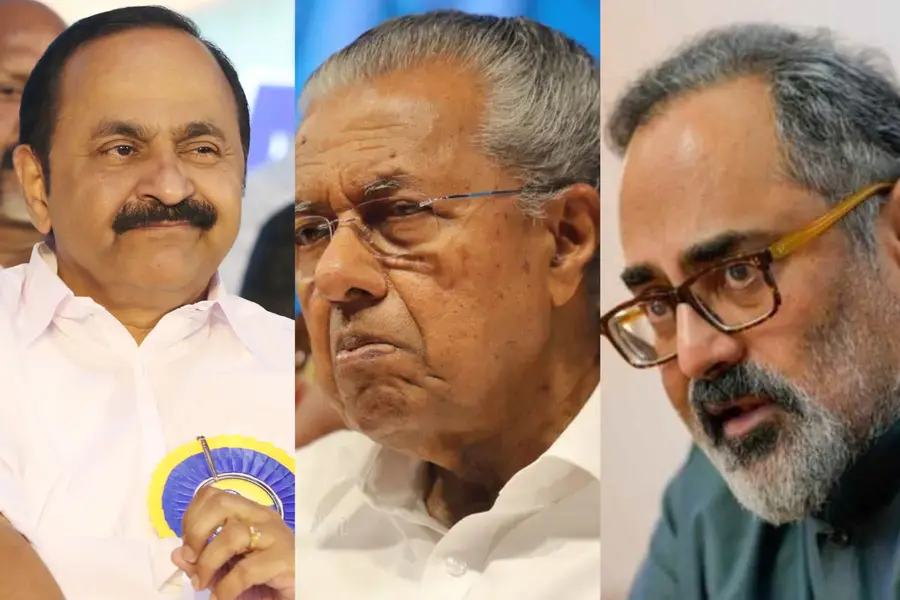
The race for the next Chief Minister has produced fragmented results, with no single leader commanding a clear majority. VD Satheesan of the Indian National Congress (INC) currently leads the pack with 22.4 per cent support. The incumbent, Pinarayi Vijayan, holds 18 per cent support, while his party colleague KK Shailaja remains a strong alternative with 16.9 per cent.
In a trend that may surprise many in Kerala, the BJP state president Rajeev Chandrasekhar has emerged as a more popular choice for Chief Minister than the INC veteran Shashi Tharoor. Chandrasekhar secured 14.7 per cent of the preference, notably drawing 34 per cent support from the general category. Meanwhile, Sharoor trails behind with 9.8 per cent. Other candidates, such as KC Venugopal (6.4 per cent) and K Surendran (2.6 per cent), sit further down the list of public preferences.
Youth and economic anxiety driving the agenda
Economic issues are dominating the minds of the electorate as the 2026 Assembly elections approach. The survey identifies the top three concerns as rising prices (22.7 per cent), corruption (18.4 per cent), and unemployment (18.2 per cent). The youth demographic, aged 18 to 24, is especially focused on these issues, with 32 per cent citing price rises and 22 per cent naming unemployment as their primary worry.
This younger generation appears to be a significant engine for change, with 42 per cent of those aged 18 to 24 expressing a preference for the UDF. Additionally, 32 per cent of youth respondents stated they are highly unlikely to vote for their incumbent MLA, contributing to a broader trend where 47.3 per cent of the total population expressed a desire to see a different candidate or party represent them.
Factionalism and strategy gaps haunt major parties
While the UDF leads the polls, the Congress party faces internal hurdles. According to the survey, 42.2 per cent of respondents believe infighting and factionalism are the biggest challenges facing the Congress in Kerala, a concern that rises above 50 per cent among voters over the age of 45. Other issues for the party include a perceived lack of a strong narrative (8.5 per cent) and a lack of charismatic leadership (7.5 per cent).
The BJP also faces expansion barriers, with 23.3 per cent of those surveyed suggesting the party has failed to truly comprehend the unique nature of Kerala. Furthermore, 19.2 per cent of respondents pointed to the CPM being viewed as a "Hindu party" as a barrier to the BJP's growth. Minority voters, specifically 32 per cent of Muslims and 28 per cent of Christians, highlighted the BJP’s failure to understand the state as a primary obstacle.
Survey details and methodology
This report represents the first round of the State Vibe study ahead of the elections scheduled for April or May next year. The survey utilized Computer-Assisted Telephone Interviewing (CATI) to gather responses from a sample size of 1,419 participants.
The demographic breakdown of the study included a gender split of 52 per cent male and 48 per cent female, with an even geographical distribution of 52 per cent rural and 48 per cent urban respondents. The social profile of the participants covered a broad spectrum, including OBC (33 per cent), Muslim (27 per cent), Christian (18 per cent), and General (10 per cent) categories. The age profile ranged from youth (22 per cent) to senior citizens (17 per cent)
Published: 21 Jan 2026, 01:23 pm IST
Related Topics
Disclaimer: Kindly avoid objectionable, derogatory, unlawful and lewd comments, while responding to reports. Such comments are punishable under cyber laws. Please keep away from personal attacks. The opinions expressed here are the personal opinions of readers and not that of Mathrubhumi.
