
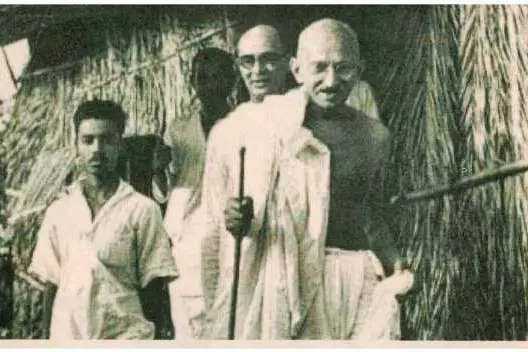
Thrissur: As India commemorates Gandhi Jayanti on October 2, it is essential to reflect on the contributions of those who played pivotal roles in the struggle for independence yet remain largely forgotten. One such figure is R. P. Parasuram, who served as Mahatma Gandhi's stenographer and secretary for twelve years. His story, intertwined with key events in India's struggle for freedom, is detailed in the 1953 book My Days with Gandhi by Nirmal Kumar Bose, where he is briefly mentioned as a Malayali.
Although his name appears in many articles related to Gandhiji, his identity remains unclear. Remarkably, he is mentioned 36 times in My Days with Gandhi. The life of R. P. Parasuram, who later became the owner of a cloth shop, remains a forgotten chapter in history.
Also Read

Parasuram’s life reflects a dedicated commitment to Gandhi's ideals. He was an active participant in major movements, from the Salt Satyagraha to the Quit India Movement. During these times, he played a crucial role in documenting Gandhi’s speeches and writings, ensuring that the messages of the movements reached the public.
Later, Parasuram returned to Thrissur, where he owned a cloth shop named Sriram and Parasuram Textiles, located near Marar Road. His home, a three-storey building near the District Cooperative Hospital on Shornur Road, is still remembered fondly by many, including Vincent Puthoor, a socialist and former Thrissur district secretary of the RJD, who has been a friend of Parasuram since 1974. Vincent recalls how Parasuram helped with the immersion of Jayaprakash Narayan’s ashes in the Bharathapuzha in 1979, highlighting his close ties with the political leader. His relative, P. N. Ganesh, recalls that Parasuram was the beloved 'Paacha' of the entire family.
Following his tenure with Gandhi, Parasuram became the secretary to Jayaprakash Narayan and later took on a role in the Central Committee Office of the Socialist Party of India. His political activities continued until he shifted his focus to his business in Thrissur.
During the 1975 Emergency, when it was anticipated that Jayaprakash Narayan would be arrested, he entrusted his autobiography to Parasuram and former Prime Minister Chandrasekhar. Upon learning this, the police, when they arrived with an arrest warrant for Parasuram, backed down upon discovering his connection to Gandhi. In 1977, during the Janata Party's governance, the then Railway Minister Madhu Dandavate visited his cloth shop, acknowledging his past and influence.
R. P. Parasuram passed away in 1982, leaving behind a legacy intertwined with some of India’s most significant historical events.
Published: 02 Oct 2024, 08:00 am IST
Related Topics
Disclaimer: Kindly avoid objectionable, derogatory, unlawful and lewd comments, while responding to reports. Such comments are punishable under cyber laws. Please keep away from personal attacks. The opinions expressed here are the personal opinions of readers and not that of Mathrubhumi.