
He was a multifaceted personality, with deep values and the ability to act on them
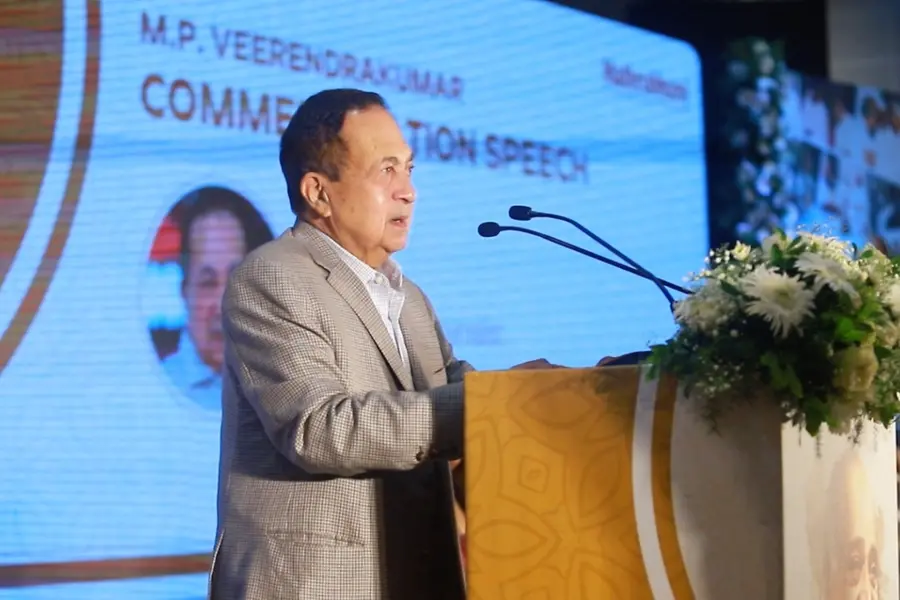
Veteran journalist N Ram on Wednesday went down the memory lane during the MP Veerendra Kumar National Thought Leadership Award ceremony in Kerala’s Kozhikode district. For the former Chairman of The Hindu group, the occasion was as much about honouring the present as it was about revisiting a relationship that began nearly five decades ago -- with a man he simply knew as "Veeran."
“I have known him for about 50 years,” Ram said. “Since just before the Emergency was declared. I remember it like yesterday -- his outrage over the promulgation of the Emergency. He was underground for several months and then was detained under the Maintenance of Internal Security Act (MISA) for a prolonged period.”
Yet detention did little to curb Veerendra Kumar’s convictions. “That did not stop him from continuing to fight for freedom of expression and other fundamental rights guaranteed by the Constitution of India,” Ram recalled. “That was the first indication for me of the calibre of the man.”
Despite an age gap – he was eight years older -- Ram said the two shared an easy rapport. “I used to call him ‘Veeran’,” he said, smiling. “I remember the mini-conversations we had and his versatile interests. He was a committed lifelong socialist, deeply influenced by the ideals of Jayaprakash Narayan and A.K. Gopalan.”
But Veerendra Kumar’s activism wasn’t limited to politics. Ram highlighted his concern for environment as an early and consistent part of his public life. “I later learned about his inclination to environmental issues -- his fight against multinational companies exploiting water resources in tribal areas, for example. It showed his broad vision.”
Equally memorable, Ram noted, was Kumar’s contribution to journalism through his leadership at Mathrubhumi. “His most enduring legacy is his initiative in rescuing and rebuilding Mathrubhumi as one of our finest national newspapers,” he said.
“He became Director in 1977 and Managing Director just two years later. He introduced circulation strategies, innovations to increase readership, and brought a progressive outlook to the publication. With his ideals of doing journalism that matters to society, once he was at the helm, there were no limits to how that could be explored.”
That sense of purpose was echoed by his son, MV Shreyams Kumar, now Managing Director of Mathrubhumi, who offered a story that reflected his father’s deeply held convictions.
“Years ago, I was in charge of the revenue division,” he said. “At the time, the Plachimada incident had come up. A multinational company was setting up operations and had the potential to significantly increase our ad revenue. But my father was publicly protesting the company, because their plant was drying up the village wells.”
Shreyams admitted he didn’t immediately understand. “I was looking at it from a business perspective,” he said. “But that day, my father told me, ‘Journalism is meant to be the voice of the voiceless. If we are not reporting on the grave situation of the villagers, then there is no meaning in having this organisation at all.’”
That clarity -- of purpose, of principle -- is what Ram believes set Veerendra Kumar apart. “He was a multifaceted personality, with deep values and the ability to act on them,” he said. “His contributions, whether in resisting authoritarianism or standing up for the environment, weren’t driven by ideology alone. They were rooted in real concern for people.”
Published: 28 May 2025, 05:07 pm IST
Disclaimer: Kindly avoid objectionable, derogatory, unlawful and lewd comments, while responding to reports. Such comments are punishable under cyber laws. Please keep away from personal attacks. The opinions expressed here are the personal opinions of readers and not that of Mathrubhumi.
