
Environmentalist Pandurang Hegde receives the M.P. Veerendra Kumar National Thought Leadership Award for his work in forest conservation and community activism.
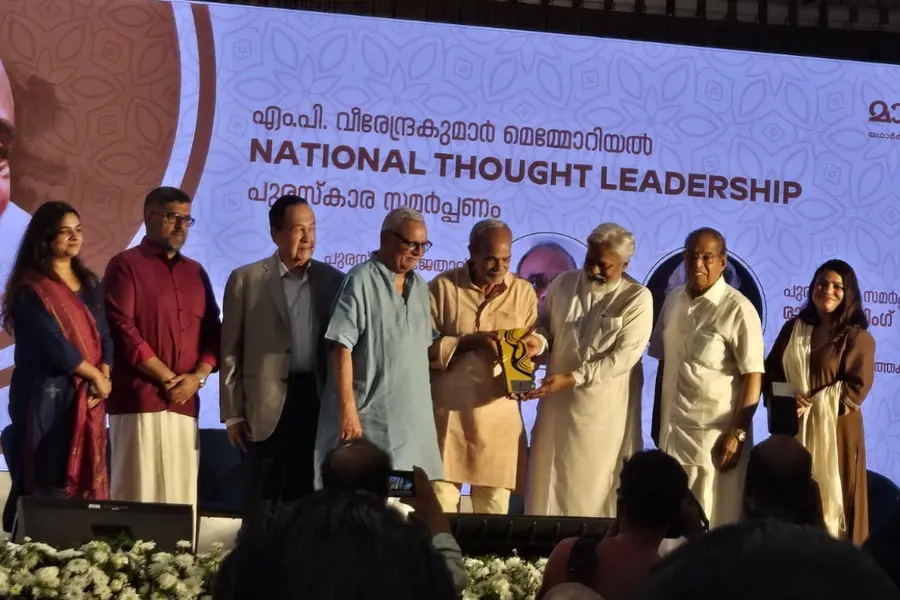
Kozhikode: Noted environmentalist and social activist Pandurang Hegde has been conferred the inaugural M.P. Veerendra Kumar National Thought Leadership Award for his exceptional work in forest conservation and community-based environmental activism.
The award was presented by acclaimed water conservationist Rajendra Singh during a memorial event commemorating the fifth death anniversary of writer, journalist, and former Rajya Sabha MP M.P. Veerendra Kumar.
The honour carries a citation, plaque, and a cash prize of Rs 5 lakh.
A lifelong commitment to environmental justice
Hegde, the founder of the Appiko Movement, has spent decades advocating for ecological preservation and sustainable living practices.
His journey into environmental activism began with a deep personal reverence for nature, which evolved into a lifelong mission grounded in grassroots mobilisation and ecological education.
His activism has not been without challenges, but through both successes and setbacks, Hegde has remained unwavering in his commitment.
The Appiko Movement
Inspired by the Chipko Movement in North India, the Appiko Movement emerged in the Uttara Kannada district in Karnataka as a powerful protest against widespread deforestation.
When contractors arrived to fell trees for teak plantations, villagers under Hegde’s leadership hugged the trees—‘Appiko’ means ‘to hug’ in Kannada—forcing the government to cancel as many as 30 deforestation projects.
Hegde also extended his efforts to the Wayanad district in Kerala, joining protests against eucalyptus plantations and promoting awareness of the long-term ecological damage caused by monoculture.
From accounting to activism
Born in Uttara Kannada, Hegde graduated from Karnataka University and initially worked as a chartered accountant in Delhi. However, a life-changing encounter with Sunderlal Bahuguna, founder of the Chipko Movement, redirected Hegde’s path.
After studying at the Delhi School of Social Work, he chose to leave behind a promising professional career to fully dedicate himself to environmental causes.
Working with communities and preserving traditions
Hegde spent four years in Damoh, Madhya Pradesh, working closely with rural communities. Upon returning to his native Sirsi, he began preserving the knowledge and livelihoods of forest-dependent communities.
Through various campaigns—ranging from beekeeping, organic farming, and seed preservation—he revived interest in traditional agricultural practices. His efforts helped conserve over 160 varieties of rice and around 80 types of jackfruit in the region.
His innovative approach included organising honey festivals, which encouraged local farmers to breed native bee species and pass down ecological knowledge to future generations.
A voice against environmental threats
Hegde has consistently spoken out against large-scale environmental threats, including the Kaiga nuclear power plant and dam construction projects in Karnataka.
As part of the Save Western Ghats campaign, he has spent years studying the fragile ecosystem and advocating for its protection.
In a past interview with Mathrubhumi, he reflected on the need for inclusive environmentalism:
“The Western Ghats is a biodiversity region stretching from Maharashtra to Kanyakumari. An elephant or a tiger that lives here doesn’t know the borders of states. They come out of the forests only when their habitat is affected—and that’s when they pose a threat to humans. Not everyone needs to be an environmental activist, but even small steps to protect nature count. When you stop throwing plastic, when you conserve every drop of water, you are already among those who protect the environment.”
Recognition of a legacy
Hegde is also a recipient of a fellowship from Ashoka, a US-based organisation that supports social entrepreneurs. He is the author of ‘Chipko and Appiko: How the People Save the Trees,’ and has played a critical role in shaping India’s grassroots environmental movements.
Published: 28 May 2025, 12:54 pm IST
Related Topics
Disclaimer: Kindly avoid objectionable, derogatory, unlawful and lewd comments, while responding to reports. Such comments are punishable under cyber laws. Please keep away from personal attacks. The opinions expressed here are the personal opinions of readers and not that of Mathrubhumi.
