
The Travancore Devaswom Board reverses its stance at the Supreme Court, backing the ban on women’s entry at Sabarimala and citing the Tantri as the final authority on ritual.
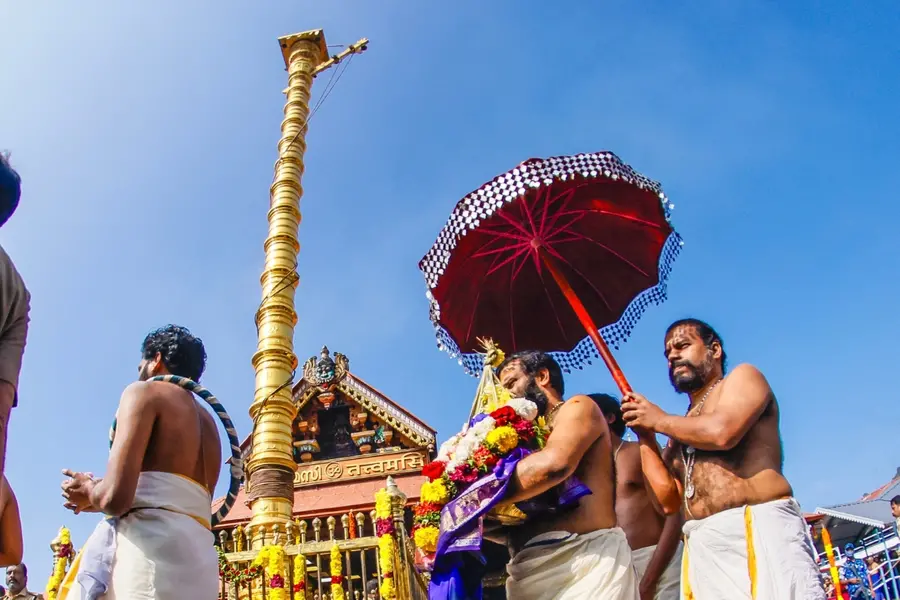
New Delhi: The Travancore Devaswom Board has strongly supported the ban on the entry of young women into Sabarimala in a submission to the Supreme Court. In the arguments filed in writing before the nine-judge bench, the Board also maintained that the Tantri (head priest) is the final authority on the customs and rituals of Sabarimala and that it is not for the Court to evaluate matters of faith.
Shift in position
The Board’s current stance is the exact opposite of the position it held in 2019. Consequently, the State Government and the Devaswom Board are once again largely at odds in the Supreme Court regarding the Sabarimala issue.
Arguments filed by Advocate P S Sudhir on behalf of the Board—prepared by Senior Advocate Abhishek Manu Singhvi—contend that the Court cannot intervene in religious rituals and matters of faith. The Board further asserted that if a conflict arises between an individual right and the rights of a community of believers, the rights of the community must prevail.
Faith beyond judicial review
The Devaswom Board emphasised the following points:
- Subjective faith: Religious practices and customs must be assessed based on the subjective faith of the respective community.
- Judicial recognition: The Court ought to recognise and respect that faith.
Kerala Government stance
Meanwhile, the State Government maintains its previous position—that such matters should be examined by seeking the opinions of religious scholars and social reformers.
The State Government reiterated the position held in its 2007 affidavit filed by the then VS Achuthanandan Government before the nine-judge bench.
The Government’s key arguments include
-
Consultative review: The Government does not claim that the Court cannot examine religious practices; however, it maintains that such reviews should involve consulting religious scholars and social reformers.
-
Legislative power: The State asserts its authority to legislate on these matters.
-
Human rights: If the practices of a religious community involve serious human rights violations, they can be challenged even by those outside that community.
The point of contention
With this the Kerala State Government and the Travancore Devaswom Board have once again taken opposing stances before the Supreme Court regarding the entry of women into Sabarimala.
While the Government suggests that rituals can be reviewed for the sake of social welfare, the Devaswom Board argues that traditions cannot be restricted based on broad grounds of social welfare or reform.
When the case was heard in 2018, the Government argued for the entry of young women, while the Board opposed it. However, during the 2019 review petitions, the Board shifted its position to align with the Government in favour of women’s entry.
(With inputs from Shine Mohan story)
Published: 24 Mar 2026, 08:06 am IST
Related Topics
Disclaimer: Kindly avoid objectionable, derogatory, unlawful and lewd comments, while responding to reports. Such comments are punishable under cyber laws. Please keep away from personal attacks. The opinions expressed here are the personal opinions of readers and not that of Mathrubhumi.
