
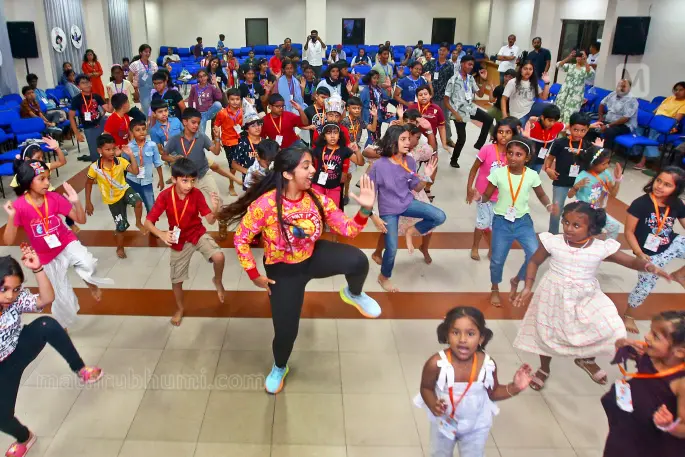
Zumba, a Latin-inspired fitness programme that blends aerobic movement with music, has grown into a global phenomenon precisely because it is more than just exercise
During our good old days, we did not have school buses to take us to school and back home. We walked, daring the rain and sun, through muddy roads and fields, ultimately reaching the old school building where crippled benches streaked with crow droppings welcomed us. Between classes, if any of us dozed off, especially during the afternoon sessions, the teacher would wake us up with the routine “stand up, sit down… stand up, sit down” drill.
We didn’t have terms like ‘positive energy’ and ‘vibe’ to describe these experiences, but we had plenty of physical activity. There was no television, no mobile phones, and no indoor games to confine our movements. ‘Couch potato’ was a term unheard of, and most of us were quite lean, unlike the well-fed kids we now see as models in TV commercials.
Times have changed, and so have children, especially in step with parents who no longer want their kids to be “exposed too much to the sun,” even though these same parents once preferred sunshine to the gloom of indoor life.
Children need sustained physical activity to stay mentally and physically healthy, and to develop their learning abilities and life skills. Textbooks and classrooms are only one part of education, not its entirety. It is from this perspective that we must view the Kerala government’s decision to introduce Zumba in schools as part of its anti-drug campaign. As expected, it has sparked both enthusiasm and criticism.
Zumba to fight drug abuse? At first glance, it might seem a bit far-fetched. But behind its catchy rhythms and fast-paced moves lies a deeper, transformative potential, especially for young minds navigating a rapidly changing world. Today’s children face growing levels of stress, which, if left unaddressed, can culminate in substance abuse or even suicide, as Kerala has tragically witnessed among students in recent times. Studies show that stress, anxiety, and a lack of positive social engagement are key factors that make children vulnerable to drug abuse. In response, the state has chosen not just to issue warnings, but to offer meaningful alternatives. Zumba, with its high-energy group setting and emphasis on fun, is one such alternative.
Zumba has helped millions across generations embrace movement as a joyful part of life. In a school setting, it can do even more. It can build confidence in shy children, offer emotional relief to anxious teens, and strengthen peer relationships. It teaches rhythm, coordination, and balance, not just of the body, but of emotions and social conduct. When schools become spaces where students are allowed to move, breathe, laugh, and connect, they are better prepared to resist the lure of drugs and other harmful distractions. They become more resilient, expressive, and in touch with their own wellbeing.
Zumba, a Latin-inspired fitness programme that blends aerobic movement with music, has grown into a global phenomenon precisely because it is more than just exercise. It is accessible, adaptable, and above all, social. It creates a space where people, regardless of athletic ability, can participate, connect, and thrive.
However, in Kerala, everything tends to take on a political dimension, often peppered with religious overtones. This case is no different. Some voices have alleged that introducing Zumba in schools could degrade our culture. Opposition has come from certain Islamic organisations and leaders who argue that the programme is incompatible with religious and cultural values. T K Ashraf, teacher and general secretary of the Wisdom Islamic Organisation, publicly declared that his son would not participate and that he was prepared to face any departmental action. Samastha leader Nasar Faizy Koodathayi criticised the move, calling it an imposition of vulgarity under the guise of fitness and a violation of personal freedom. The objections primarily revolve around concerns about modesty, gender mixing, and the belief that rhythmic dance movements contradict Islamic teachings.
These voices must be heard and acknowledged with respect. At the same time, it is important to note that Zumba, like yoga or any other fitness practice, can be adapted to fit cultural and social contexts. The Education Department’s order clearly states that students will participate in the programme during school hours and there is no question of any revealing dress. The aim is not to impose any particular culture, but to provide a healthy, enjoyable, and socially enriching experience that also promotes gender sensitivity. Ironically, this opposition comes at a time when co-education is being encouraged across the globe as a means to enhance children’s social intelligence.
It is also worth noting that Zumba has gained widespread acceptance in several Muslim-majority nations, from UAE to Turkey to Malaysia, particularly when tailored to local cultural and religious expectations. In many of these countries, it is actively promoted through public health campaigns. Yes, we can customise it as needed, but outright rejection of any idea is regressive. Unfortunately, the opposition voiced by certain religious groups is being misrepresented by some vested interests as the unanimous view of the Muslim community, unfairly portraying the entire community in a negative light.
From a social perspective, the benefits of Zumba are particularly compelling. Unlike competitive sports, Zumba sessions are inclusive, as there are no points, medals, or rankings. It is just shared energy, collective movement, and spontaneous joy. In classrooms increasingly divided by academic pressure, screen time, and social media isolation, Zumba offers a level playing field where students rediscover the simple joy of moving together.
The shared laughter, synchronised steps, and mutual encouragement during a session help foster bonding and empathy. These moments break down barriers between students from different backgrounds and even between students and teachers. For children who struggle with traditional forms of learning or self-expression, Zumba can be a lifeline: a space where they feel seen, capable, and included.
In the backdrop of Kerala’s anti-drug campaign, Padanamaanu Lahari (Learning is the High), Zumba makes sense. In this context, it is not merely dance; it is resistance. It is public health in motion.
Kerala has long been a frontrunner in public education, healthcare, and social reform. Its schools should reflect both sensitivity to tradition and openness to innovation. To reject a programme solely on the basis of assumption or misinformation is to risk denying our children tools that could help them flourish mentally, physically, and socially.
The real question is not whether we agree with a particular form of exercise. It is whether we are willing to give our children tools to live fuller, healthier lives. If the answer is yes, then Zumba deserves a fair chance, guided by reason, shaped by dialogue, and embraced with an open heart.
Published: 28 Jun 2025, 02:37 pm IST
Disclaimer: Kindly avoid objectionable, derogatory, unlawful and lewd comments, while responding to reports. Such comments are punishable under cyber laws. Please keep away from personal attacks. The opinions expressed here are the personal opinions of readers and not that of Mathrubhumi.
